
Pristiphora erichsonii
(Hartig, 1837)
Larch Sawfly
Pristiphora erichsonii, commonly known as the larch , is a of sawfly native to Europe that was introduced to North America in the mid-to-late 19th century. It is a significant defoliator of larch trees (Larix spp.), particularly tamarack (Larix laricina) in North America. The species undergoes that can cause severe defoliation, though trees typically recover from single-year damage. Severe defoliation over multiple years can weaken trees and reduce winter survival. The species has been the subject of extensive ecological and research due to its economic importance in forestry.
Pronunciation
How to pronounce Pristiphora erichsonii: //prɪˈstɪfərə ˌɛrɪkˈsoʊni.aɪ//
These audio files are automatically generated. While they are not always 100% accurate, they are a good starting point.
Identification
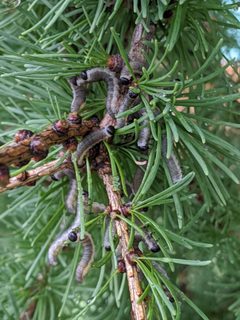
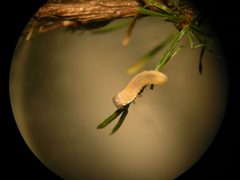
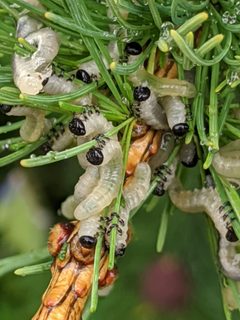
can be distinguished from true by their thick waist and saw-like ovipositor. Larvae are distinguished from caterpillars by having six or more pairs of (caterpillars have five or fewer) and by lacking (hooked structures) on their prolegs. The 'J'-shaped defensive curling of larvae is diagnostic. -laying damage causes shoots to curl as they grow, providing a visible sign of .
Images
Habitat
Associated with larch forests. Larvae feed on larch foliage; are found near trees. Cocoons are formed in the soil beneath host trees. The occurs from high forest to subarctic regions, including at the tree line, and has been observed on isolated larch growing under extreme climatic conditions.
Distribution
Native to Europe (Austria, Britain, Czechoslovakia, Denmark, Finland, France, Germany, Ireland, Netherlands, Norway, Poland, Romania, Sweden, Japan, and Russia). Introduced to North America in the mid-to-late 19th century; first recorded in Quebec in 1882 and British Columbia in the 1930s. Currently established across Canada (Manitoba, Saskatchewan, Ontario, Alberta, New Brunswick, Nova Scotia, Prince Edward Island, Labrador, British Columbia), the northeastern United States, the Lake States, northwestern Montana, and northern Minnesota. Northern limits extend to approximately 61° N latitude.
Seasonality
emerge in late spring when larch trees are leafing out and new growth is expanding. Larvae feed for 3–4 weeks, generally in late June and early July, though can be delayed and larvae may be present throughout summer. Winter is spent as in soil cocoons.
Diet
Larvae feed exclusively on foliage of Larix , particularly Larix laricina (tamarack/eastern larch) in North America. feed on nectar, pollen, and other insects.
Host Associations
- Larix laricina - primary Tamarack/eastern larch; native in North America
- Larix - -level All larch are susceptible
Life Cycle
Winter is spent in the soil as a within a cocoon. emerge in late spring. Females deposit in elongating shoots near branch tips using a saw-like ovipositor, causing shoots to curl as they grow. Eggs hatch and larvae feed on needles for 3–4 weeks. Larvae occur in groups or clumps. When feeding is complete, larvae fall from trees to the soil and spin brown cocoons in which to pupate. Some individuals may exhibit delayed , with larvae present throughout summer.
Behavior
Larvae occur in groups and characteristically curl their bodies upward in a 'J' shape when disturbed. Larvae may wander in search of food when local defoliation occurs; air temperature affects the distance and rate of such movement. Dislodged fifth-instar larvae are able to reach foliage and resume feeding on nearby trees. Females use a saw-like ovipositor to slice leaves or stems to create pockets for insertion.
Ecological Role
Primary consumer and defoliator of larch forests. can cause significant foliage reduction and branch mortality, and can stress trees, making them more susceptible to other mortality factors such as the eastern larch beetle (Dendroctonus simplex). Serves as host for multiple , including the tachinid fly Bessa harveyi. Cocoons in soil are preyed upon by small mammals.
Human Relevance
Significant forest pest in North America due to defoliation of economically and ecologically important larch/tamarack stands. Severe defoliation over multiple years can reduce timber value and increase tree mortality. Extensive research has been conducted on monitoring, sampling methods ( and cocoon estimation), and management. Most trees tolerate single-year defoliation and recover during summer.
Similar Taxa
- Pristiphora rufipesColumbine sawfly; similar and appearance but feeds on columbine (Aquilegia) rather than larch, and has different larval association
- Coleophora laricellaLarch casebearer; another defoliator of larch, but is a (Lepidoptera) with case-bearing larvae rather than gregarious larvae
- Dendroctonus simplexEastern larch beetle; a bark beetle that feeds on phloem rather than foliage, and is often associated with larch as trees stressed by defoliation become susceptible
More Details
Population Dynamics
have been recorded since 1883 in the Maritime Provinces of Canada. outbreaks reached peak numbers in 1981 for high regions and 1985 for subarctic regions in Quebec. In outbreak conditions, larval starvation commonly occurs due to declining vigor after 3–4 successive years of severe defoliation, acting as a natural population control mechanism.
Research Significance
Extensively studied with established protocols for estimation (sampling curled shoots) and cocoon population estimation (soil sampling and larval fall traps). Vital dyes (Nile blue sulphate, rhodamine B) have been used as markers for behavioral and population studies, persisting through development and incorporated into cocoons and eggs.
Climate Interactions
Historical were naturally limited by cold winter temperatures. Recent warming trends may be altering of associated pests such as the eastern larch beetle, which can reach maturity without under warmer conditions.
Sources and further reading
- BugGuide
- Wikipedia
- GBIF taxonomy match
- iNaturalist taxon
- NCBI Taxonomy
- Eastern Larch Beetle Outbreak Keeps Going When Winter's Not So Cold
- Vanquished vanishing columbines: Columbine sawfly, Pristiphora rufipes — Bug of the Week
- Archive — Bug of the Week
- Pristiphora erichsonii . [Distribution map].
- ESTIMATION OF EGG POPULATIONS OF THE LARCH SAWFLY, PRISTIPHORA ERICHSONII (HTG.)
- Estimation of Cocoon Populations of the Larch Sawfly, Pristiphora erichsonii (Hartig)
- Chemical basis of differential feeding behavior of the larch sawfly,Pristiphora erichsonii (Hartig)
- First Record of the Larch Sawfly Pristiphora erichsonii in Maryland, with Notes on Its Distribution
- HEAD CAPSULE MEASUREMENTS OF THE LARCH SAWFLY, PRISTIPHORA ERICHSONII (HYMENOPTERA: TENTHREDINIDAE) IN KOUCHIBOUGUAC NATIONAL PARK, NEW BRUNSWICK
- A Survey of Parasites of the Larch Sawfly (Pristiphora erichsonii (Hartig)) in Manitoba and Saskatchewan
- Effects of Defoliation on Survival of Larvae of the Larch Sawfly Pristiphora erichsonii (Htg.)
- Ecological Life-History of the Larch Sawfly, Pristiphora erichsonii (Htg.) (Hymenoptera: Tenthredinidae), in Manitoba and Saskatchewan
- RECENT OUTBREAK OF THE LARCH SAWFLY, PRISTIPHORA ERICHSONII (HARTIG), IN SUBARCTIC QUÉBEC
- VITAL DYES AS MARKERS FOR BEHAVIORAL AND POPULATION STUDIES OF THE LARCH SAWFLY, PRISTIPHORA ERICHSONII (HYMENOPTERA: TENTHREDINIDAE)
- Studies on the Starvation of Last-Instar Larvae of the Larch Sawfly, Pristiphora erichsonii (Htg.) (Hymenoptera: Tenthredinidae)
- EGG PRODUCTION, OVIPOSITION BEHAVIOR, AND SEX RATIOS OF BESSA HARVEYI (DIPTERA: TACHINIDAE) PARASITIZING THE LARCH SAWFLY, PRISTIPHORA ERICHSONII (HYMENOPTERA: TENTHREDINIDAE)
- Mortality of Cocoons of the Larch Sawfly, Pristiphora erichsonii (Htg.), in Relation to Distance from Small-Mammal Tunnels