
Isodontia philadelphica
(Lepeletier de Saint Fargeau, 1845)
Grass-carrying Wasp
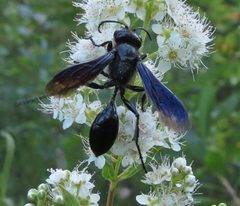
Isodontia philadelphica is a solitary in the Sphecidae, commonly known as a grass-carrying wasp. Females construct nests in pre-existing cavities such as hollow stems, abandoned insect burrows, or window tracks, using dry grass to partition and plug entrances. They provision nests with paralyzed tree crickets and katydids as food for their larvae. The occurs in North America and is not aggressive toward humans.
Pronunciation
How to pronounce Isodontia philadelphica: /ˌaɪsəˈdɑntiə ˌfɪləˈdɛlfɪkə/
These audio files are automatically generated. While they are not always 100% accurate, they are a good starting point.
Identification
Distinguished from other Isodontia by geographic range and subtle morphological differences; I. mexicana is more common in the eastern U.S. and has been more extensively documented. Specific diagnostic features for I. philadelphica are not detailed in available sources. Members of the Isodontia can be recognized by their habit of resting with wings splayed away from the body, exposing the narrow petiole, in contrast to other sphecid that typically fold wings flat over the .
Images
Habitat
Utilizes pre-existing tubular cavities for nesting, including hollow plant stems, abandoned burrows, and artificial structures such as window tracks and wind chimes. Suburban and rural environments with access to nesting cavities and hunting grounds for orthopteran prey.
Distribution
North America; present in Middle America. Specific range details within North America are not well-documented in available sources, though the is broadly distributed across the continent.
Seasonality
active during summer months. In northern climates, larvae pupate and overwinter in nests, with adults emerging the following summer.
Diet
feed on nectar from flowers including sweetclover, sumac, and grape; also consume honeydew from colonies. Larvae feed on paralyzed tree crickets and small katydids provisioned by the female parent.
Life Cycle
Female constructs nest in pre-existing cavity, creating multiple along the tunnel length. Each cell is provisioned with several paralyzed orthopteran prey items, then an is laid and the cell partitioned with dry grass. The tunnel entrance is sealed with a plug of dry grass. Larva hatches and consumes the fresh prey, then pupates within the cell. emerge the following summer in northern regions.
Behavior
Solitary nesting; each female constructs and provisions her own nest without cooperation from conspecifics. Females hunt actively, paralyzing prey with venom and transporting it back to the nest. often rest with wings splayed outward rather than folded. Not aggressive; stings only if physically handled.
Ecological Role
of tree crickets and katydids; contributes to regulation of orthopteran . Larvae in nests may serve as for flies and . function as when foraging for nectar.
Human Relevance
Occasionally nests in window tracks of homes, causing minor nuisance; easily managed by cleaning tracks or providing alternative nesting structures such as boxes or bamboo bundles. Not a public health threat. Provides opportunities for observation of solitary .
Similar Taxa
- Isodontia mexicanaVery common eastern U.S. with similar appearance and nesting ; distinguished primarily by geographic overlap and subtle morphological differences not detailed in available sources.
- Isodontia elegansWestern North American ; occurs in Washington state and other western regions, distinguished by distribution.
- Sphex lucaeSimilar black and red coloration in females, but digs soil burrows rather than using pre-existing cavities, and provisions nests with katydids rather than tree crickets.