
Palmodes praestans
(Kohl, 1890)
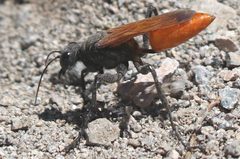
Palmodes praestans is a thread-waisted wasp in the Sphecidae, characterized by its distinctive thread-like petiole connecting the and . The is known to be kleptoparasitized by Stizoides renicinctus, which exploits its food caches of prey. Like other members of its , it hunts katydids (Tettigoniidae) to provision underground nest for its larvae.
Pronunciation
How to pronounce Palmodes praestans: //ˈpæl.moʊ.diːz ˈpreɪ.stænz//
These audio files are automatically generated. While they are not always 100% accurate, they are a good starting point.
Images
Distribution
Middle America; North America. Distribution records indicate presence in both Middle America and North America, though specific countries or regions within these areas are not documented in available sources.
Diet
feed on nectar. Females hunt katydids ( Tettigoniidae), specifically including (Anabrus simplex), to provision nest for larval development.
Life Cycle
Females dig burrows in soil with angled tunnels terminating in underground . Each cell is stocked with paralyzed prey; a single is laid on the last victim placed in the cell. The larva consumes the provided prey, developing through instars before pupating. Eggs may require two winters before hatching in some .
Behavior
Solitary nesting with females constructing and provisioning individual burrows. Known to be exploited by kleptoparasitic Stizoides renicinctus, which locates closed burrows, digs them open, destroys the , and replaces it with its own.
Ecological Role
of katydids, potentially providing of orthopteran including agricultural pest . Serves as for kleptoparasitic , contributing to complex interactions in its .
Similar Taxa
- Palmodes laeviventrisCongeneric with similar and ; both are known of Stizoides renicinctus and hunt prey. The two species may co-occur in western North American .
- Prionyx speciesRelated sphecid with similar thread-waisted and -hunting . Stizoides renicinctus is also known to parasitize Prionyx nests, indicating ecological similarity.
- Sphex pensylvanicusLarge black sphecid with superficially similar appearance, but distinguished by all-black coloration with violet wing reflections and rather than prey specialization.