
Eremnophila aureonotata
(Cameron, 1888)
gold-marked thread-waisted wasp
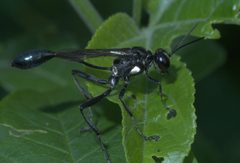
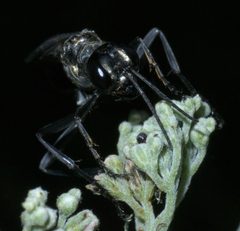
Eremnophila aureonotata is a thread-waisted wasp in the Sphecidae, commonly known as the gold-marked thread-waisted wasp. are nectar feeders, frequently visiting flowers such as spotted horsemint (Monarda punctata) and goldenrods. Females hunt caterpillars, paralyzing them with a sting to provision underground nests for their larvae. Males exhibit a distinctive mating , grasping females by the neck and traveling in tandem while the female forages. The ranges across eastern North America and adjacent southern Canada.
Pronunciation
How to pronounce Eremnophila aureonotata: /ˌɛrɛmˈnɒfɪlə ˌɔːriˌɒnəˈteɪtə/
These audio files are automatically generated. While they are not always 100% accurate, they are a good starting point.
Identification
The gold-marked thread-waisted wasp can be recognized by two pairs of golden setal patches: one pair on the sides of the and one pair on the propodeum, contrasting against an otherwise black body. The narrow, thread-like petiole (waist) characteristic of sphecid is prominent. Males and females are similar in coloration but may show subtle abdominal differences; males have a blunter abdominal tip, while females taper to a point. The is often observed in tandem pairs, with males grasping females by the neck—a distinctive behavioral cue.
Images
Habitat
Found in open, sunny including meadows, prairies, and fields with abundant flowering plants. Often associated with spotted horsemint (Monarda punctata), goldenrods (Solidago spp.), and other late summer to early autumn bloomers in the Asteraceae . Nesting occurs in sandy or hard-packed loam soils where females excavate vertical burrows.
Distribution
Eastern United States and adjacent southern Canada. Records extend from the Atlantic seaboard westward through the Great Plains region. The has been documented as far south as Central America and northern South America, though North American are most frequently encountered and studied.
Seasonality
Active primarily during late summer and early autumn (August through October in temperate regions). activity coincides with peak flowering of spotted horsemint and goldenrods.
Diet
feed on nectar from flowers, particularly spotted horsemint, goldenrods, and other Asteraceae. Larvae are , feeding exclusively on paralyzed caterpillars provisioned by the female parent.
Life Cycle
Females excavate vertical burrows in sand or hard-packed loam soil. Each burrow receives a single paralyzed caterpillar and one . The egg hatches into a legless larva that consumes the living but immobilized prey. Before departing, the female disguises the burrow entrance with debris, pebbles, and soil—likely to deter and . occurs within the burrow, with emerging the following season.
Behavior
Females hunt caterpillars by searching foliage, subduing prey with a paralyzing sting, and transporting victims to subterranean nests. Males exhibit prolonged copulatory guarding: after mating, they remain attached to females by grasping the neck, traveling in tandem as the female forages for nectar. This likely ensures paternity by preventing rival males from mating. Some thread-waisted wasps, possibly including this , display a sleeping behavior where clamp their onto vegetation and hang suspended overnight.
Ecological Role
As a of caterpillars, this contributes to natural regulation of lepidopteran . nectar-feeding supports pollination of late-season flowering plants. The provisioning of nests with paralyzed prey represents a significant transfer of from foliage-feeding herbivores to higher .
Human Relevance
Generally beneficial to humans due to caterpillar , potentially reducing pest in gardens and agricultural settings. Not aggressive toward humans; stings are rare and occur only if the is handled. The ' conspicuous presence on flowers makes it a subject of interest for naturalists and photographers.
Similar Taxa
- Ammophila pictipennisAlso a thread-waisted wasp that hunts caterpillars and provisions subterranean nests, but lacks the distinctive golden thoracic and propodeal patches of E. aureonotata.
- Sphex nudusA larger -hunting sphecid with different prey preferences and without the gold-marked coloration; nests in pre-existing cavities rather than excavated burrows.
- Sceliphron caementariumBlack and yellow mud dauber that builds mud nests rather than excavating burrows; provisions nests with spiders rather than caterpillars.
Sources and further reading
- BugGuide
- Wikipedia
- GBIF taxonomy match
- iNaturalist taxon
- NCBI Taxonomy
- Catalogue of Life
- Thread-waisted wasps really dig spotted horsemint: Thread-waisted wasp, Eremnophila aureonotata — Bug of the Week
- Thread-waisted wasps traveling in tandem - what’s that about? Thread-waisted wasp, Eremnophila aureonotata — Bug of the Week
- Bug Eric: Wasp Wednesday: Wasps in Love
- Bug Eric: Wasp Wednesday: Wasp Workshop
- Archive — Bug of the Week
- Diggers and daubers - Thread-wasted wasps, Sphecidae — Bug of the Week