
Ammophila cleopatra
Menke, 1964
Ammophila cleopatra is a of thread-waisted wasp in the Sphecidae, described by Arnold Menke in 1964. Like other members of the Ammophila, it is a solitary that hunts caterpillars to provision nests for its offspring. The species occurs in North America and Middle America, though specific details about its remain poorly documented compared to better-studied such as A. procera and A. pictipennis.
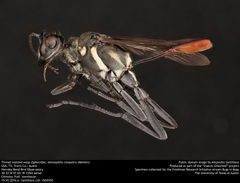
Pronunciation
How to pronounce Ammophila cleopatra: /æ.moʊˈfaɪ.lə ˌkliː.oʊˈpæ.trə/
These audio files are automatically generated. While they are not always 100% accurate, they are a good starting point.
Identification
No -specific diagnostic features are documented in the available sources. Identification likely requires examination of morphological characters used in Menke's 1964 original description and his comprehensive monograph The Ammophila of North and Central America, which is considered the authoritative reference for the .
Images
Distribution
Recorded from North America and Middle America based on GBIF distribution data. Specific locality records are not detailed in the provided sources.
Host Associations
- Strepsiptera - parasitized byAmmophila , including A. cleopatra, are documented of twisted-wing parasites in the order Strepsiptera. Research by RJ Millena demonstrated that Strepsiptera larvae enter Ammophila hosts through joints or , with parasitized wasps acting as to their offspring during parental care.
Similar Taxa
- Ammophila proceraLarger (25-38 mm) with distinctive silver stripes on , known for carrying caterpillars beneath body while flying and for roosting in clusters during inclement weather.
- Ammophila pictipennisDistinguished by orange or yellow wings, metallic blue reflections on black body areas, and lack of silver thoracic stripes; common east of the Rocky Mountains.
More Details
Taxonomic authority
The was described by Arnold Menke in 1964. Menke's monograph The Ammophila of North and Central America (Hymenoptera, Sphecidae) remains the definitive reference for identification of North American species in this .
Research significance
While A. cleopatra itself is not specifically studied, the Ammophila has become important in research on - dynamics. Studies at the Bohart Museum of Entomology using thousands of Ammophila specimens revealed that with extended maternal care—provisioning nests with multiple small caterpillars rather than single large ones—show significantly higher rates of Strepsiptera , with this trait explaining approximately 90% of variation in parasitism risk across species.
Sources and further reading
- BugGuide
- GBIF taxonomy match
- iNaturalist taxon
- NCBI Taxonomy
- Catalogue of Life
- 'When I Grow Up, I Want to Be an Entomologist' | Bug Squad
- Humbled and Honored to Receive ACE Awards | Bug Squad
- RJ Millena: from Entomology-Focused Kindergartener to Scoring Cover of Journal With Her Research | Bug Squad
- Bug Eric: Wasp Wednesday: Ammophila procera
- Bug Eric: Ammophila in Action
- Bug Eric: Wasp Wednesday: Ammophila pictipennis