
Dielis
Saussure & Sichel, 1864
scoliid wasps
Species Guides
6- Dielis dorsata(Caribbean scoliid wasp)
- Dielis pilipes(Hairy-footed Scoliid Wasp)
- Dielis plumipes(feather-legged scoliid wasp)
- Dielis tejensis
- Dielis tolteca(Toltec scoliid wasp)
- Dielis trifasciata(three-banded scoliid wasp)
Dielis is a New World of scoliid wasps (Hymenoptera: Scoliidae) in the tribe Campsomerini, formerly treated as a subgenus of Campsomeris. The genus comprises 12 of medium to large solitary distributed from Canada to southern South America. are nectar-feeders, while larvae develop as ectoparasitoids of scarab beetle in soil. The genus is notable for pronounced in color pattern and body structure, and for unusual mitochondrial architecture including a split cox2 gene.

Pronunciation
How to pronounce Dielis: /ˈdaɪ.ɛ.lɪs/
These audio files are automatically generated. While they are not always 100% accurate, they are a good starting point.
Identification
Distinguished from other Campsomerini by forewing venation: two recurrent and two submarginal (shared with Campsomeris but not Colpa, which has different venation). Differs from Campsomeris by —elevated from subgenus to based on phylogenetic analyses showing Campsomeris as . in banding pattern (fewer tergites banded in females) aids field identification. -level identification requires examination of male genitalia and detailed color pattern analysis; see updated keys to Nearctic species.
Images
Appearance
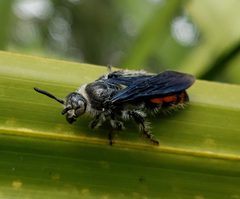
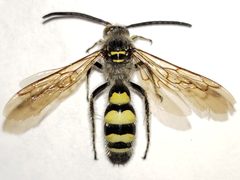
Medium to large-bodied with robust build. Females black with broad yellow or orange bands on first 3–4 abdominal tergites; males with yellow bands on first 4–5 tergites. Setae usually white, sometimes yellowish to brownish. Forewing with two recurrent and two submarginal (diagnostic for Campsomerini excluding Colpa). pronounced in body structure and coloration.
Habitat
Diverse open including edges of mixed deciduous forests, mesquite woods, post oak savannah, thickets, and grassland . Occurs in sandy and loamy soils with clay-loam bottomlands where scarab beetle are present. Found from low elevations (10–50 m in Gulf Coastal Plains) to moderate altitudes (up to 600 m). In western Colorado, observed in canyon systems along river corridors.
Distribution
New World distribution from Canada south through the United States, Mexico, Central America, and South America to Chile and Argentina. Center of diversity in southern Nearctic and Neotropical regions. Specific records include eastern Texas (Brazos Valley, Gulf Coastal Plains), western Colorado (McInnis Canyons National Conservation Area), and throughout the Caribbean.
Seasonality
Spring and summer activity in temperate regions; D. tejensis observed as spring in western Colorado. Multi-generational in southern parts of range (e.g., Texas), with partial seasonal previously unknown in Scoliidae.
Diet
forage for nectar at flowers including Asteraceae (Hymenopappus artemisiifolius, Eupatorium serotinum, Baccharis halimifolia) and Brassicaceae (flowering mustards). Larvae are idiobiont ectoparasitoids of soil-inhabiting scarab beetle (Scarabaeidae).
Host Associations
- Scarabaeidae - larval ectoparasitoid of soil-dwelling ; specific unknown for most
- Cotalpa lanigera - confirmed for D. plumipes confluenta (Rutelinae)
- Phyllophaga plaei - confirmed for D. trifasciata (Melolonthinae)
- Hymenopappus artemisiifolius - nectar sourcemajor nectaring plant for D. tejensis; distribution closely matches range
Life Cycle
Solitary with complete . Females excavate soil to locate scarab beetle , sting to paralyze, and oviposit on . Larvae develop as ectoparasitoids, feeding externally on paralyzed grub. Multi-generational per year in southern range (e.g., D. tejensis in Texas); hypothesized of female stages may produce male-biased sex ratios. Partial seasonal observed in some .
Behavior
: females actively dig in soil to locate . visit flowers for nectar, with females observed hunting scarab grubs and males patrolling flowering vegetation. Strong in : females hunt and provision, males seek nectar and mates.
Ecological Role
agent of scarab beetle through larval . contribute to pollination of flowering plants while foraging. Venom have documented medical applications. of soil-dwelling scarab larvae may benefit agricultural and natural systems.
Human Relevance
Potential biocontrol agent for pest scarabs; venom studied for pharmaceutical applications. Subject of biodiversity surveys and citizen science documentation. D. tolteca highlighted as favorite insect by extension entomologists for educational outreach.
Similar Taxa
- CampsomerisFormerly included Dielis as subgenus; distinguished by phylogenetic placement and subtle morphological differences; Dielis now recognized as separate based on molecular data showing Campsomeris paraphyly
- ColpaAlso in Campsomerini but differs in forewing venation (only one submarginal or different recurrent arrangement); phylogenetically sister to Scoliini rather than to other Campsomerini
- ScoliaIn tribe Scoliini; differs in wing venation, body form, and phylogenetic placement; typically lacks the broad yellow abdominal banding pattern of Dielis
More Details
Mitochondrial Genome
Dielis possess enlarged mitochondrial (~18.7 kb) due to a 2.5 kb insertion splitting the cox2 gene into two separate protein-coding regions (COXIIA and COXIIB) that form a heteromeric complex. Additional unusual features include gene rearrangements, tRNA duplications, and enlarged .
Taxonomic History
Elevated from subgenus of Campsomeris to full status based on phylogenetic analyses using ultraconserved element (UCE) data. These analyses showed Campsomeris and several other genera (including Dielis, Megascolia, and Campsomeriella) to be non-monophyletic, necessitating taxonomic revision.
Conservation Status
D. tejensis recently declined in Harris County, Texas, where previously more abundant; cause unknown. General conservation status of poorly documented due to under-surveying in many regions.
Sources and further reading
- BugGuide
- Wikipedia
- GBIF taxonomy match
- iNaturalist taxon
- NCBI Taxonomy
- Ziad Khouri: Zeroing in on Mammoth Wasps, the Scoliid Wasps | Bug Squad
- Dielis tolteca - Entomology Today
- Dielis tolteca Archives - Entomology Today
- How a Colorado Extension Entomologist Wrangles Pests and Protects Biodiversity
- Alloreferent and Apparent Seasonal Polyphenism of Dielis tejensis with an Updated Key to Nearctic Dielis Species (Hymenoptera: Scoliidae)
- New Dielis species and structural dichotomy of the mitochondrial cox2 gene in Scoliidae wasps.