
Scoliini
Genus Guides
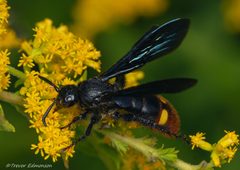
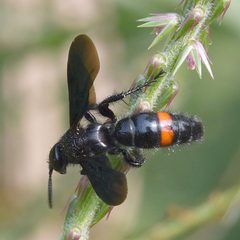
2Scoliini is a tribe within the Scoliidae, a group of large-bodied commonly known as mammoth wasps or scoliid wasps. The tribe includes such as Scolia, Megascolia, Triscolia, and Microscolia. Recent phylogenetic studies indicate that Scoliini is closely related to the genus Colpa, with which it forms a clade sister to the remaining Campsomerini. Many genera within Scoliini, including Megascolia and Scolia, have been inferred to be non-monophyletic based on molecular data.

Pronunciation
How to pronounce Scoliini: //skəˈliːɪnaɪ//
These audio files are automatically generated. While they are not always 100% accurate, they are a good starting point.
Identification
Members of Scoliini can be distinguished from Campsomerini sensu stricto by phylogenetic position, though morphological characters for tribal-level identification require revision. The tribe includes some of the largest scoliid wasps, such as in Megascolia. -level identification relies on combinations of morphological features including wing venation, body , and male genitalia, though many traditional generic boundaries are not supported by molecular .
Images
Distribution
. The tribe occurs across multiple continents with constituent showing distinct regional distributions: Microscolia is recorded from the Palaearctic Region (Japan), Laos, Thailand, Vietnam, India, and China; Triscolia includes Australasian ; other genera occur in the Americas, Africa, and Eurasia.
Host Associations
- Parastasia ferrieri (Coleoptera: Scarabaeidae: Rutelinae) - of Microscolia uenoi; biological information for Microscolia indicates larval of scarabaeid
Life Cycle
Larvae are of scarabaeid . This trait is characteristic of the Scoliidae and has been explicitly documented for Microscolia within Scoliini.
Ecological Role
As of scarabaeid larvae, members of Scoliini contribute to of scarab beetles, some of which are agricultural pests. This role has led to historical use of scoliid wasps as agents.
Human Relevance
Scoliid wasps have been studied and used as agents against scarabaeid pests. The Bohart Museum of Entomology at UC Davis houses approximately 2,300 mammoth specimens, including representatives of Scoliini, supporting research into their and evolution. Recent systematic research using ultraconserved element (UCE) data has focused on resolving the of Scoliidae, including Scoliini, to provide a foundation for future taxonomic revision.
Similar Taxa
- CampsomeriniHistorically treated as a separate tribe, but recent phylogenetic analyses indicate that Campsomerini excluding Colpa (Campsomerini sensu stricto) is sister to the clade comprising Scoliini plus Colpa, rendering Campsomerini non-monophyletic as traditionally circumscribed.
- ProscoliaProscolia is inferred as sister to all other extant scoliids, placing it outside Scoliini and representing the earliest-diverging lineage of the Scoliidae.
More Details
Taxonomic instability
The higher-level of Scoliidae, including generic boundaries within Scoliini, is in need of revision. Phylogenetic studies have found that Megascolia, Scolia, Campsomeriella, and Dielis are non-monophyletic as currently circumscribed. Taxonomic changes are recommended to be predicated on expanded geographic and taxonomic sampling.
Evolutionary history
Analyses incorporating fossil data indicate an Early Cretaceous origin of crown Scoliidae, with the split between Scoliini + Colpa and Campsomerini sensu stricto most probably occurring in the Late Cretaceous. Crown ages for Scoliini + Colpa are estimated in the Paleogene, with Nearctic clades showing stem ages consistent with across Beringia during the Oligocene or later Eocene.