
Cotalpa lanigera
(Linnaeus, 1758)
Goldsmith beetle
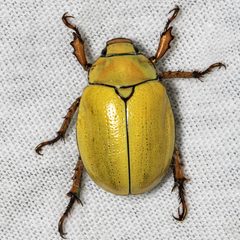
Cotalpa lanigera, known as the Goldsmith , is a scarab beetle in the Rutelinae. measure 19–26 mm and are active nocturnally during late spring and early summer. The is distributed across eastern and central North America, with records from Canada and the northeastern United States.
Pronunciation
How to pronounce Cotalpa lanigera: //koʊˈtælpə læˈnɪdʒərə//
These audio files are automatically generated. While they are not always 100% accurate, they are a good starting point.
Identification
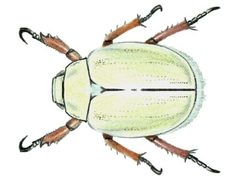
Distinguished from other Cotalpa by the combination of yellow-brown pronotum and paler yellow ; the specific color pattern separates it from darker relatives in the .
Images
Appearance
measure 19–26 mm in length. The and pronotum are yellow-brown; the are usually paler yellow.
Habitat
Associated with deciduous forest and riparian areas where trees occur.
Distribution
Eastern and central North America: recorded from Canadian provinces (Alberta, Manitoba, Ontario, Saskatchewan) and the United States (Vermont).
Seasonality
Active late spring to early summer; .
Diet
feed on leaves of trees including poplars (Populus), silver maple (Acer saccharinum), sweetgum (Liquidambar), pear (Pyrus), hickory (Carya), and willow (Salix).
Host Associations
- Populus - food source feeding on leaves
- Acer saccharinum - food source feeding on leaves
- Liquidambar - food source feeding on leaves
- Pyrus - food source feeding on leaves
- Carya - food source feeding on leaves
- Salix - food source feeding on leaves
Behavior
Nocturnally active.
Ecological Role
function as folivores on deciduous trees; larval unknown.
Human Relevance
Occasional minor pest of ornamental and fruit trees due to folivory.
Similar Taxa
- Other Cotalpa speciesDistinguished by coloration; C. lanigera has distinctly paler yellow contrasting with darker pronotum.
More Details
Taxonomic history
Originally described as Scarabaeus lanigerus by Linnaeus in 1758. The infraspecific name Cotalpa lanigera tau (Wickham, 1905) is now treated as a synonym.