
Colpa
Dufour, 1841
Species Guides
4- Colpa alcione(halcyon scoliid wasp)
- Colpa flammicoma
- Colpa octomaculata(Eight-spotted Scoliid Wasp)
- Colpa pollenifera
Colpa is a of scoliid wasps comprising 24 recognized distributed across six subgenera. Phylogenetic analysis has repositioned this genus from the tribe Campsomerini to a sister-group relationship with Scoliini, rendering Campsomerini non-monophyletic. This taxonomic revision has prompted proposals for either establishing a new tribe Colpini or transferring the genus to Scoliini. Species occur across multiple continents including North America, Africa, and Eurasia.

Pronunciation
How to pronounce Colpa: /ˈkɔlpa/
These audio files are automatically generated. While they are not always 100% accurate, they are a good starting point.
Identification
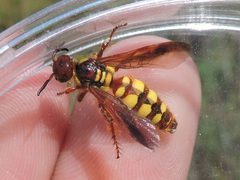
Colpa can be distinguished from other scoliid wasps by their phylogenetic placement as sister to Scoliini rather than within Campsomerini. Specific diagnostic morphological features for the require further systematic documentation. Some species exhibit distinctive color patterns: Colpa octomaculata and its display eight spots, while Colpa sexmaculata and Colpa quinquecincta show six and five bands or spots respectively. The genus includes both large-bodied forms typical of mammoth wasps and more moderately sized species.
Images
Habitat
vary by and geographic region. North American species such as Colpa octomaculata occur in temperate and subtropical zones. African species including those in subgenera Junodelis and Nyaselis are found in eastern and southern African regions. Specific microhabitat preferences for nesting and foraging are not well documented across the .
Distribution
The has a disjunct distribution spanning multiple continents. North American records include the United States and Mexico (Colpa octomaculata complex, Colpa pollenifera). African occur in South Africa, Kenya, Tanzania, and other eastern African localities (subgenera Junodelis, Nyaselis, and others). Eurasian distribution includes Morocco (Colpa quinquecincta maroccana) and Mongolia (Colpa tartara mongoiica). The Palearctic and Nearctic regions each distinct species .
Diet
are known to feed on nectar and pollen. Larvae are of scarabaeid , consistent with the -wide strategy of Scoliidae.
Life Cycle
Larval development occurs as of scarabaeid , with females presumably locating burrows and depositing . Specific details of egg placement, larval instars, and sites within host are not documented for Colpa specifically.
Behavior
includes nectar feeding at flowers. As with other scoliid wasps, females are presumed to excavate or access scarabaeid burrows to oviposit on or near larvae. Male behavior and mating systems are not documented. The is not known to be social; individuals are solitary.
Ecological Role
As of scarabaeid , Colpa contribute to of scarab . This service potentially benefits agriculture and natural vegetation management by limiting herbivorous beetle larval densities. nectar feeding may contribute to pollination, though this role is undocumented for the specifically.
Human Relevance
The Scoliidae, including Colpa, has been studied for potential use as agents against pest scarabaeid beetles. The Bohart Museum of Entomology at UC Davis houses approximately 2,300 mammoth specimens, including representatives of this , supporting systematic research. No specific economic impacts or medical significance are documented for Colpa .
Similar Taxa
- Campsomeris and related Campsomerini generaHistorically classified together; distinguished by phylogenetic position and pending formal revision of tribal boundaries
- Scoliini genera (e.g., Scolia, Megascolia)Sister-group relationship; morphological distinctions require updated systematic treatment
More Details
Taxonomic instability
The higher-level classification of Colpa remains unresolved. Two possibilities are under consideration: (1) establishment of a new tribe Colpini, or (2) transfer of the to Scoliini. This decision awaits phylogenetic analysis of additional genera including Guigliana and Dasyscolia.
Phylogenetic significance
Ultraconserved element (UCE) phylogenomic analysis confirmed Colpa as sister to Scoliini, with the split between these lineages and Campsomerini sensu stricto estimated to the Late Cretaceous. Crown group ages for these lineages are estimated to the Paleogene.
Subgeneric classification
The is organized into six subgenera: Colpa (Carbonelis), Colpa (Colpa), Colpa (Crioscolia), Colpa (Heterelis), Colpa (Junodelis), and Colpa (Nyaselis). This infrageneric structure reflects historical morphological groupings that may not align with phylogenetic relationships.