
Tachypompilus ferrugineus annexus
(Banks, 1944)
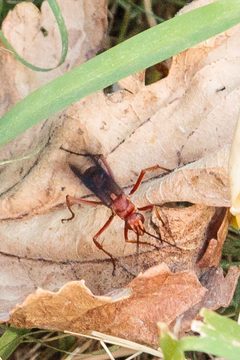
Tachypompilus ferrugineus annexus is a of spider wasp in the Pompilidae. It belongs to a group of large, solitary that hunt spiders to provision nests for their larvae. The Tachypompilus ferrugineus is known for its distinctive rusty or reddish coloration. This subspecies was described by Nathan Banks in 1944.
Pronunciation
How to pronounce Tachypompilus ferrugineus annexus: //ˌtæk.ɪˈpɒm.pɪ.ləs fɛˌruːˈdʒɪn.i.əs ænˈnɛk.səs//
These audio files are automatically generated. While they are not always 100% accurate, they are a good starting point.
Identification
Distinguished from other spider wasps by combination of large size and extensive rusty-reddish coloration. Separable from other Tachypompilus by specific color patterns and morphological details. The annexus may be distinguished from the nominate T. f. ferrugineus by geographic distribution and potentially subtle differences in coloration or body proportions, though specific diagnostic features for this subspecies are not well documented in available sources.
Images
Appearance
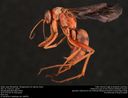
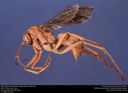
Large spider wasp with predominantly rusty or ferruginous (reddish-brown) coloration. Members of the Tachypompilus are among the larger spider wasps, with robust bodies and long legs adapted for capturing and transporting spider prey. Wings typically show dark coloration with possible iridescent or blue-black highlights. The specific annexus presumably shares the general of T. ferrugineus but may exhibit subtle differences in coloration or body proportions compared to the nominate subspecies.
Habitat
Open including fields, meadows, and forest edges where hunting spiders are abundant. Nests are excavated in soil or sandy substrates.
Distribution
Recorded from Vermont, United States based on GBIF data. The Tachypompilus ferrugineus has broader distribution in North America.
Seasonality
active during warmer months, typically summer. Specific for this not documented.
Host Associations
- Lycosidae - preySpider wasps in this hunt wolf spiders and related large ground-dwelling spiders as food for their larvae
- Pisauridae - preyFishing spiders may also be taken as prey
Life Cycle
Solitary nesting . Females hunt spiders, sting them to induce paralysis, and transport them to underground nests. An is laid on the paralyzed spider, which serves as fresh food for the developing larva. The larva consumes the spider and pupates in a cocoon within the nest .
Behavior
Females fly low over ground in searching patterns to detect spider prey. When a spider is located, the lands, pursues, and stings it into paralysis. The paralyzed spider may be dragged to a nest site or left in place while the female excavates a burrow. Multiple spiders may be provisioned per nest . Males patrol areas seeking emerging females and may roost gregariously on vegetation.
Ecological Role
of spiders, contributing to of large ground-dwelling spider . As a predator, helps maintain balance in terrestrial .
Human Relevance
Generally beneficial due to spider . Females can sting if handled but are not aggressive toward humans. Large numbers may indicate abundant spider .
Similar Taxa
- Tachypompilus ferrugineus ferrugineusNominate ; differences likely subtle and primarily geographic
- Scolia dubiaAlso large, rusty-reddish with dark wings, but belongs to Scoliidae and has different body shape; attacks scarab beetle rather than spiders
- Polistes carolina/P. perplexusLarge reddish with dark wings, but social paper wasps with different body proportions and nest-building
More Details
Taxonomic Note
This was described by Nathan Banks in 1944. Banks was a prominent American entomologist who made significant contributions to the of Hymenoptera and other insect orders. The specific epithet 'annexus' (Latin for 'connected' or 'attached') may refer to morphological features or geographic connection to related .
Data Limitations
Available sources provide minimal specific information about this . Most behavioral and ecological information is inferred from the level or level, and from related spider wasps in the Pompilidae. Direct observation records and detailed studies of T. f. annexus specifically appear to be lacking in the accessible literature.
Sources and further reading
- BugGuide
- GBIF taxonomy match
- iNaturalist taxon
- Catalogue of Life
- UBI Professor Demonstrates 'How to Draw a Bug' at Bohart Museum Open House | Bug Squad
- Encyrtid Holdings | Entomology Research Museum
- Bug Eric: Wasp Wednesday: A Real Surprise
- Bug Eric: Wasp Wednesday: Blue-winged Wasp
- Listening to Larvae: How Acoustics Can Measure Efficacy of Palm Weevil Management
- Northern Ireland, invertebrate finds in review 2023 - Buglife Blog - Buglife