
Tachypompilus
Ashmead, 1902
spider wasps
Species Guides
2- Tachypompilus ferrugineus(rusty spider wasp)
- Tachypompilus unicolor(Western Red-tailed Spider Wasp)
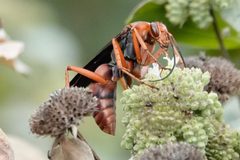
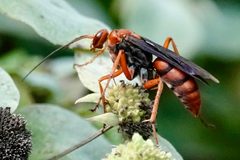
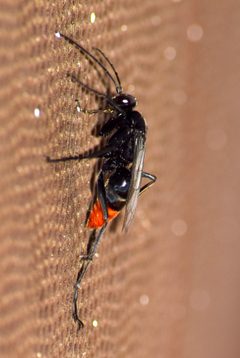
Tachypompilus is a of spider wasps in the Pompilidae, distributed across the Neotropics, Nearctic, eastern Palearctic, Indomalayan, and Afrotropical regions. The genus includes approximately 20 described , several with distinctive such as the red-tailed spider wasp (T. analis), rusty spider wasp (T. ferrugineus), and rain spider wasp (T. ignitus). Members are solitary that hunt spiders as food for their larvae.
Pronunciation
How to pronounce Tachypompilus: /ˌtækiˈpɒmpɪləs/
These audio files are automatically generated. While they are not always 100% accurate, they are a good starting point.
Images
Distribution
Neotropics, Nearctic, eastern Palearctic, Indomalayan, and Afrotropical regions. Specific observations documented from Syracuse, New York, USA, and Vermont, USA.
Seasonality
Mid-summer through early fall activity documented for T. ferrugineus in New York (July–September).
Diet
Spiders (paralyzed and used as larval food source). Documented prey includes wolf spiders (Lycosa helluo, Lycosa rabida). , particularly males, have been observed feeding at flowers.
Host Associations
- Lycosa helluo - preyparalyzed and used as larval food
- Lycosa rabida - preyparalyzed and used as larval food
Life Cycle
Females construct nest in protected crevices using loosened soil, powdered mortar, and debris. Each cell contains a single paralyzed spider positioned side up, with the affixed laterally to the base of the . Larvae presumably feed externally on the spider before .
Behavior
Males exhibit perching on elevated structures such as cemetery monuments, engaging in wing fanning, circling, following, and chases with rival males. Multiple males may simultaneously pursue incoming females with extensive wing fanning and antennal waving. No overt territoriality or observed. Both sexes shelter in narrow crevices during night and inclement weather. Females transport paralyzed spiders backward on the ground to nest sites and perform exploratory walks inside crevices before constructing nests.
Ecological Role
of wolf spiders, providing of spider . Solitary contributing to regulation of ground-dwelling spider .
Similar Taxa
- Scolia dubiaBoth are large, colorful with reddish abdominal coloration that may be confused by observers. Scolia dubia is a scoliid wasp with a black and red bicolored and blue-black wings, but belongs to Scoliidae and parasitizes scarab beetle rather than spiders.
- Polistes carolina / P. perplexusLarge reddish with dark wings that may be mistaken for Tachypompilus . Paper wasps have different body proportions, nest socially in exposed situations or hollow trees, and hunt caterpillars rather than spiders.
More Details
Species diversity
The includes approximately 20 described , with T. ferrugineus being among the most studied. Several species have distinctive reflecting their coloration: T. analis (red-tailed spider wasp), T. ferrugineus (rusty spider wasp), T. ignitus (rain spider wasp), and T. unicolor (red-tailed spider hunter).
Research focus
Most detailed behavioral studies have focused on T. ferrugineus and the T. ferrugineus nigrescens, particularly male at landmark sites. These studies represent limited geographic and temporal sampling and may not reflect -wide patterns.
Sources and further reading
- BugGuide
- Wikipedia
- GBIF taxonomy match
- iNaturalist taxon
- NCBI Taxonomy
- Catalogue of Life
- Bug Eric: Wasp Wednesday: A Real Surprise
- Bug Eric: Wasp Wednesday: Blue-winged Wasp
- Ecology, Mating and Nesting of <i>Tachypompilus Ferrugineus Nigrescens</i> (Hymenoptera: Pompilidae)
- Additional Observations on <i>Tachypompilus Ferrugineus</i> With Emphasis on Male Behavior (Hymenoptera: Pompilidae)