
Tachypompilus ferrugineus
(Say, 1824)
rusty spider wasp, red-tailed spider hunter, red-tailed spider wasp
Species Guides
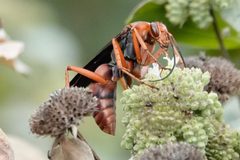
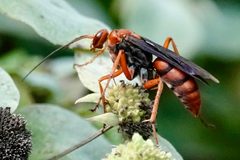
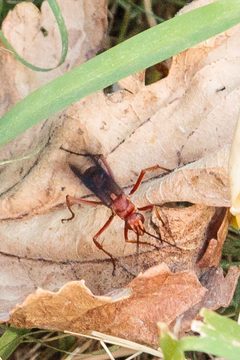
3Tachypompilus ferrugineus is a large spider wasp ( Pompilidae) native to the Americas, ranging from Canada through the United States to Central and South America. measure 15–25 mm in length and are characterized by reddish-brown coloration with four narrow dark abdominal bands and distinctive violet-blue wings. Females hunt and paralyze large wandering spiders, particularly wolf spiders (Lycosidae), to provision underground nests for their larvae. Males exhibit perching on elevated structures and compete for access to females. The includes nine recognized with variable geographic distributions.
Pronunciation
How to pronounce Tachypompilus ferrugineus: /ˌtækɪˈpɒmpɪləs fɛˈruːdʒɪniəs/
These audio files are automatically generated. While they are not always 100% accurate, they are a good starting point.
Identification
Distinguished from other spider wasps by the combination of reddish-brown body with four dark abdominal bands and violet-blue wings. The similar Asian Tachypompilus analis shares the "red-tailed spider wasp" but occurs in different geographic regions. Distinguished from Scolia dubia (blue-winged scoliid wasp) by abdominal pattern: T. ferrugineus has dark bands on reddish background, while S. dubia has black upper and red lower abdomen with yellow spots. Distinguished from Polistes paper wasps by more robust build and different wing posture at rest.
Images
Appearance
A mostly reddish-brown with four narrow dark bands encircling the . The wings are violet-blue in color. Body length ranges from 15–25 mm (0.59–0.98 in).
Habitat
Occupies diverse terrestrial including open ground, cemeteries, and areas near gravelly roadways. Nesting occurs in dry, powdery soil, often under trees or buildings. Specific microhabitats include narrow crevices in stone monuments or similar structures used for shelter and nest construction. Prefers loosened soil, powdered mortar, and debris for nest excavation.
Distribution
Widespread in the Americas from southern Canada through the United States, Mexico, and Central America to South America and the Caribbean. Specific records include Illinois, California, New York, Ohio, Florida, New Jersey, Pennsylvania, North Carolina, Tennessee, and Colorado in the United States. Nine recognized occupy different portions of this range: T. f. ferrugineus (southeastern United States), T. f. nigrescens (northeastern United States), T. f. torridus (Sonoran Desert and adjacent regions), T. f. bicolor (Hispaniola and Cuba), and others.
Seasonality
active from mid-summer through early fall. In New York, peak activity observed August–September. Male perching and pursuit of females occurs during daylight hours; males abandon searching by late afternoon and gather to roost on vegetation overnight.
Diet
feed on nectar from various flowering plants including Rhus copallina, Cicuta maculata, Eryngium yuccifolium, Oxypolis rigidior, Pastinaca sativa, Asclepias incarnata, Erechtites hieracifolia, Pycnanthemum tenuifolium, Hazardia squarrosa, Celosia floribunda, Eriogonum fasciculatum, Koeberlinia spinosa, Melilotus albus, and Daucus carota. Both sexes also feed on honeydew. Larvae are obligate , feeding on paralyzed spiders provisioned by the female.
Host Associations
- Lycosa helluo - preyWolf spider; primary prey in some
- Lycosa rabida - preyWolf spider; primary prey in some
- Tigrosa helluo - preyWolf spider; documented prey
- Rabidosa rabida - preyWolf spider; documented prey
- Dolomedes tenebrosus - preyDark fishing spider; recorded as prey in southern Canada
- Hogna timuqua - preyWolf spider; recorded as prey in Florida
Life Cycle
Females construct simple nest as depressions in soil, excavated by raking with legs and tamping with metasoma. The female paralyzes a spider by stinging, grasps it by or , and drags it backward to the nest. An is deposited on the of the paralyzed spider, near the base. The nest is backfilled with soil and camouflaged with debris. The larva hatches and feeds externally on the spider for one to two weeks before spinning a silken cocoon. Development continues through pupal stage to .
Behavior
Males exhibit perching on elevated structures such as stone monuments, with and legs outstretched and wings held flat along the dorsum. Males chase rivals from favored perches and pursue incoming females in . Multiple males may simultaneously pursue a single female, exhibiting wing fanning (scissoring motion) and antennal waving during courtship. Copulation lasts approximately 27 seconds, after which the female departs with the male following briefly. Both sexes shelter in narrow crevices at night and during inclement weather; up to eight individuals observed sharing shelter. Females transport paralyzed spiders backward along the ground while . No overt territoriality or observed among males despite size variation; several males may maintain multiple stations.
Ecological Role
of wandering spiders, particularly wolf spiders (Lycosidae), with documented on Pisauridae and Ctenidae as well. Functions as a agent for spider . Paralysis of prey is typically permanent, preventing spider from completing its regardless of whether it is consumed by larvae.
Human Relevance
Generally beneficial due to on spiders, including that may be perceived as pests. Not aggressive toward humans; females sting only if physically molested. Large numbers may indicate abundant spider . Occasionally mistaken for more aggressive species such as Polistes paper wasps. Presence sometimes noted in residential areas, cemeteries, and gardens.
Similar Taxa
- Tachypompilus analisShares "red-tailed spider wasp" but is Asian with different geographic distribution; distinguished by range and subtle morphological differences
- Scolia dubiaSimilar size and blue wing coloration, but has black upper and red lower abdomen with yellow spots; parasitizes scarab beetle rather than spiders
- Polistes carolinaSimilar reddish-brown coloration and size, but is social paper wasp with different body proportions, nest architecture, and ; wings not violet-blue
- Polistes perplexusSimilar reddish-brown coloration and size, but is social paper wasp with different body proportions and ; wings not violet-blue
Misconceptions
The "red-tailed spider wasp" is also applied to the Asian Tachypompilus analis, potentially causing confusion. The species is sometimes mistaken for Scolia dubia (blue-winged wasp) due to similar wing coloration, but belongs to a different with different . Observations of females dragging large spiders have been misattributed to other families by observers unfamiliar with pompilid .
More Details
Subspecies
Nine recognized : T. f. annexus, T. f. bicolor (Hispaniola and Cuba), T. f. ferrugineus (nominate subspecies, southeastern United States), T. f. nigrescens (northeastern United States, possibly melanistic morph rather than valid ), T. f. torridus (Sonoran Desert and adjacent regions from southern California to Chiapas, Mexico), and four others. Subspecies vary in coloration and geographic distribution.
Nesting substrate
Females have been observed using diverse materials for nest construction, including soil, powdered mortar from deteriorating masonry, and accumulated debris in crevices. In Ohio, females were observed dragging leaves into nests, possibly for structural reinforcement or camouflage.
Male seasonal behavior shift
Male attachment to perching sites wanes seasonally due to mortality, increased floral feeding, and decreased female receptivity. This seasonal shift affects the dynamics of male at landmark sites.
Sources and further reading
- BugGuide
- Wikipedia
- GBIF taxonomy match
- iNaturalist taxon
- NCBI Taxonomy
- Catalogue of Life
- UBI Professor Demonstrates 'How to Draw a Bug' at Bohart Museum Open House | Bug Squad
- Encyrtid Holdings | Entomology Research Museum
- Bug Eric: Wasp Wednesday: A Real Surprise
- Bug Eric: Wasp Wednesday: Blue-winged Wasp
- Listening to Larvae: How Acoustics Can Measure Efficacy of Palm Weevil Management
- Northern Ireland, invertebrate finds in review 2023 - Buglife Blog - Buglife
- Ecology, Mating and Nesting of <i>Tachypompilus Ferrugineus Nigrescens</i> (Hymenoptera: Pompilidae)
- Additional Observations on <i>Tachypompilus Ferrugineus</i> With Emphasis on Male Behavior (Hymenoptera: Pompilidae)