
Anoplius americanus
(Palisot de Beauvois, 1811)
blue-black spider wasp
Species Guides
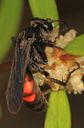
3Anoplius americanus is a of spider wasp in the Pompilidae, characterized by its predominantly black body with distinctive bright orange spots on the second and third abdominal segments. The species is widely distributed across the New World and is approximately 20 mm in length. have been observed visiting flowers from multiple families for nectar.
Pronunciation
How to pronounce Anoplius americanus: /ænˈoʊpliəs əˌmɛrɪˈkænəs/
These audio files are automatically generated. While they are not always 100% accurate, they are a good starting point.
Identification
The bright orange spots on abdominal segments 2 and 3 are specifically distinct and serve as the primary diagnostic feature separating this from other black Anoplius species. Most Anoplius species are wholly blue-black with few distinguishing field marks; microscopic examination is typically required for species-level identification within the .
Images
Appearance
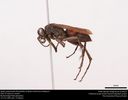
Approximately 20 mm in length. Body is almost completely black with bright orange spots on the second and third abdominal segments. Wings are black with blue or violet reflections typical of the .
Distribution
North America, Central America, and the West Indies.
Diet
have been observed nectaring on flowers of the Apiaceae, Asteraceae, Lamiaceae, and Polygonaceae. The predominant prey is likely wolf spiders of the family Lycosidae, consistent with other members of the Anoplius.
Similar Taxa
- Anoplius aethiopsSimilar large black spider wasp with blue or violet wing reflections; distinguished by the orange abdominal spots present in A. americanus but absent in A. aethiops, which is uniformly black.
- Anoplius cleoraSimilar black spider wasp; A. cleora is found in open sand dune and rarely visits flowers, whereas A. americanus has distinctive orange abdominal markings.
More Details
Taxonomic note
Catalogue of Life lists this with status 'synonym', while GBIF lists it as 'ACCEPTED'. This discrepancy suggests ongoing taxonomic evaluation.
Genus-level biology
in the Anoplius exhibit diverse habits. Most prey on wolf spiders (Lycosidae), either exclusively or in part. A few are , capturing crab spiders (Thomisidae), jumping spiders (Salticidae), ground spiders (Clubionidae, Corinnidae, Gnaphosidae), and grass spiders (Agelenidae). Females sting prey into paralysis, excavate or use pre-existing burrows, lay a single on the paralyzed spider, and seal the burrow.
Sources and further reading
- BugGuide
- Wikipedia
- GBIF taxonomy match
- iNaturalist taxon
- Catalogue of Life
- Congratulations, UC Davis Linnaean Games Team: National Champs! | Bug Squad
- Bug Eric: Wasp Wednesday: Anoplius aethiops
- Bug Eric: Wasp Wednesday: Anoplius
- Oklahoma is More than OK for Burying Beetles
- Bug Eric: A Couple of Weirdos
- Emerald Ash Borer Infestation of White Fringetree Found to be Widespread