
Pepsis ruficornis
(Fabricius, 1775)
tarantula hawk
Pepsis ruficornis is a of tarantula hawk in the Pompilidae. Like other members of the Pepsis, it is a large, solitary wasp that hunts tarantulas as prey for its larvae. The species was described by Fabricius in 1775, making it one of the earlier described members of this diverse genus of spider wasps.
Pronunciation
How to pronounce Pepsis ruficornis: //ˈpɛpsɪs ˌruːfɪˈkɔːrnɪs//
These audio files are automatically generated. While they are not always 100% accurate, they are a good starting point.
Identification
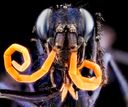
The 'ruficornis' indicates reddish or orange , which may serve as a distinguishing feature from other Pepsis . Definitive identification to species level in Pepsis typically requires examination of wing venation, antennal segment counts (males of some species have 12 segments), and other subtle morphological characters. The Pepsis is distinguished from the related genus Hemipepsis by its iridescent blue-black coloration (Hemipepsis are matte black) and different wing venation.
Images
Appearance
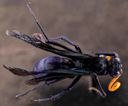
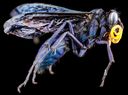
Specific morphological details for P. ruficornis are not well documented in the provided sources. Members of the Pepsis are generally large with iridescent blue-black bodies and either bright orange or black wings. The epithet 'ruficornis' (red-horned) suggests reddish or orange , distinguishing it from . Females possess long, coarse hairs beneath the of the front leg in some related species.
Habitat
As a member of the tarantula hawk guild, P. ruficornis likely inhabits arid and semi-arid regions where tarantulas are abundant. The is well-represented in the southwestern United States, Mexico, and extending into Central and South America. Specific associations for this are not documented in available sources.
Distribution
The distribution of P. ruficornis is not explicitly detailed in the provided sources. The Pepsis occurs broadly from the southwestern United States through Mexico, Central America, and into South America. Some Pepsis show distinct geographic variation in wing coloration (orange-winged xanthic forms versus black-winged melanic forms) across their ranges.
Seasonality
Seasonal activity patterns for P. ruficornis specifically are not documented. Related Pepsis in the southwestern U.S. are most active in spring through fall, with peak activity varying by elevation and local climate conditions.
Diet
feed on nectar, particularly from milkweed flowers (Asclepias spp.), but also from creosote bush, blue palo verde, eucalyptus, mesquite, and acacia. Females also drink water at puddle edges. The larval diet consists exclusively of tarantula spiders, which are paralyzed and cached in underground burrows.
Host Associations
- Tarantula spiders - preyparalyzed and used as living food source for larvae
Life Cycle
Females hunt tarantulas, sting them to induce paralysis, and drag them to underground burrows. A single is laid on the paralyzed spider. The larva hatches and consumes the living spider, eventually pupating and emerging as an . Development likely spans several months to a year depending on conditions.
Behavior
Females hunt tarantulas primarily in morning and evening hours to avoid heat stress, searching on foot with flickering wings and quivering . Males are often more numerous at nectar sources and may gather in multi- during midday heat and overnight. Some Pepsis males perform 'hill-topping,' perching on high points to intercept passing females. When agitated, individuals adopt a threat posture with wings splayed and curled, while releasing a distinctive odor.
Ecological Role
As a top , P. ruficornis helps regulate tarantula . The serves as a model for Müllerian and complexes; cerambycid beetles in the Tragidion mimic the distinctive orange-and-black coloration of tarantula hawks. function as while foraging for nectar.
Human Relevance
The sting of Pepsis is considered among the most painful of any insect, rated near the top of the Schmidt sting pain index. However, the venom causes no lasting tissue damage and effects subside within minutes. The wasps are generally placid unless provoked. They are popular subjects for nature observation and photography due to their large size and striking appearance.
Similar Taxa
- Pepsis grossaLargest North American tarantula hawk, with both orange-winged and black-winged forms; males have 12 antennal segments (unique in )
- Hemipepsis ustulataSimilar size and , but matte black rather than iridescent blue-black body; earlier seasonal activity in many areas
- Pepsis mexicanaVery similar appearance but smaller than P. grossa; distinguished by antennal segment counts and other subtle characters
- Tragidion spp. (Cerambycidae)Longhorn beetles that are Batesian mimics of tarantula hawks; beetles have hardened forewings and lack the 's narrow waist
More Details
Taxonomic Note
The specific epithet 'ruficornis' (Fabricius, 1775) is one of the older names in the , predating many of the better-studied North American . The species has received less modern taxonomic attention than members of the P. grossa and P. thisbe species groups.
Mimicry Complex
Tarantula hawks including P. ruficornis are involved in extensive mimicry relationships. The bright aposematic coloration warns of their painful sting, and this signal is exploited by harmless mimics including beetles, flies, and other .
Sources and further reading
- BugGuide
- GBIF taxonomy match
- iNaturalist taxon
- Catalogue of Life
- Of Lady Beetles and Green Fruit Beetle Larvae | Bug Squad
- Bug Eric: Wasp Wednesday: Pepsis grossa
- Bug Eric: Wasp Wednesay: Hemipepsis ustulata
- Bug Eric: Tarantula Hawks
- Bug Eric: Spider Sunday: Spider Enemies
- New species and a review of the genus Tragidion | Beetles In The Bush