Timulla euterpe
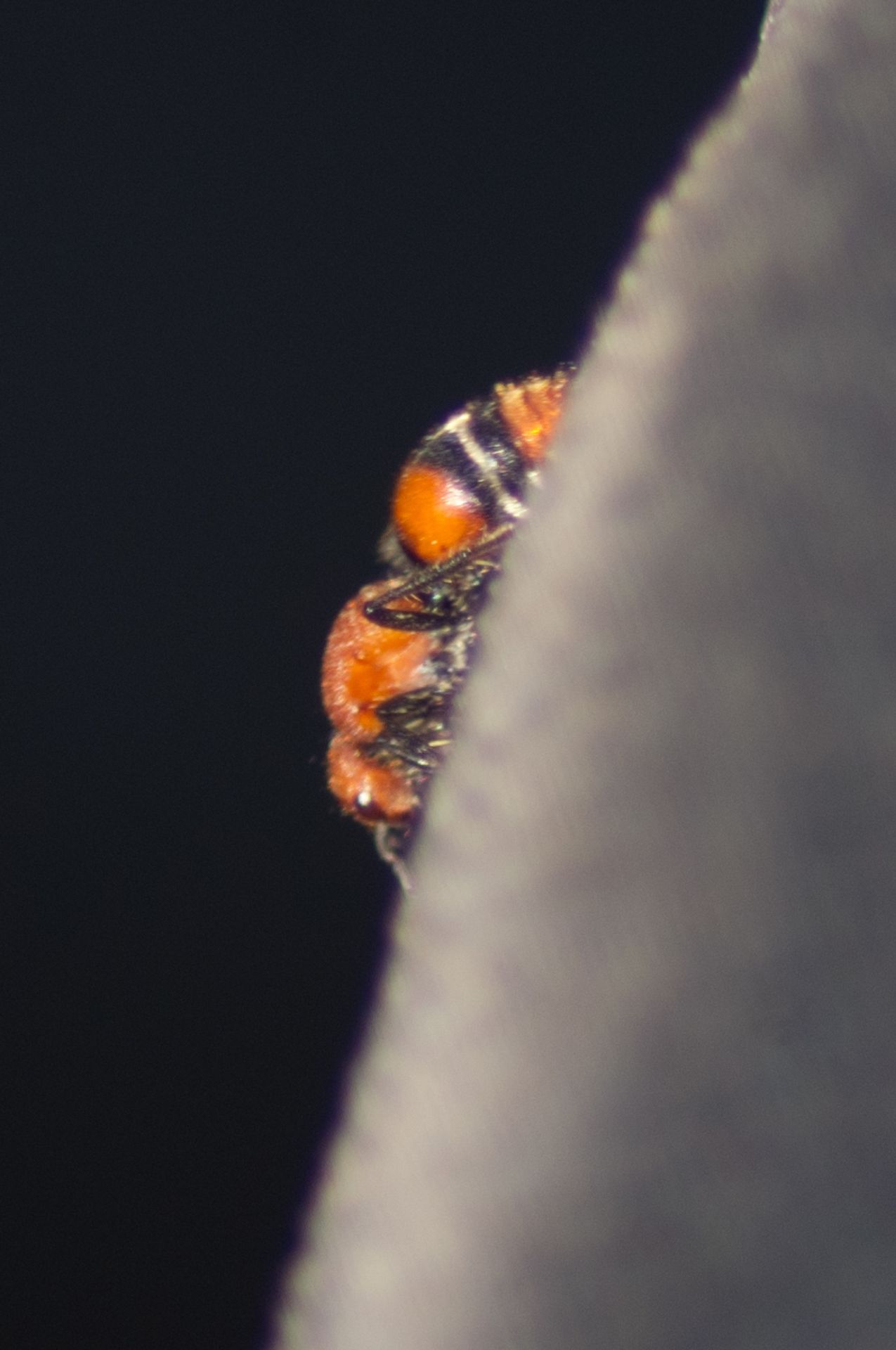
Timulla euterpe is a of velvet ant in the Mutillidae, a group of wingless known for their potent sting and aposematic coloration. Like other mutillids, females are wingless while males possess wings. The Timulla is frequently mimicked by spiders in the genus Sergiolus, which share similar in sun-dappled forest floors. T. euterpe is part of a mimicry complex involving multiple Timulla species that resemble each other and their spider mimics.
Pronunciation
How to pronounce Timulla euterpe: /tɪˈmʊlə juːˈtɜrpi/
These audio files are automatically generated. While they are not always 100% accurate, they are a good starting point.
Identification
Females can be distinguished from similar Timulla by subtle differences in color pattern, , and microscopic features of the . Separation from the spider Sergiolus requires noting the 8 legs (versus 6 in insects), presence of in spiders, and antennal structure. Unlike spiders, velvet ants have a constricted waist with one or two nodes and elbowed . The sting is a definitive feature not present in spiders.
Images
Appearance
Velvet ants have dense, velvety covering the body. Females are wingless with a robust, -like appearance. Coloration typically involves contrasting patterns of red, black, and white or silver. The body is compact with a tough, flexible . Males possess wings and are generally less frequently encountered.
Habitat
Deciduous forest floors, particularly sun-dappled patches with leaf litter. Also found in gardens, meadows, and lawns with similar light conditions.
Distribution
Eastern North America, with range overlapping that of its spider mimic Sergiolus capulatus. Specific distribution details for T. euterpe not separated from broader Timulla distribution in available sources.
Seasonality
active during warmer months. Activity patterns not specifically documented for this .
Life Cycle
Mutillids are , but specific for T. euterpe are not documented in available sources. Females lay in host nests; larvae develop as ectoparasitoids on stages of hosts.
Behavior
Females are solitary and fast-moving. They possess a potent sting used for defense. When disturbed, they may produce a stridulatory sound. They do not construct nests but instead search for nests in which to deposit .
Ecological Role
Human Relevance
Similar Taxa
- Sergiolus capulatusSpider that closely mimics Timulla velvet ants in coloration and ; distinguished by 8 legs, , and lack of sting
- Other Timulla speciesMultiple Timulla resemble each other, forming a Müllerian mimicry ring; require microscopic examination for definitive identification
Misconceptions
Despite the 'velvet ant,' these are , not ants. The wingless females are often mistaken for ants due to convergent .