
Sergiolus
Simon, 1892
ground spiders
Species Guides
12- Sergiolus angustus
- Sergiolus capulatus(Variegated Ground Spider)
- Sergiolus columbianus
- Sergiolus cyaneiventris
- Sergiolus decoratus
- Sergiolus gertschi
- Sergiolus minutus
- Sergiolus montanus(Common Patterned Ant-mimic Ground Spider)
- Sergiolus ocellatus(Ground Spider)
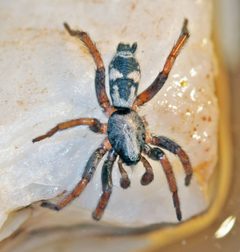
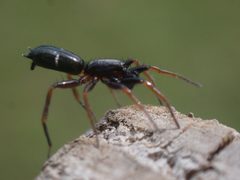
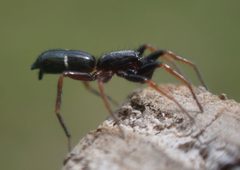
Sergiolus is a of ground spiders in the Gnaphosidae, first described by Eugène Simon in 1892. The genus contains approximately 21-26 distributed across North America, parts of Central America, and East Asia (China, Korea, Japan). These spiders are notable for their strikingly bold coloration, which has led to speculation that they may be mimicking velvet ants (Mutillidae). They are active hunters that do not construct webs for prey capture.
Pronunciation
How to pronounce Sergiolus: /sɛrˈd͡ʒi.o.lus/
These audio files are automatically generated. While they are not always 100% accurate, they are a good starting point.
Identification
Sergiolus are distinguished by their exceptionally vivid and contrasting color patterns, often combining red, black, and white markings. The cylindrical at the tip of the are characteristic of the Gnaphosidae and help separate Sergiolus from similarly colorful spiders in other families. Distinguishing Sergiolus from other gnaphosid such as Callilepis requires examination of genitalia: the in females and the in males. Body length ranges from 3.3 to 10 mm depending on species and sex.
Images
Habitat
Sergiolus frequent sun-dappled patches on deciduous forest floors, often in leaf litter. They also occur in gardens, meadows, lawns, and reasonably dry situations under stones and other objects. They are capable climbers and have been observed on foliage, walls, and ceilings.
Distribution
The occurs in North America (USA, Canada, Mexico), Central America (Cuba, Jamaica, Hispaniola), and East Asia (China, Korea, Japan). In North America, are distributed from the Atlantic to the Pacific, with S. capulatus ranging from Nebraska and Oklahoma eastward, and S. montanus occurring in western regions.
Seasonality
can be found in almost any season, though they are most active during warmer months. They probably live over one year.
Behavior
Sergiolus are nomadic, agile hunters that actively prowl for prey rather than building capture webs. They are mostly . When fleeing potential danger, they move rapidly and may temporarily disappear from view before reappearing. They construct silk retreats for molting, sac guarding by females, and possibly . They do not spin webs to snare prey.
Human Relevance
Sergiolus spiders are occasionally encountered indoors, where they are often mistaken for ants or velvet ants due to their coloration. They are harmless to humans and are sometimes kept as pets in simple enclosures. They have been observed controlling small insect , including flies.
Similar Taxa
- CallilepisAnother gnaphosid with bold coloration; distinguished by subtle genitalic differences
- Timulla (velvet ants)Wingless that Sergiolus may mimic; distinguished by six legs, different body segmentation, and stinger
More Details
Mimicry hypothesis
The striking coloration of Sergiolus has led to speculation that they may be mimicking velvet ants (Mutillidae), specifically the Timulla, which share similar and possess a potent sting. However, this hypothesis remains unconfirmed.
Taxonomic history
Several members of Sergiolus were formerly placed in the Poecilochroa, and older references may treat them as such.