
Timulla
Ashmead, 1899
velvet ants
Species Guides
19Timulla is a of velvet ants ( Mutillidae) comprising nearly 200 described . These solitary exhibit pronounced : females are wingless and often brightly colored with dense velvety , while males are winged. The genus occurs across the Americas and has been documented as a of solitary bees and other ground-nesting insects. Some Timulla species serve as models for Müllerian or complexes, notably with ground spiders in the genus Sergiolus.
Pronunciation
How to pronounce Timulla: /tɪˈmʌlə/
These audio files are automatically generated. While they are not always 100% accurate, they are a good starting point.
Identification
Females distinguished from true ants (Formicidae) by absence of petiole node(s) and presence of straight ; from other wingless female mutillids by specific patterns of and integumental . Males distinguished from other vespiform by the dense velvety setae and wing venation. -level identification requires examination of male genitalia and female mandibular structure.
Images
Appearance
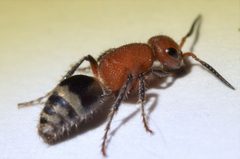
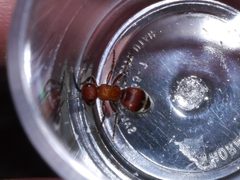
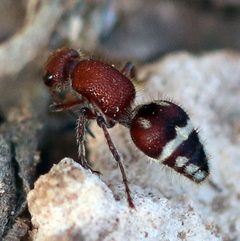
Females are wingless, -like in form, and covered in dense, velvety setae that create striking color patterns—often combinations of red, black, and white. Males possess wings and more elongate bodies. Both sexes have a robust and a powerful sting. The is heavily sculptured, with the velvety pile obscuring much of the underlying .
Habitat
Distribution
Primarily Neotropical and Nearctic; recorded from North America (including USA: Vermont, and broadly across eastern and western states) through Central and South America. Specific documented localities include: Miranda Pantanal, Mato Grosso do Sul, Brazil; various USA states; Oriental region (T. oculata complex).
Seasonality
active during warmer months; specific varies by latitude and . In temperate North America, likely active spring through fall.
Host Associations
- Exomalopsis fulvofasciata - Documented for T. terminalis and T. intermissa; females enter nests and parasitize mature larvae or pre-pupae in soil nests
- Solenopsis invicta - Cited from literature; not directly observed in provided sources
- Epicharis sp. - Cited from literature; not directly observed in provided sources
- Sphecidae - Cited from literature; not directly observed in provided sources
- Eumeninae (Vespidae) - Cited from literature; not directly observed in provided sources
Life Cycle
of ground-nesting Hymenoptera. Females enter nests and deposit on or near mature larvae or pre-pupae. Development occurs within host nest; timing likely synchronized with host . Specific details of egg, larval, and pupal stages not documented in provided sources.
Behavior
Females are solitary and nomadic, actively searching for nests. Documented entering host nests and remaining approximately five minutes. Both sexes possess a potent sting used defensively. Males are winged and likely engage in patrolling for mates, though specific male behavior not detailed in sources.
Ecological Role
Human Relevance
Females can deliver a painful sting if handled; caution advised. Some are involved in mimicry complexes with spiders that humans may encounter. Occasionally enter human dwellings. Not known to cause structural damage or agricultural harm.
Similar Taxa
- DasymutillaAnother large of New World velvet ants with wingless females; distinguished by differences in integumental , setal patterns, and male genitalia
- MutillaOld World velvet ant ; geographic separation and subtle morphological differences in wing venation and genitalia
- Sergiolus (spider)Ground spiders that mimic Timulla in coloration and pattern; distinguished by 8 legs, , and absence of
More Details
Mimicry relationships
The serves as a model for -mimicry and -mimicry complexes. The ground spider Sergiolus capulatus bears 'uncanny resemblance' to Timulla , sharing similar (sun-dappled deciduous forest floors) and coloration. This is suspected to be a case of Batesian or Müllerian mimicry, though the remain partially unexplained.
Taxonomic scope
The contains approximately 200 described , making it one of the larger genera in Mutillidae. Species-level relies heavily on male genitalia and subtle differences in female mandibular and setal patterns.