
Sergiolus capulatus
(Walckenaer, 1837)
Variegated Ground Spider
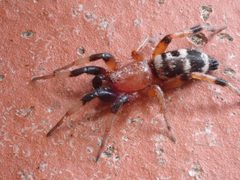
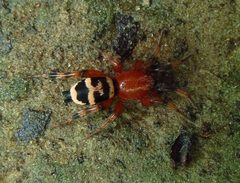
Sergiolus capulatus is a colorful ground spider in the Gnaphosidae, commonly known as the Variegated Ground Spider. It is known for its bold, contrasting coloration that resembles velvet ants (Mutillidae), suggesting possible mimicry. The is active during the day and is frequently encountered in sun-dappled forest floors, gardens, and occasionally indoors. It does not build prey-capture webs but constructs silk retreats for molting and guarding.
Pronunciation
How to pronounce Sergiolus capulatus: /sɛrɡiˈoʊləs kæpjuˈleɪtəs/
These audio files are automatically generated. While they are not always 100% accurate, they are a good starting point.
Identification
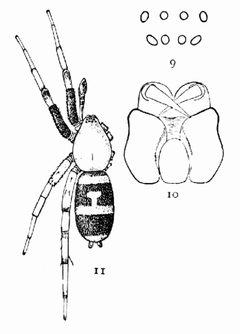
Sergiolus capulatus can be distinguished from other spiders by its striking color pattern: typically a red or orange , black legs, and a black-and-white patterned . The cylindrical at the tip of the abdomen are characteristic of Gnaphosidae and help separate it from similarly colorful spiders in other . From other gnaphosids such as Callilepis, separation requires examination of genitalia: the in females and in males. The overall body length ranges 5.5–10 mm, with males smaller than females. The bears a particularly strong resemblance to velvet ants in the Timulla.
Images
Habitat
Found in sun-dappled patches on deciduous forest floors, gardens, meadows, and lawns. Also occurs under stones and other objects in reasonably dry situations. Frequently climbs vegetation, walls, and other surfaces.
Distribution
United States and Canada. Records span from Nebraska and Oklahoma eastward, with additional reports from Michigan, Virginia, North Carolina, Tennessee, New York, Massachusetts, Connecticut, Texas, Montana, Idaho, Washington, Oregon, Colorado, Georgia, Arkansas, Pennsylvania, Ohio, New Hampshire, Kentucky, and Utah.
Seasonality
have been observed in almost any season, with peak activity during warmer months. Probably lives over one year.
Life Cycle
Constructs silk retreats for molting. Females guard sacs within retreats. Retreats may also be used for .
Behavior
and highly agile, especially when fleeing potential danger. Nomadic hunter that prowls through leaf litter rather than building webs to capture prey. Good climber, frequently found on foliage and walls. When disturbed, may quickly disappear and reappear if observer remains patient.
Ecological Role
Predatory ground spider that contributes to control in forest floor and garden . Suspected mimic of velvet ants (Mutillidae), which may provide protection from .
Human Relevance
Occasionally enters buildings, where it is often noticed due to its conspicuous coloration. Can be kept in captivity with minimal requirements: small container, weekly water provision, and feeding every two weeks. Not known to be medically significant.
Similar Taxa
- Sergiolus montanusAnother colorful western North American Sergiolus ; requires genital examination for definitive separation
- Callilepis spp. gnaphosids with similar preferences; distinguished by genitalia and subtle morphological differences
- Timulla spp.Velvet ants (Mutillidae) that S. capulatus visually mimics; these are wingless with potent sting, not spiders