Acantholyda erythrocephala
(Linnaeus, 1758)
red-headed pine sawfly, pine false webworm
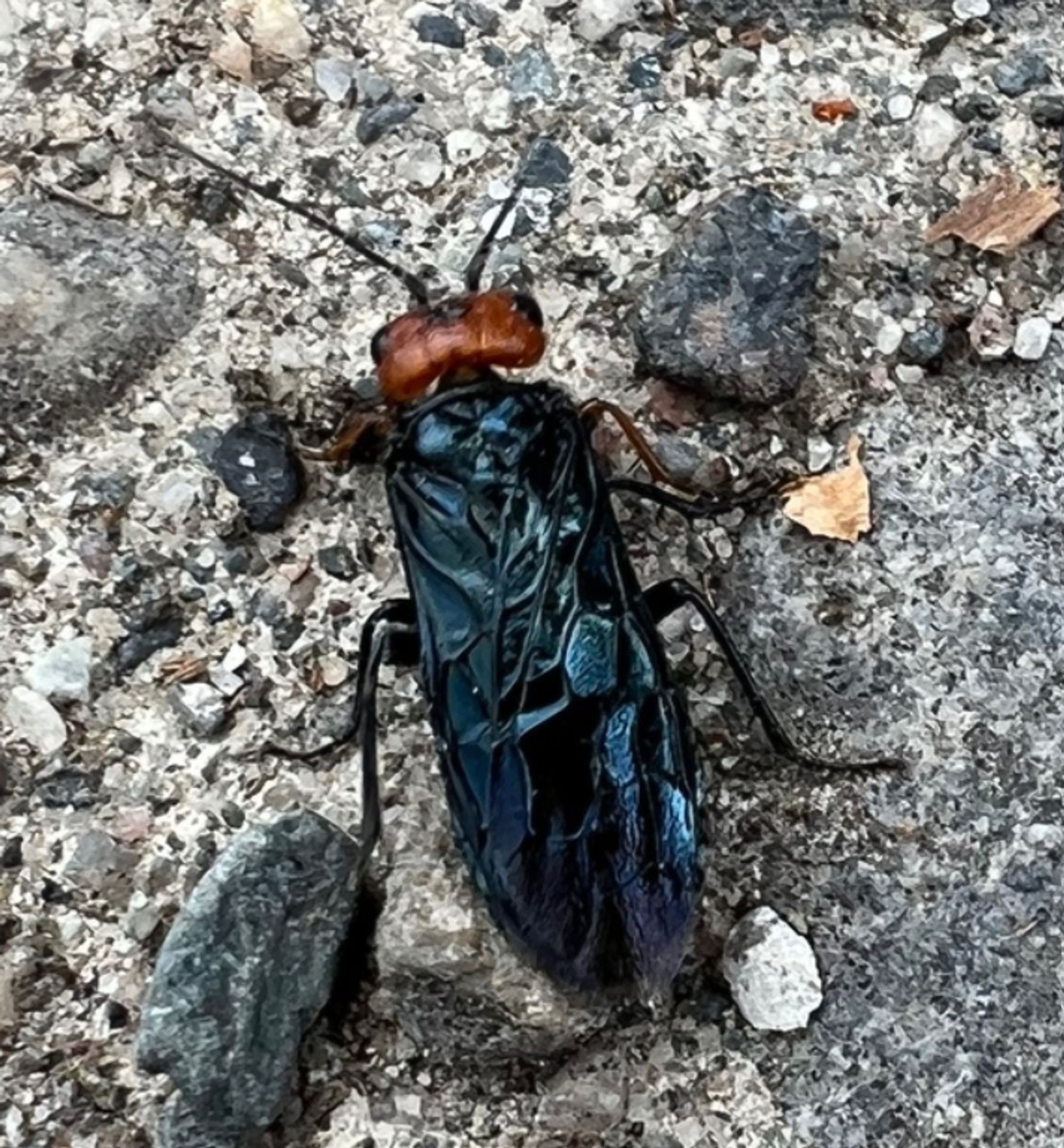
Acantholyda erythrocephala is a in the Pamphiliidae, native to Europe and introduced to North America in 1925, where it became an pest of pine trees. The is commonly known as the red-headed pine sawfly or pine false webworm. Its larvae construct distinctive silken tubes for feeding and shelter, causing defoliation of trees. The species has been the target of efforts using flies and viral agents.
Pronunciation
How to pronounce Acantholyda erythrocephala: /əˌkænθəˈlɪdə ɛˌrɪθroʊˈsɛfələ/
These audio files are automatically generated. While they are not always 100% accurate, they are a good starting point.
Identification
Larvae are distinguished by their yellowish with dark brown spots and greenish-grey bodies bearing purplish longitudinal stripes dorsally and laterally. The silken webbing and tube-dwelling are diagnostic. emerge in late spring, which helps distinguish this from other pine-feeding with different phenologies.
Images
Habitat
Pine forests and plantations, particularly those containing white pine (Pinus strobus), Scots pine (Pinus sylvestris), and red pine (Pinus resinosa).
Distribution
Native to Europe; introduced to North America in 1925 and now widespread in northern United States and Canada.
Seasonality
emerge in late spring. Larvae feed through late spring and early summer, with full development reached by end of June. Larvae overwinter in earthen in the ground.
Diet
Larvae feed on pine needles, preferentially on previous year's needles before moving to new growth if old needles are exhausted. include white pine (Pinus strobus), Scots pine (Pinus sylvestris), and red pine (Pinus resinosa).
Host Associations
- Pinus strobus - major pest
- Pinus sylvestris -
- Pinus resinosa -
Life Cycle
Females lay on previous year's needles. Eggs hatch in approximately two weeks. Larvae feed at the base of old needles, constructing silken tubes in which they live; older larvae construct individual tubes. By end of June, fully developed larvae fall to ground and create earthen to overwinter. emerge the following late spring.
Behavior
Larvae construct silken webbing and live in tubes, chewing off pine needles and pulling them inside for consumption. Tubes accumulate needle fragments, cast skins, and . Older larvae construct their own individual tubes rather than sharing communal webbing.
Ecological Role
Defoliator of pine trees. Defoliation does not directly kill trees but weakens them, predisposing them to attack by and bark beetles, which may cause mortality. In Europe, larvae are attacked by the tachinid fly Myxexoristops hertingi.
Human Relevance
Major pest of commercially important pine plantations in North America. Subject of programs, including releases of the fly Myxexoristops hertingi in Ontario and trials with Neodiprion abietis (NeabNPV).
Similar Taxa
- Other Acantholyda speciesMay share pine-feeding habits but differ in larval coloration and spotting patterns; A. erythrocephala specifically has yellowish heads with dark brown spots and purplish longitudinal stripes on the body.
- Other Pamphiliidae sawfliesMay construct silken webs, but A. erythrocephala is distinguished by its specific associations with Pinus and its introduced status in North America.
More Details
Bacterial associates
A 2008 study identified Pseudomonas spp., , and Arthrobacter sp. as predominant bacterial components associated with all life stages. Life-stage-specific associations include Photorhabdus temperata with and larvae, Janthinobacterium sp. with eonymphs, and Chryseobacterium sp. predominant at all stages except .
Biological control history
Between 2002 and 2004, pupae of Myxexoristops hertingi were imported from Italy and released in Ontario, Canada. Evaluation was complicated by natural fluctuations of the . Trials with NeabNPV reduced larval survival by approximately 50% but results were inconclusive.