
Pamphiliidae
Cameron, 1890
Web-spinning sawflies, Leaf-rolling sawflies
Subfamily Guides
2- Cephalciinae
- Pamphiliinae(leaf-rolling sawflies)
is a of in the suborder containing approximately 200 distributed across temperate regions of North America and Eurasia. The family is divided into three : Cephalciinae, Juralydinae (extinct), and Pamphiliinae. Larvae are herbivorous, feeding on plants using silk to construct webs, tents, or leaf rolls for protection. The family is distinguished from the closely related Megalodontesidae by simple, . Fossil records extend to the Jurassic period.
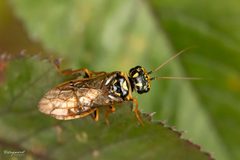
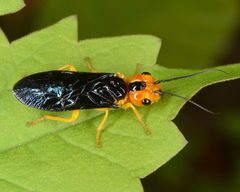
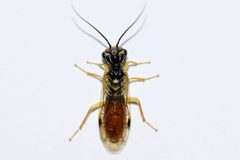
Pronunciation
How to pronounce Pamphiliidae: //ˌpæmˈfɪli.aɪdiː//
These audio files are automatically generated. While they are not always 100% accurate, they are a good starting point.
Identification
can be distinguished from Megalodontesidae by their simple, . Within the , the three are distinguished by phylogenetic analysis of morphological characters. can be separated by combinations of morphological features; keys exist for regional faunas including the Nearctic Neurotoma and European Pamphilius vafer complex.
Images
Habitat
Larvae occur on plants in forests, plantations, and natural woodlands. Host plants include conifers (pine, spruce, cedar), oaks, and various angiosperms including Rosaceae (Rubus, Rosa, Padus, Crataegus), Viburnum, Cornus, and Astilbe. Larvae construct silk shelters on host foliage.
Distribution
Temperate regions of North America and Eurasia. Documented in northeastern and north-central United States (Connecticut, Massachusetts, Maine, New Hampshire, New Jersey, New York, Pennsylvania, Vermont, Wisconsin), Canadian provinces (Alberta, Newfoundland, Ontario), and across Europe and Asia including China, Japan, Lebanon, and Italy.
Seasonality
typically occurs in spring and early summer. For Acantholyda erythrocephala, emergence extends from early May to early June. Pamphilius ochreipes emerges in late May and early June. Larval feeding occurs primarily in June.
Diet
Larvae feed on plant foliage. plants include Pinaceae (Pinus resinosa, P. strobus, Picea, Cedrus libani), Fagaceae (Quercus rubra), Rosaceae (Rubus spp., Rosa multiflora, Padus obtusata, Crataegus spp.), Viburnum opulus (Adoxaceae), Cornus spp. (Cornaceae), and Astilbe spp. (Saxifragaceae).
Host Associations
- Pinus resinosa - larval red pine
- Pinus strobus - larval white pine, preferred in northern New York
- Picea - larval spruce
- Cedrus libani - larval cedar of Lebanon
- Quercus rubra - larval northern red oak
- Rubus inopertus - larval for Onycholyda xanthogaster
- Rubus hirsutus - larval for Onycholyda fulvicornis
- Rubus peltatus - larval for Onycholyda atra
- Rosa multiflora - larval for Pamphilius palliceps
- Padus obtusata - larval for Pamphilius padus
- Crataegus - larval for Neurotoma crataegi
- Viburnum opulus - larval for Pamphilius ochreipes
- Cornus - larval for Pamphilius japonicus
- Astilbe - larval for Pamphilius ishikawai, first Saxifragaceae record for
- Steinernema sp. - found in Acantholyda erythrocephala
- Homaspis interruptus - ichneumonid of Acantholyda erythrocephala larvae
- Homaspis rufinus - ichneumonid larval of Cephalcia spp.
- Homaspis narrator - ichneumonid larval of Cephalcia spp.
- Sinophorus crassifemur - ichneumonid larval of Cephalcia spp.
- Olesicampe monticola - ichneumonid larval of Cephalcia spp.
- Xenoschesis fulvipes - ichneumonid larval of Cephalcia spp.
- Myxexoristops abietis - tachinid larval of Cephalcia spp.
- Clonostachys rosea - fungus from Cephalcia chuxiongica
Life Cycle
Development includes , larval, prepupal, and stages. Larvae feed on foliage, often for approximately 6 weeks. enter soil to overwinter. Some exhibit extended : Acantholyda erythrocephala shows 9-66% of prepupae remaining in soil for more than one year; Cephalcia arvensis has , , and rare triennial individuals. Longer-cycle individuals tend to be larger and more fecund. Pamphilius ochreipes is , as larva in soil.
Behavior
Larvae use silk to construct protective structures: communal webs or tents (web-spinning sawflies) or individual leaf rolls or tubes (leaf-rolling sawflies). Some are gregarious with larvae living in large groups. are . Females of some species oviposit preferentially on portions of branches and lower crown sections.
Ecological Role
Herbivores that can cause significant defoliation of trees during . Serve as prey for diverse complexes including ichneumonid wasps and tachinid flies. Host and fungi. include extended as a strategy.
Human Relevance
Some are forest pests during . Acantholyda erythrocephala (pine false webworm) caused an unprecedented sustained outbreak affecting 5440 hectares of white pine in northern New York from 1981-1995. Cephalcia species cause outbreaks in European spruce forests. Larval silk production and leaf-rolling make them subjects of ecological and behavioral study.
Similar Taxa
- MegalodontesidaeClosely related distinguished by complex, often serrate or pectinate versus the simple antennae of
Misconceptions
name is sometimes incorrectly spelled 'Pamphilidae' (missing the second 'i').
More Details
Taxonomic Structure
Three recognized: Cephalciinae (Acantholyda, Cephalcia, Caenolyda, Chinolyda), Juralydinae (extinct: Juralyda, Atocus, Scabolyda, Tapholyda, plus extant Neurotoma), and Pamphiliinae (Pamphilius, Onycholyda, Chrysolyda, Kelidoptera, Pseudocephaleia).
Fossil Record
extends to Jurassic period with extinct Juralydinae. Early Eocene fossils from Okanagan Highlands (Ulteramus republicensis) represent some of the oldest confirmed occurrences.
Oviposition Behavior
Females of Acantholyda erythrocephala oviposit on pine needle fascicles with significant preference for third of branches and lower third of crown. Potential is linearly related to body mass; prior year defoliation inversely affects adult size and fecundity.
Genetic Studies
COI has been used to associate larvae with and identify new , particularly in Chinese Onycholyda and Japanese Pamphilius species.
Sources and further reading
- BugGuide
- Wikipedia
- GBIF taxonomy match
- iNaturalist taxon
- NCBI Taxonomy
- Catalogue of Life
- OVIPOSITION AND FECUNDITY OF PINE FALSE WEBWORM (HYMENOPTERA: PAMPHILIIDAE)
- BIOLOGY OF PINE FALSE WEBWORM (HYMENOPTERA: PAMPHILIIDAE) DURING AN OUTBREAK
- Untersuchungen über die Fichtengespinstblattwespen Cephalcia spp. Panz. (Hym., Pamphiliidae)
- History of a pine false webworm (Hymenoptera: Pamphiliidae) outbreak in northern New York
- Leaf-rolling sawflies (Hymenoptera, Pamphiliidae, Pamphiliinae) of Tianmushan Mountains, Zhejiang Province, China
- A new species of Acantholyda (Hymenoptera: Pamphiliidae) from Lebanon, associated with Cedrus libani (Pinaceae)
- Leaf-rolling Sawflies of the Pamphilius vafer complex (Hymenoptera, Pamphiliidae) in Europe
- Pamphilius japonicus feeds on Cornus: the first Old World record of Pamphiliidae (Hymenoptera) associated with Cornaceae
- THE NEARCTIC SAWFLIES OF THE GENUS NEUROTOMA (HYMENOPTERA, PAMPHILIIDAE)
- DNA Barcodes Identify the Larvae and Unassociated Male of Three Onycholyda Sawflies (Hymenoptera, Pamphiliidae) from China
- AN OUTBREAK OF A SAWFLY, PAMPHILIUS PHYLLISAE (HYMENOPTERA: PAMPHILIIDAE), ON NORTHERN RED OAK, WITH NOTES ON LARVAL MORPHOLOGY
- A STUDY OF THE BIOLOGY OF THE WEB-SPINNING SAWFLY PAMPHILIUS OCHREIPES (HYMENOPTERA: PAMPHILIIDAE) IN ONTARIO
- New early Eocene Siricomorpha (Hymenoptera: Symphyta: Pamphiliidae, Siricidae, Cephidae) from the Okanagan Highlands, western North America
- Bionomics of the spruce web‐spinning sawfly Cephalcia arvensis Panzer (Hym., Pamphiliidae) in Northeastern Italy
- Pamphilius ishikawai feeds on Astilbe: the first record of Pamphiliidae (Hymenoptera) associated with Saxifragaceae
- Analysis of Toxic Components in Secondary Metabolites of Entomopathogenic Fungi Clonostachys rosea (Hipocreales: Bionectriaceae) from Cephalcia chuxiongica (Hymenoptera: Pamphiliidae).