
Colpotrochia trifasciata
(Cresson, 1864)
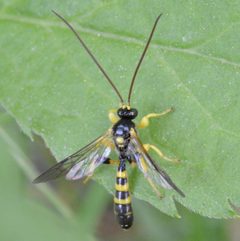
A small ichneumon in the Metopiinae, averaging 6-10 millimeters in body length. Females possess a very short ovipositor used to lay in caterpillars, particularly leafrollers in the Tortricidae. The wasp larva develops inside the , consuming it without disrupting the caterpillar's until after it pupates; an wasp emerges from the host pupa rather than a . One of two Colpotrochia recorded in Massachusetts, with a range extending from the Atlantic coast to barely west of the Mississippi River.
Pronunciation
How to pronounce Colpotrochia trifasciata: //ˌkɒlpəˈtroʊkiə ˌtraɪˌfæʃiˈeɪtə//
These audio files are automatically generated. While they are not always 100% accurate, they are a good starting point.
Identification
One of four North American in the Colpotrochia, distinguished from C. crassipes by subtle morphological features best determined by examination. Members of Metopiinae can be distinguished from other ichneumonid subfamilies using the identification key by Gavin Broad. The genus is characterized by the metopiine trait of laying in larvae and emerging from host pupae.
Images
Habitat
Found near outdoor lights at night in small towns, including on buildings such as police stations and post offices.
Distribution
Eastern North America, ranging from the Atlantic coast to barely west of the Mississippi River. Recorded in Massachusetts.
Seasonality
Active in June; observed at outdoor lights on June 23, 2009 in South Deerfield, Massachusetts.
Diet
The larva feeds on caterpillars of leafroller moths ( Tortricidae), developing internally as a .
Host Associations
- Tortricidae - leafroller caterpillars
Life Cycle
Female lays in caterpillar using short ovipositor; larva consumes host from within without killing it immediately; emerges from host pupa after caterpillar pupates.
Behavior
Attracted to outdoor artificial lights at night.
Ecological Role
of caterpillars, contributing to regulation of leafroller .
Human Relevance
Potential agent for leafroller pests; of interest to hymenopterists and naturalists attracted to outdoor lighting for insect observation.
Similar Taxa
- Colpotrochia crassipesCo-occurs in Massachusetts; both in same with similar size range (6-10 mm) and ; requires examination to distinguish.
- Other MetopiinaeShare the trait of emerging from pupae rather than larva; distinguished by -level and -level morphological characters.
Sources and further reading
- BugGuide
- GBIF taxonomy match
- iNaturalist taxon
- NCBI Taxonomy
- Catalogue of Life
- Bug Eric: April 2011
- Halloween ID challenge answer – Argiope trifasciata | Beetles In The Bush
- Bug Eric: Spider Sunday: Banded Argiope
- A truly disturbed garden spider | Beetles In The Bush
- Tiger Beetles at Florida’s “Road to Nowhere” | Beetles In The Bush