
Metopiinae
Shannon, 1924
Genus Guides
10Metopiinae is a of ichneumonid wasps containing 26 extant . Members are koinobiont endoparasitoids of Lepidoptera larvae, with many attacking leaf-rolling caterpillars. The subfamily is characterized by distinctive facial , though this trait is not universal across all genera.
Pronunciation
How to pronounce Metopiinae: /mɛˈtoʊpiˌaɪni/
These audio files are automatically generated. While they are not always 100% accurate, they are a good starting point.
Identification
The bulging, convex lacking a groove between face and is diagnostic when present, though many members lack this character. The triangular facial process between (in most ), stout legs, and short ovipositor aid identification. Larger may be distinguished from similar mimetic by their buzzing when captured and ichneumonid wing venation. For -level identification, consult illustrated keys to Ichneumonidae subfamilies.
Images
Appearance
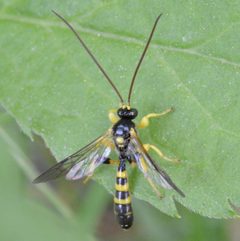
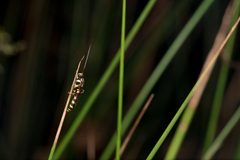
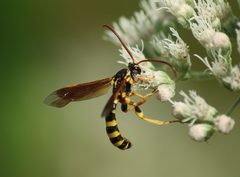
Most are medium to large ichneumonids. Many possess a bulging, shield-like with no groove separating the face from the ; in most , the upper face forms a triangular process extending between the . Stout, robust legs are common. Ovipositors are generally short relative to body size. Larger species may exhibit aposematic coloration with yellow-black patterns resembling .
Habitat
Found in diverse terrestrial worldwide. Documented from midland undisturbed forest habitats including tropical rainforests, Atlantic semi-deciduous forest, Amazonian forest, and cerrado. Many are associated with vegetation supporting leaf-rolling caterpillars. frequently observed at artificial lights at night.
Distribution
distribution with records from all zoogeographical regions except unconfirmed presence in Afrotropics for some . Documented from North America (Atlantic coast to west of Mississippi River), Central America ( Rica, Panama, Guatemala, Belize, Nicaragua, Honduras), South America (Brazil, Ecuador, Venezuela, Peru, Argentina, Bolivia, Colombia, French Guiana, Suriname, Curaçao, Saint Vincent and the Grenadines), Europe, Asia (Türkiye, South Korea, Japan, India, Western Ghats, Eastern Himalayas), and the Neotropical region broadly.
Host Associations
- Lepidoptera larvae - koinobiont endoparasitoidprimary ; laid in host larva, emerges from host pupa
- Crambidae - leaf-rolling caterpillars; documented for Cubus and Leurus in Rica
- Tortricidae - leafrollers; documented for Colpotrochia
- Geometridae - documented for Colpotrochia japi reared from Opisthoxia farantes
- Noctuidae - known for Colpotrochia
- Erebidae - known for Colpotrochia
- Notodontidae - known for Colpotrochia
Life Cycle
Koinobiont endoparasitoid development: females oviposit into larval stage of caterpillar. larva develops internally, allowing host to continue development and pupate. Wasp emerges as fully developed from host pupa. Development time approximately 31 days from host to wasp has been observed. remains within host pupal case for protection until emergence. Solitary parasitoid; single wasp emerges per host.
Behavior
Females use stout legs and smooth to push into leaf rolls to access with their short ovipositors. females have been observed biting hosts to feed on . Some larger produce buzzing noises when captured, possibly as defensive mimicry of . Adults are and attracted to artificial lights.
Ecological Role
of lepidopteran larvae, particularly leaf-rolling and leaf-rolling caterpillars. Contributes to regulation of caterpillar in forest and agricultural . High cryptic diversity documented in tropical regions suggests substantial undescribed contribution to complexity.
Human Relevance
Potential agents for caterpillar pests, particularly leafroller affecting orchards and forests. Gardeners may benefit from their of caterpillar pests. No documented negative impacts on humans.
Similar Taxa
- other Ichneumonidae subfamiliesMetopiinae distinguished by bulging , triangular facial process (when present), stout legs, and short ovipositor; other typically have grooved face, slender legs, or longer ovipositors
- BraconidaeSimilar lifestyle but separated by wing venation, segment number, and other ichneumonid vs. braconid diagnostic characters; Metopiinae specifically distinguished by facial
- Vespidae (aculeate wasps)Larger Metopiinae mimic in coloration and buzzing , but lack stinger, have ichneumonid wing venation, and typically longer with more segments
More Details
Cryptic diversity
studies in Rica have revealed extensive cryptic diversity, with 11 new sympatric Cubus and 10 new Leurus species described from what appeared to be single species based on alone.
Taxonomic challenges
The exhibits significant morphological variability; the diagnostic bulging is absent in many , complicating identification. Oriental region contains 113 in 24 genera, but only 24 species in 8 genera reported from India, suggesting incomplete sampling.
Sources and further reading
- BugGuide
- Wikipedia
- iNaturalist taxon
- NCBI Taxonomy
- Catalogue of Life
- Bug Eric: Wasp Wednesday: Colpotrochia
- New Parasitoid Wasp Species Discovered in South Korea
- Seticornuta koreana Archives - Entomology Today
- New species of Metopiinae (Hymenoptera, Ichneumonidae) from Brazil
- New country records of the Metopiinae (Hymenoptera: Ichneumonidae) in the Neotropical region
- New species of Colpotrochia Holmgren (Hymenoptera, Ichneumonidae, Metopiinae) from Brazil, with biological notes
- A new Darwin wasp genus, Soliga (Hymenoptera: Ichneumonidae: Metopiinae), from India
- A taxonomical and biogeographical analysis of the fauna Metopiinae (Hymenoptera: Ichneumonidae) of Türkiye
- First record of Seticornuta Morley (Hymenoptera, Ichneumonidae, Metopiinae) from Brazil and description of a new species
- Review of the parasitoid genus Synosis Townes, 1959 (Hymenoptera: Ichneumonidae: Metopiinae) in the Neotropical region, with a key to species
- Review of the subgenera Metopius Panzer and Peltastes Illiger of the genus Metopius Panzer (Hymenoptera: Ichneumonidae: Metopiinae) from Japan
- Endoparasitoid wasps of the genus Cubus (Hymenoptera, Ichneumonidae, Metopiinae) reared from caterpillars of Área de Conservación Guanacaste, Costa Rica
- Cryptic diversity of Leurus wasps (Hymenoptera: Ichneumonidae: Metopiinae), parasitoids of caterpillars in Area de Conservación Guanacaste, Costa Rica
- New species of Exochus Gravenhorst and Trieces Townes (Hymenoptera, Ichneumonidae, Metopiinae) and first record of seven species from Brazil
- Descriptions of Three New Species of the Genus Acerataspis Uchida, 1934 (Hymenoptera, Ichneumonidae, Metopiinae), with an Illustrated Identification Key to Extant Species.