
Colpotrochia crassipes
(Provancher, 1886)
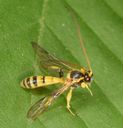
Colpotrochia crassipes is a small ichneumon in the Metopiinae. Females parasitize caterpillars, particularly leafrollers in the Tortricidae, by laying using a short ovipositor. The wasp larva develops inside the caterpillar, completing its growth after the host pupates and emerging from the host pupa instead of the expected . The occurs in eastern North America from the Atlantic coast westward to approximately the Mississippi River.
Pronunciation
How to pronounce Colpotrochia crassipes: //kɔlpoʊˈtroʊkiə ˈkræsɪˌpiːz//
These audio files are automatically generated. While they are not always 100% accurate, they are a good starting point.
Identification
Colpotrochia crassipes is one of two Colpotrochia recorded in Massachusetts, alongside C. trifasciata. are small, measuring 6–10 mm in body length. The can be recognized within the Metopiinae by features detailed in ichneumonid identification keys. Specific distinguishing characters separating C. crassipes from C. trifasciata require examination of detailed morphological features not summarized in available sources.
Images
Distribution
Eastern North America, ranging from the Atlantic coast west to approximately the Mississippi River. Documented in Massachusetts and occurs broadly across the eastern United States.
Diet
females parasitize caterpillars, with Tortricidae (leafroller moths) documented as . The larva feeds internally on the host, consuming it after the host pupates.
Host Associations
- Tortricidae - leafroller caterpillars
Life Cycle
Females use a short ovipositor to lay in caterpillar . The larva hatches and develops internally, avoiding disruption of the host's until after . The wasp emerges from the host pupa rather than the emerging.
Behavior
Females have been observed at outdoor lights at night, suggesting or activity patterns. likely visit flowers for nectar, as is common in the , though this has not been explicitly documented for this .
Ecological Role
of caterpillars, contributing to of Tortricidae. As a koinobiont parasitoid, it allows the to continue development until , maintaining the host's ecological functions until the completes its own development.
Human Relevance
agent of leafroller caterpillars, which can be agricultural or horticultural pests. The is too small to attract significant attention from the general public.
Similar Taxa
- Colpotrochia trifasciataCo-occurs in Massachusetts and other parts of the range; both are small Metopiinae ichneumonids with similar . Requires detailed morphological examination to distinguish.
- Other MetopiinaeShare the general habitus of small ichneumonids with short ovipositors and caterpillar . Identification to level requires use of technical keys.
More Details
Subfamily characteristics
All members of Metopiinae are koinobiont endoparasitoids of caterpillars, emerging from the pupa. This strategy is consistent across the and distinguishes them from many other ichneumonid subfamilies.
Sources and further reading
- BugGuide
- Wikipedia
- GBIF taxonomy match
- iNaturalist taxon
- NCBI Taxonomy
- Catalogue of Life
- Emily Bick: Salinity, the Water Hyacinth and a Weevil | Bug Squad
- Bug Eric: April 2011
- Bee Assassin on Coneflower | Beetles In The Bush
- How to Become a Vulture: Tropical Bees and Their Gut Microbes
- Milichiideae | Beetles In The Bush