
Buathra laborator
(Thunberg, 1822)
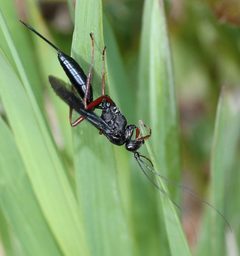
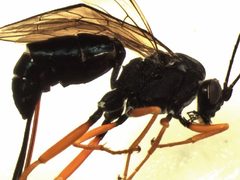
Buathra laborator is a large, conspicuous ichneumonid (Darwin wasp) in the Cryptinae, common and widespread across Britain. Both sexes are predominantly black with red legs; females possess a long ovipositor, while males display distinctive white facial markings and white hind . The is frequently observed in open areas on flowers during its April–August period. Despite its abundance and visibility, it has never been successfully reared in Europe, and its associations remain poorly documented.
Pronunciation
How to pronounce Buathra laborator: /buˈa.θra la.bɔˈra.tor/
These audio files are automatically generated. While they are not always 100% accurate, they are a good starting point.
Identification
Images
Appearance
Large-bodied ichneumonid with predominantly black coloration. Legs are red in both sexes. Females possess a notably long ovipositor. Males distinguished by bright white markings on the and white hind .
Habitat
Open areas, frequently observed on flowers.
Distribution
Common and widespread across Britain; also occurs across Europe, temperate Asia, and North America. Museum collections demonstrate wide British distribution.
Seasonality
period from April to August.
Host Associations
- Melanolophia imitata - Western Carpet ; only confirmed rearing record from North America, pupates in leaf litter
Behavior
Often observed visiting flowers in open . Conspicuous due to large size. Despite abundance, has never been reared in Europe.
Ecological Role
Idiobiont ectoparasitoid of cocooned pupae hidden in soil or leaf litter. are permanently paralyzed; larva feeds externally on host.
Human Relevance
Subject of sequencing research; genome assembly of 330 Mb from a female collected in Hartslock, UK, with 68.92% scaffolded into 11 chromosomal pseudomolecules.
Similar Taxa
- Buathra tarsoleucosSimilar appearance; separation requires close examination of female ovipositor tip or male propodeum details. B. tarsoleucos is known to parasitize sand wasp pupae.
- Cryptus spp.Usually smaller than B. laborator; can be confused in the field due to general morphological similarity within Cryptinae.
Misconceptions
European records in literature appear to relate to misidentifications; the only confirmed host association is from North America, making published European host data unreliable.
More Details
Host Association Uncertainty
The only confirmed record is from North America (Melanolophia imitata). European host records are considered unreliable due to misidentifications. Host is inferred from related , particularly B. tarsoleucos.
Genomic Resources
assembly available: 330 Mb total size, 68.92% scaffolded into 11 chromosomal pseudomolecules, derived from a female specimen collected at Hartslock, UK.
Sources and further reading
- BugGuide
- GBIF taxonomy match
- iNaturalist taxon
- NCBI Taxonomy
- Catalogue of Life
- UC Davis Seminar Speaker to Share Honey Bee Research | Bug Squad
- Big Balloon Battle at Briggs: Just Call It '15 Minutes of Aim' | Bug Squad
- Addie Abrams Targeting Aphids and Thrips in California Lettuce | Bug Squad
- Congrats to the Two 'Jakes' from the Rachel Vannette Lab | Bug Squad
- Researchers Propose Standardized Naming of Lab-Reared Insect Stocks
- Study Shows Rapid Evolution in Lab-Reared Insects
- The genome sequence of the ichneumon wasp Buathra laborator (Thunberg, 1822).