
Buathra
Cameron, 1903
Species Guides
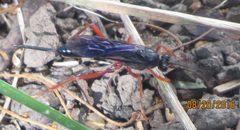
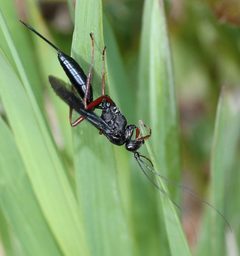
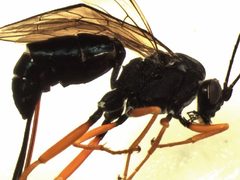
2Buathra is a of ichneumonid wasps in the Cryptinae, established by Cameron in 1903. The genus includes conspicuous, large-bodied found in open across the Northern Hemisphere. Best known member Buathra laborator is among the largest Cryptinae species in Britain, with both sexes black and red-legged; males display distinctive bright white facial markings. The genus comprises idiobiont ectoparasitoids, with larvae feeding externally on paralyzed pupae. Host associations remain poorly documented for most species; B. laborator has never been reared in Europe despite being common and widespread, while related B. tarsoleuca parasitizes sphecid pupae.
Pronunciation
How to pronounce Buathra: //ˈbwɑːθrə//
These audio files are automatically generated. While they are not always 100% accurate, they are a good starting point.
Images
Habitat
Open areas; frequently observed on flowers. are cocooned pupae hidden in soil.
Distribution
Europe (including Britain, Denmark, Norway, Sweden), temperate Asia, and North America.
Seasonality
period April to August (based on B. laborator records).
Host Associations
- Melanolophia imitata (Geometridae) - single American rearing record for B. laborator; European records appear to be misidentifications
- Ammophila sabulosa (Sphecidae) - confirmed for B. tarsoleuca; host pupae in soil nests
- Podalonia affinis (Sphecidae) - confirmed for B. tarsoleuca; host pupae in soil nests
Life Cycle
Idiobiont ectoparasitoid: permanently paralyzed, larva feeds externally on host pupae. Hosts are cocooned pupae concealed in soil.
Behavior
detection involves distinctive behavioral patterns characterized through frame-by-frame video analysis for B. tarsoleuca. are conspicuous in open . Males of B. laborator have bright white facial markings and white markings on the hind .
Ecological Role
of or pupae; potential agent.
Similar Taxa
- Cryptussimilar appearance; B. laborator frequently confused with Cryptus
- Buathra tarsoleucacongeneric with overlapping distribution; distinguished by tarsal coloration (B. laborator has red legs, B. tarsoleuca has pale/white hind )
- Meringopus calescenspossible of same sphecid
Sources and further reading
- BugGuide
- GBIF taxonomy match
- iNaturalist taxon
- NCBI Taxonomy
- Catalogue of Life
- A Note on Host Detection by Buathra tarsoleuca (Schrank) (Hymenoptera: Ichneumonidae), a Parasite of Ammophila sabulosa (L.) and Podalonia affinis (Kirby) (Hymenoptera: Sphecidae)
- The genome sequence of the ichneumon wasp Buathra laborator (Thunberg, 1822).