
Agrothereutes
Förster, 1850
Species Guides
3Agrothereutes is a of in the Ichneumonidae, containing over 40 described . Members are solitary ectoparasitoids that attack concealed lepidopteran , primarily targeting prepupal and pupal stages. Several species have been studied for their host relationships and reproductive , including A. lanceolatus and A. minousubae. The genus exhibits facultative and variable voltinism, with some producing one or two annually.
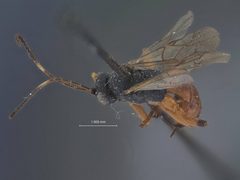
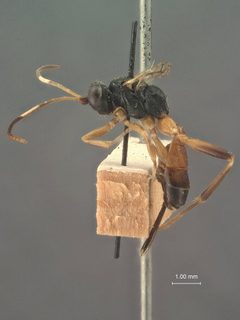

Pronunciation
How to pronounce Agrothereutes: //ˌæɡroʊˈθiːrjuːtiːz//
These audio files are automatically generated. While they are not always 100% accurate, they are a good starting point.
Images
Distribution
Records from Denmark (DK), Norway (NO), and Sweden (SE) exist in GBIF. Distribution for the as a whole is insufficiently documented beyond these northern European localities.
Seasonality
In A. minousubae, occurs in late April with partial second eclosion in early June; the exhibits an extended period of 10–11 months due to aestivo-hibernation. Photoperiodic response for induction shows a critical of 13 hr 40 min at 20°C.
Host Associations
- Lepidoptera - primary prepupal and pupal stages of concealed larvae; A. lanceolatus uses pyralids and tortricids, A. minousubae uses Zygaenidae (Pryeria sinica), A. hospes uses Pyralidae (Galleria mellonella)
Life Cycle
Solitary ectoparasitoid development. , larval, prepupal and pupal stages require thermal accumulation: approximately 19, 120, 82 and 112 above 7°C respectively in A. minousubae. is facultative and occurs in the eonymphal stage. Some exhibit or cycles with extended dormancy.
Behavior
Ectoparasitic on externally concealed stages. A. lanceolatus has been observed to accept hosts for oviposition differentially based on female body size, with larger females accepting more hosts. Host-feeding occurs in females. A. lanceolatus shows atypical use of pupal stage hosts, diverging from the pattern of attacking prepupal stages.
Ecological Role
Solitary ectoparasitoid regulating of lepidopteran larvae and pupae. Acts as a agent for concealed-feeding .
Human Relevance
Potential for of pest including wax moth (Galleria mellonella) and tortricid fruit pests. Laboratory rearing protocols have been developed for some .
Sources and further reading
- BugGuide
- Wikipedia
- GBIF taxonomy match
- iNaturalist taxon
- NCBI Taxonomy
- Catalogue of Life
- A survey of the Agrothereutes hospes, an ectoparasitoid on wax moth Galleria mellonella
- Adult size and reproduction in the ectoparasitoid Agrothereutes lanceolatus Walker (Hym., Ichneumonidae)
- Unexpected Use of Pupal Stage of a Lepidopteran Host by the Ectoparasitoid Wasp Agrothereutes lanceolatus (Hymenoptera: Ichneumonidae)
- Biology of the Ectoparasitoid Wasp Agrothereutes lanceolatus (Hymenoptera : Ichineumonidae) : Host Acceptance and Larval Development on a Laboratory Host
- One host—one parasitoid system: Seasonal life cycles of Pryeria sinica (Ledipoptera) and Agrothereutes Minousubae (Hymenoptera)
- Effects of host size and laboratory rearing on offspring development and sex ratio in the solitary parasitoid Agrothereutes lanceolatus (Hymenoptera: Ichneumonidae)