
Pryeria sinica
Moore, 1877
euonymus leaf notcher, euonymus defoliator moth
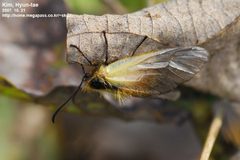
Pryeria sinica is a zygaenid native to East Asia, introduced to the United States in 2002 where it has established in Maryland and Virginia. The is a herbivore of Celastraceae, particularly Euonymus species, where larvae feed gregariously and create distinctive marginal notches on leaves. are mimics with clear wings and aposematic coloration. The species has been reported more recently in the United Kingdom.

Pronunciation
How to pronounce Pryeria sinica: //praɪˈɛriə ˈsɪnɪkə//
These audio files are automatically generated. While they are not always 100% accurate, they are a good starting point.
Identification
Larval feeding damage is diagnostic: marginal notches along leaf edges and coarsely shredded leaves, often with accumulated beneath plants. Larvae are gregarious and found in large clusters. are distinguished from other zygaenids by their activity, -mimicking coloration (black and orange body patches), and largely clear wings with yellow basal scaling. The can be distinguished from native clearwing moths (Sesiidae) by its zygaenid body structure and specific wing pattern.
Images
Habitat
Associated with cultivated and ornamental plantings of Euonymus and Celastrus . In its native range, occurs in undisturbed supporting plants. In the introduced range, primarily found in suburban and urban landscapes, commercial nurseries, and residential plantings.
Distribution
Native to East Asia: eastern Russia, China, Korea, Japan, and Taiwan. Introduced to the United States, where established in Maryland (Anne Arundel, Prince George's, Baltimore, Carroll, and Baltimore City counties) and Virginia (Fairfax and Prince William counties). Recently reported from the United Kingdom.
Seasonality
. fly, mate, and oviposit in late October through November and December. overwinter and hatch in mid-March to early April. Larval development occurs through spring, with and pupae present from mid-April to early June. Adult occurs in late autumn.
Diet
Larvae feed on of Euonymus (Celastraceae), including Euonymus alatus, E. fortunei, E. japonicus, E. kiautschovica, and E. sieboldianus, as well as Celastrus species including C. punctatus and C. orbiculatus. Early instars feed as leaf skeletonizers within silken webs; later instars feed as leaf notchers on expanded leaves.
Host Associations
- Euonymus alatus - larval food plantNative Asian ; also used in introduced range
- Euonymus fortunei - larval food plantWidely cultivated ornamental
- Euonymus japonicus - larval food plantPrimary in both native and introduced ranges
- Euonymus kiautschovica - larval food plantCultivar 'Manhattan' reported in North America
- Euonymus sieboldianus - larval food plantNative Asian
- Celastrus punctatus - larval food plantNative Asian
- Celastrus orbiculatus - larval food plantOriental bittersweet; in North America
Life Cycle
cycle. overwinter on twigs and hatch in early spring. Larvae pass through four instars, developing in tight silken webs initially, then feeding gregariously on expanded leaves. Prepupal and pupal stages occur in silken cocoons in protected locations. emerge in autumn, mate, and females deposit egg clusters on plant terminals. Thermal requirements: approximately 85.6, 80.5, 85.2, 177.0, and 197.6 for first through fourth instars and prepupal stage respectively (above base temperature).
Behavior
Larvae are gregarious, feeding in groups and creating communal silken webbing at branch terminals. Early instars skeletonize folded leaves within webs; later instars notch leaf margins. Mature larvae wander from plants to locate sites. are and exhibit mimicry (), likely reducing by day-feeding birds. Adults do not feed.
Ecological Role
herbivore of Celastraceae. In its native range, are regulated by the ichneumonid Agrothereutes minousubae, which causes significant mortality in prepupal and pupal stages. The one- one-parasitoid relationship represents a tightly coupled trophic interaction. Larval chemical defense via cyanoglucoside storage in cuticular cavities provides protection against .
Human Relevance
Significant pest of ornamental Euonymus in landscapes and nurseries. Heavy can completely defoliate shrubs. Management options include mechanical removal of masses (pruning infested terminals December-March), hand removal of larval , or application of Bacillus thuringiensis kurstaki or spinosad-based . First detected in North America in 2002 in Fairfax, Virginia; subsequently spread through Maryland. Slow rate compared to other insects. Subject to monitoring and survey efforts by state agriculture departments.
Similar Taxa
- Sesiidae (clearwing moths) of some sesiids also have clear wings and -mimicking appearance, but differ in body shape, wing venation, and are not associated with Euonymus herbivory
- Other ZygaenidaeRelated zygaenids such as Zygaena trifolii share cyanogenic defense chemistry and cuticular cavity structure, but differ in larval coloration pattern, plant associations, and geographic distribution
More Details
Population Variation
Korean and Japanese show distinct morphological differences in distribution and wing venation, as well as variation in thermal and photoperiodic sensitivity. Korean populations exhibit optimal larval development at 15°C, while Japanese populations show higher mortality at this temperature during early instars but better in later stages.
Chemical Defense
Larvae possess two types of cuticular cavities homologous to those in Zygaena trifolii, used for storage of cyanogenic defensive secretions. The aposematic coloration (white with black stripes) warns of this chemical defense, though the pattern is not contiguous with the cavities as in some related .
Dispersal History
Remains one of the slowest-spreading insects in North America, having remained largely restricted to Maryland and Virginia for over 20 years since its 2002 detection, in contrast to rapid spread of such as emerald ash borer or spotted lanternfly.
Sources and further reading
- BugGuide
- Wikipedia
- GBIF taxonomy match
- iNaturalist taxon
- NCBI Taxonomy
- Catalogue of Life
- Anne Arundel County - This Bug's for You: The Euonymus Leaf Notcher, Pryeria sinica — Bug of the Week
- Euonymus peril - Euonymus leaf notcher, Pryeria sinica — Bug of the Week
- Look out Pennsylvania, an invasive pest is headed your way: Euonymus leaf- notcher, Pryeria sinica — Bug of the Week
- From the Bug of the Week mailbag – Be on the lookout for one slowly moving invasive pest: Euonymus leaf notcher, Pryeria sinica — Bug of the Week
- Yet another exotic invader: Euonymus leaf notcher, Pryeria sinicia — Bug of the Week
- Biology and Distribution of Pryeria sinica, a New Pest of Euonymus Found in Virginia and Maryland
- The structure and distribution of cyanoglucoside‐storing cuticular cavities in Pryeria sinica Moore (Lepidoptera, Zygaenidae)*
- One‐host one‐parasitoid system: Population dynamics of a zygaenid moth Pryeria sinica Moore in an undisturbed habitat
- Distinct Morphological Traits of Korean Populations of Pryeria sinica Moore (Lepidoptera: Zygaenidae) Associated With Regional Variation
- One host—one parasitoid system: Seasonal life cycles of Pryeria sinica (Ledipoptera) and Agrothereutes Minousubae (Hymenoptera)
- Population-level variation in thermal and photoperiodic responses of Pryeria sinica (Lepidoptera: Zygaenidae): a comparative study of Korean and Japanese populations