
Perilitus
Nees, 1818
Perilitus is a of braconid wasps whose are of beetles. Members of this genus have been documented attacking weevils (Curculionidae), lady beetles (Coccinellidae), and leaf beetles (Chrysomelidae). The genus exhibits notable developmental adaptations including teratocytes— derived from the embryonic that proliferate in the and serve as the principal larval food source. Some species have been investigated for applications against agricultural pests.
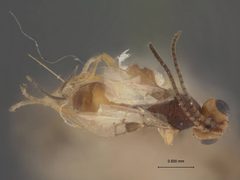
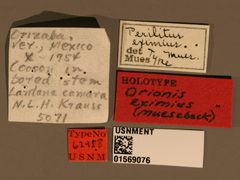
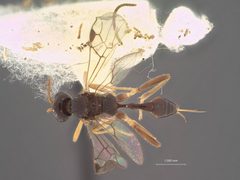
Pronunciation
How to pronounce Perilitus: //pɛˈrɪlɪtəs//
These audio files are automatically generated. While they are not always 100% accurate, they are a good starting point.
Identification
-level identification within Perilitus requires examination of morphological characters not consistently documented in available sources. The can be distinguished from related braconid genera by its association with and by the distinctive of teratocyte-mediated nutrition. Specimens should be compared with type material or authoritative keys for definitive identification.
Images
Habitat
occur in supporting their , including agricultural fields, meadows, and willow stands (Salix). Perilitus brevicollis has been studied specifically in association with Salix species.
Distribution
Documented from Europe (British Isles, widely distributed across the continent) and North America (Canada, United States including Missouri). GBIF records indicate presence in Denmark, Norway, and Sweden.
Seasonality
Activity patterns follow those of beetles. Seasonal synchrony has been documented between Perilitus coccinellae and its lady beetle hosts, with abundance tracking host .
Host Associations
- Coccinellidae (lady beetles) - Perilitus coccinellae attacks Coccinella septempunctata, C. novemnotata, Coleomegilla maculata lengi
- Curculionidae (weevils) - Perilitus rutilus parasitizes Sitona lineata and S. hispidula
- Chrysomelidae (leaf beetles) - Perilitus dubius parasitizes Phytodecta olivacea
Life Cycle
Females oviposit in the , typically at the apex. The expands dramatically after laying, increasing over 1000-fold in volume. Upon hatching, the larva releases teratocytes into the host hemocoel; approximately 550 have been counted in P. coccinellae. These cells absorb host and serve as the principal larval food source. Larval development is synchronized with host physiology, arresting at first instar in diapausing hosts and resuming when terminates. The mature larva emerges from the host to form a cocoon, with the host often remaining alive and attached to the cocoon by silk threads.
Behavior
Females actively pursue beetles assiduously until oviposition is accomplished. Host selection has been studied specifically in P. coccinellae. Developmental arrest in diapausing hosts and resumption upon termination represents synchronization with host physiology.
Ecological Role
Primary of beetles, with potential for of herbivorous . The teratocyte system represents a distinctive nutritional strategy that minimizes direct tissue damage to the during early parasitoid development.
Human Relevance
Several have been investigated or released as agents: P. rutilus and Microctonus aethiops were released in Canada against Sitona cylindricollis; P. brevicollis has been studied for biocontrol on Salix. P. coccinellae may impact beneficial lady beetle .
Similar Taxa
- DinocampusHistorically congeneric; P. coccinellae has been treated as Dinocampus terminatus and D. (Perilitus) rutilus was described as Dinocampus rutilus. The two share of beetles and teratocyte .
- MicroctonusAlso parasitizes Sitona weevils and has been used in similar programs; M. aethiops was released alongside P. rutilus in Canada.
More Details
Teratocyte biology
The embryonic (teratocytes) of Perilitus were historically misidentified as 'disorganised fat-body' of the . These cells dissociate, become globular and opaque white due to fatty inclusions, and are ingested by the developing larva. This system appears to be relatively uncommon among parasitic Hymenoptera.
Parthenogenesis
In P. rutilus, may occur with only males produced from unmated females ().
Sources and further reading
- BugGuide
- Wikipedia
- GBIF taxonomy match
- iNaturalist taxon
- NCBI Taxonomy
- Catalogue of Life
- Some Aspects of Host Selection by Perilitus coccinellae1
- Seasonal Synchrony of the Parasite Perilitus coccinellae1 and its Host Coleomegilla maculata2
- Perilitus coccinellae (Hymenoptera: Braconidae): Parasitization and Development in Relation to Host-stage Attacked
- Seasonal Abundance of Perilitus coccinellae1 and Its Coccinellid Hosts and Degree of Parasitism in Central Missouri
- Plant-mediated effects of different Salix species on the performance of the braconid parasitoid Perilitus brevicollis
- Importance of temperature for the performance and biocontrol efficiency of the parasitoid Perilitus brevicollis (Hymenoptera: Braconidae) on Salix
- Behavioral and anatomical responses of the convergent lady beetle to parasitism by Perilitus coccinellae (Schrank) (Hymenoptera: Braconidae)
- Microctonus aethiops(Nees) auctt. andPerilitus rutilus(Nees) (Hymenoptera: Braconidae), European Parasites ofSitonaWeevils (Coleoptera: Curculionidae)
- First Record ofPerilitus coccinellae(Schrank) (Hymenoptera: Braconidae) as a Parasite ofCoccinella novemnotataHbst. andColeomegilla maculata lengiTimb. (Coleoptera: Coccinellidae) in Canada
- The Biology ofDinocampus(Perilitus)rutilusNees, a Braconid Parasite ofSitona lineataL.—Part I.
- Synchronous growth of a parasitoid, Perilitus coccinellae, and teratocytes with the development of the host, Coccinella septempunctata
- OBSERVATIONS ON THE BIOLOGY OF PERILITUS DUBIUS (WESMAEL) (HYMENOPTERA: BRACONIDAE), A PARASITE OF THE CHRYSOMELID BEETLE PHYTODECTA OLIV ACEA (FORSTER)