
Sitona cylindricollis
Fåhraeus, 1840
sweetclover weevil
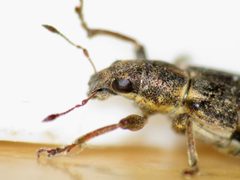
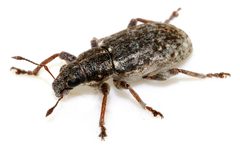
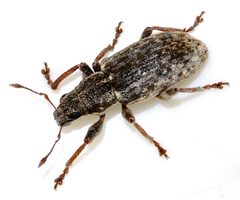
Sitona cylindricollis, the sweetclover weevil, is a broad-nosed weevil in the Curculionidae. It is a documented agricultural pest of sweet clover (Melilotus officinalis) and alfalfa/lucerne (Medicago sativa). feed on above-ground foliage, causing defoliation damage that is most severe during late summer . Larvae feed on root nodules and root tissue underground. The exhibits temperature- and light-dependent , with peak flight activity occurring in morning hours when ambient temperatures reach threshold levels.
Pronunciation
How to pronounce Sitona cylindricollis: /sɪˈtoʊnə sɪˌlɪndrɪˈkoʊlɪs/
These audio files are automatically generated. While they are not always 100% accurate, they are a good starting point.
Identification
As a member of the broad-nosed weevil Entiminae, distinguished from other weevil groups by the short, broad rostrum. Differentiation from other Sitona requires examination of minute morphological characters not detailed in available sources. are associated with sweet clover and alfalfa fields, which may aid in field recognition.
Images
Habitat
Agricultural fields, specifically those cultivated for sweet clover (Melilotus officinalis) and alfalfa/lucerne (Medicago sativa). Associated with open, sunlit environments where plants grow.
Distribution
North America, with documented occurrence in the Canadian prairies and mid-western United States. Also recorded from Europe (Austria, Bulgaria, Czechoslovakia, Denmark, Finland, France, Germany, Hungary, Italy, Netherlands, Norway, Portugal, Spain, Sweden, Switzerland, Yugoslavia) and Asia (Afghanistan, China, Iran, Israel, Tibet, former U.S.S.R.) per distribution map records.
Seasonality
are active during growing season of plants. occur primarily during a short period in May, with peak flight activity between 09:00-11:00 hours. Defoliation damage is most severe when feeding occurs during the from 15 August to 20 September.
Diet
feed on foliage of sweet clover (Melilotus officinalis) and alfalfa/lucerne (Medicago sativa). Larvae feed on root nodules and root cortex tissue of these plants.
Host Associations
- Melilotus officinalis - primary plantsweet clover; feed on foliage, larvae feed on root nodules and roots
- Medicago sativa - primary plantalfalfa/lucerne; feed on foliage, larvae feed on root nodules and roots
Life Cycle
Complete with , larval, pupal, and stages. Larvae develop underground, feeding on root nodules and root tissue of plants. occurs near the soil surface. Specific timing of developmental stages not documented in available sources.
Behavior
exhibit pre- warming posture before takeoff. flights are induced by rising temperature and light intensity, with an ambient temperature threshold of approximately 25°C in bright sunshine (corresponding to body temperature of ~35°C). Flight activity decreases at wind speeds above 0.1 m/sec and ceases at 0.6 m/sec. Feeding and temperature increase the threshold for flight activity. Young adults typically do not fly. plant odor, specifically coumarin, serves as a significant olfactory stimulus for terminating flight and facilitating landing. Strong anemotactic response to host plant odor enables colony establishment.
Ecological Role
Agricultural pest of sweet clover and alfalfa. defoliation and larval root feeding reduce stand establishment, , and forage yield. In the Canadian prairies, typically remain below economic damage thresholds. Contributes to as prey for predatory including Cerceris weevil wasps.
Human Relevance
Economic pest in forage crop production. Damage potential includes seedling mortality at high weevil densities (1 weevil per seedling), reduced second-year forage yield from defoliation during critical late-summer period, and chronic stand decline from larval root feeding. Currently not considered a major deterrent to sweet clover production in western Canada due to typically sub-threshold levels.
Similar Taxa
- Sitona hispidulusclover root curculio; also a pest of alfalfa and clovers with similar larval root-feeding habit, but differs in specific associations and damage patterns
- Hypera posticaalfalfa weevil; another curculionid pest of alfalfa, but with different and
More Details
Flight behavior research
Laboratory and field studies demonstrate that temperature preference is plastic based on prior thermal experience: weevils emerging from hibernation have lower temperature preferences than those collected during summer months. High humidity inactivates weevils at all temperatures. Light does not alter temperature responses, but high temperature reverses negative phototactic .
Damage thresholds
Field cage experiments in the Canadian prairies established -dependent damage relationships: 1 weevil per 7 seedlings destroyed less than 5% of seedlings, while 1:1 ratio caused 100% mortality. For second-year plants, 4.5-9 weevils per plant caused significant yield reduction, and 18 weevils per plant caused near-total destruction of forage yield.
Sources and further reading
- BugGuide
- Wikipedia
- GBIF taxonomy match
- iNaturalist taxon
- NCBI Taxonomy
- Clover Root Curculio: Historic Perspectives Guide Modern Management
- Complexity Untangled: For Plant Defenses, Pest Attack Order Matters
- Britain’s First Bug Reserve – is OPEN - Buglife Blog - Buglife
- Meloidae | Beetles In The Bush | Page 3
- Bug Eric: June 2011
- North America’s largest stag beetle | Beetles In The Bush
- Sitona cylindricollis . [Distribution map].
- DAMAGE POTENTIAL OF THE SWEETCLOVER WEEVIL, SITONA CYLINDRICOLLIS (COLEOPTERA: CURCULIONIDAE), IN THE CANADIAN PRAIRIES
- THE INFLUENCE OF PHYSICAL FACTORS AND HOST PLANT ODOUR ON THE INDUCTION AND TERMINATION OF DISPERSAL FLIGHTS IN SITONA CYLINDRICOLLIS FAHR.