
Halictus confusus
Smith, 1853
southern bronze furrow bee, confused sweat bee, confusing furrow bee
Species Guides
1- Halictus confusus arapahonum(Arapaho Metallic-Furrow bee)
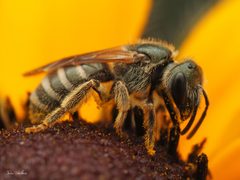
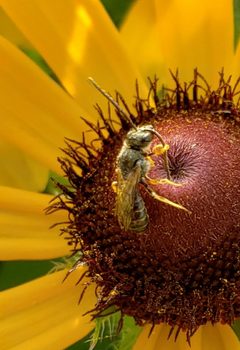
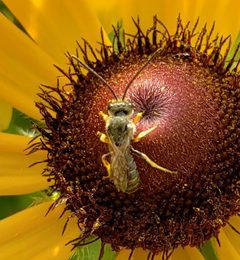
Halictus confusus is a small primitively eusocial sweat bee in the Halictidae. Females measure 7 mm in length with forewings 5.5 mm long, displaying metallic greenish coloration on the and that darkens to black on the . The exhibits primitive eusociality with behaviorally distinct but morphologically similar . It is widely distributed across Eurasia and North America, with multiple described reflecting this broad range.
Pronunciation
How to pronounce Halictus confusus: /həˈlɪktəs kənˈfjuːsəs/
These audio files are automatically generated. While they are not always 100% accurate, they are a good starting point.
Identification
In Britain and Europe, reliably distinguished from Halictus tumulorum only by examination of male genitalia. Fresh females of H. confusus have wider pale banding on tergites 3 and 4 compared to H. tumulorum. Males of H. confusus have more yellow on the joints of the hind and middle legs than H. tumulorum.
Images
Habitat
In Britain, strongly associated with sandy including sandy heaths and sand pits. In other parts of its range, appears more in habitat choice. Nests in with horizontal entrance tunnels beneath mounds.
Distribution
Widely distributed across Europe, Asia, and North America. In Great Britain, has a southerly distribution from Dorset east to Kent and north to Norfolk. In North America, ranges from Nova Scotia to North Dakota southward to Florida and Texas. include: H. c. confusus (North America), H. c. alpinus (China, Poland, Spain, Switzerland), H. c. arapahonum (Midwest North America), H. c. pelagius (Russia), and H. c. perkinsi (western Europe except higher mountains, and China).
Seasonality
Active from spring through late summer. In North America, queens emerge in spring, switch from early woodland flowers to dandelions, then to wintercress as main pollen source. Nests close off in June; first emerges to forage on clover. Late summer brood produces reproductive females and males that overwinter after mating.
Diet
Polylectic, feeding on a wide variety of flowers. In North America, spring beauty (Claytonia virginica) and toothwort (Cardamine concatenata) used by emerging queens; dandelions and wintercress (Barbarea vulgaris) as main resources; clover used by ; late summer flowers include Lespedeza lineata and Symphyotrichum ericoides.
Life Cycle
Primitively eusocial with colonies. Queens found new nests each spring, constructing horizontal entrance tunnels beneath mounds. Colony has potential to develop into matriarchy with mother and daughter . Workers may become reproductively capable depending on colony size and size differential between queen and workers. First emerges as workers; final brood produces reproductive females and males. Females overwinter after mating.
Behavior
Nests in with guarded entrances. guard nest entrances and may be overcome by . Foraging are preyed upon by crab spiders and predatory . Workers may tailgate returning foragers to enter nests, a exploited by parasitic phorid flies.
Ecological Role
. Serves as for multiple including conopid flies ( females), phorid flies (nest parasites), and the parasitic Ripiphorus walshi (larval parasite). Ants are main nest ; crab spiders and predatory prey on foraging adults.
Human Relevance
Listed as Secure on NatureServe in North America; listed as Vulnerable in Belgium. No significant economic impact; pollination services in natural and agricultural .
Similar Taxa
- Halictus tumulorumExtremely similar appearance in Britain and Europe; requires examination of male genitalia for reliable separation. Females distinguished by width of pale banding on tergites 3 and 4; males by amount of yellow on leg joints.
More Details
Social dynamics
Exhibits primitive eusociality where 's ability to suppress depends on colony size and size differential between queen and workers.
Parasite load
diverse : Conopidae flies attack females, Phoridae flies enter nests by tailgating , Ripiphorus walshi larvae attach to adults at flowers and are transported to nests, plus fungi and .