
Ripiphorus
Bosc, 1791
wedge-shaped beetles
Species Guides
24Ripiphorus is a of wedge-shaped beetles comprising at least 30 described . Members are parasitic beetles with highly modified body plans and complex involving multiple . The genus has been recorded across multiple continents, with notable disjunct distributions including isolated volcanic archipelagos such as the Cape Verde Islands. are typically short-lived and often associated with flowers, while larvae are of other insects.
Pronunciation
How to pronounce Ripiphorus: //rɪˈpɪfərəs//
These audio files are automatically generated. While they are not always 100% accurate, they are a good starting point.
Identification
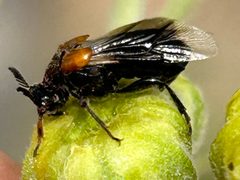
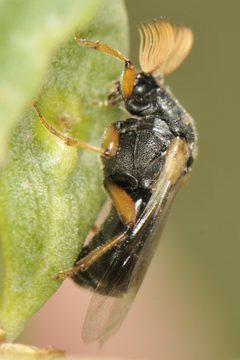
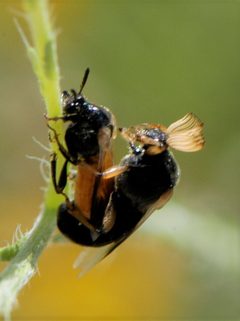
The combination of wedge-shaped body, abbreviated leaving most of the exposed, and sexually dimorphic (pectinate in males, serrate or in females) separates Ripiphorus from other . The overall humpbacked appearance and reduced wing covers are diagnostic for the Ripiphoridae and genus Ripiphorus. Specific identification often requires examination of female leg , such as hind tibia width and metatarsomere proportions.
Images
Habitat
are often found on flowers or vegetation. Larval are tied to organisms, including nests of bees and , wood-boring galleries, and habitats. One has been documented from volcanic island environments (Boavista Island, Cape Verde).
Distribution
Widespread distribution with records from multiple continents. Documented from North America, Europe, Africa (including the Cape Verde archipelago—the first Ripiphorus record on an isolated volcanic archipelago worldwide), and likely other regions. The exhibits disjunct distributions suggestive of long-distance capabilities.
Seasonality
activity periods vary by and region; typically associated with flowering periods of -associated plants. Specific seasonal patterns are poorly documented for most species.
Host Associations
Life Cycle
Complex with . First instar larvae are free-living, active, and campodeiform (flattened and legged), resembling those of R. smithi. Subsequent instars are -like and parasitic within . Larvae penetrate host nests or bodies, feeding internally. occurs within the host remains or nest. The secretive nature of later instars makes complete life cycle documentation difficult for most .
Behavior
have been observed on flowers, presumably feeding on pollen or nectar. First instar larvae are active and free-living, seeking out . Behavioral observations suggest adults are short-lived and primarily focused on . Larvae exhibit host-seeking before becoming internal .
Ecological Role
Human Relevance
No direct economic importance established. Potential impact on (bees and ) is unknown but of possible concern. The unusual and rarity of observations make the of interest to entomologists and collectors.
Similar Taxa
- PelecotomaAlso in Ripiphoridae with wedge-shaped body and abbreviated ; distinguished by antennal structure and body proportions
- MacrosiagonRelated ripiphorid ; differs in body shape, antennal form, and associations
- Mordellidae (tumbling flower beetles)Related with similar humpbacked appearance; distinguished by more complete covering and different antennal structure
- Meloidae (blister beetles)Related superfamily (Tenebrionoidea) with soft-bodied ; distinguished by complete and different larval
More Details
Dispersal and Biogeography
The discovery of R. caboverdianus on Boavista Island, Cape Verde, represents the first Ripiphorus record from an isolated volcanic archipelago and has significant implications for understanding oceanic abilities in Ripiphorinae. This disjunct distribution suggests or larvae may have substantial dispersal capabilities, possibly via wind or association with migrating .
Sources and further reading
- BugGuide
- Wikipedia
- GBIF taxonomy match
- iNaturalist taxon
- NCBI Taxonomy
- Catalogue of Life
- Wedge-Shaped Beetles (suggested common name) Ripiphorus spp. (Insecta: Coleoptera: Ripiphoridae)
- Ripiphorus caboverdianus sp. nov.—the first ripiphorid record from the Macaronesian volcanic islands (Coleaoptera: Ripiphoridae: Ripiphorinae)