
Cephalotes texanus
(Santschi, 1915)
Texanus-group Turtle Ants
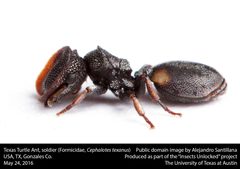
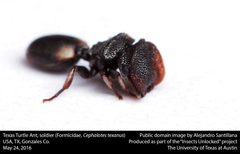
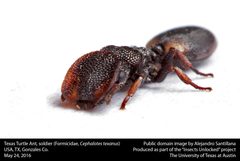
Cephalotes texanus is a of arboreal in the Cephalotes, commonly known as turtle ants. The species is characterized by its ability to glide through the air when falling from trees, a facilitated by enlarged, flattened legs. It exhibits , a defensive where soldiers use their uniquely shaped to block nest entrances. The species inhabits pre-existing cavities in wood, particularly those created by longhorn beetle larvae, rather than constructing its own nests. Native to Texas and northeastern Mexico, it was first described by Felix Santschi in 1915.
Pronunciation
How to pronounce Cephalotes texanus: /sɛfəˈlɔtɛs tɛkˈsanəs/
These audio files are automatically generated. While they are not always 100% accurate, they are a good starting point.
Identification
Distinguished from other Cephalotes by geographic distribution (Texas and northeastern Mexico). The combination of gliding ability via flattened legs and is characteristic of the , but specific identification requires examination of and geographic provenance. The abruptly modified head shape of soldiers, used for blocking nest entrances, differs in detail from congeneric species.
Images
Appearance
Possesses an irregularly shaped adapted for , with soldiers capable of using their heads to seal nest entrances. Has enlarged, flattened legs that enable gliding . are positioned laterally on the head and protected by the head shield. A ridge on the assists in blocking nest openings when combined with the head.
Habitat
Arboreal; inhabits pre-existing cavities in trees, specifically tunnels and chambers excavated by longhorn beetle larvae (Cerambycidae). Does not construct its own nests. Occupies forested environments where suitable -excavated cavities are available.
Distribution
Native to Texas, United States, and the Mexican states of Nuevo León, San Luis Potosí, and Tamaulipas.
Host Associations
- Longhorn beetle larvae (Cerambycidae) - commensalOccupies nest cavities excavated by larvae; does not construct own nests
Behavior
Exhibits directed aerial descent (gliding) when falling from trees, steering toward the trunk to regain access to the . Soldiers practice : using their modified to block nest entrances, with the thoracic ridge forming a secondary seal. are protected during this defensive posture by lateral placement and head shielding. are capable of controlled parachuting .
Similar Taxa
- Other Cephalotes speciesShare gliding ability and , but differ in geographic distribution and specific details
More Details
Phragmosis
The morphological where soldiers use their to block nest entrances, combined with a thoracic ridge for complete sealing. This represents a derived trait within the Cephalotes.
Gliding mechanics
Larger and flatter legs relative to body size generate aerodynamic lift and control during descent, allowing directed return to tree trunks rather than uncontrolled falling.
Sources and further reading
- BugGuide
- Wikipedia
- GBIF taxonomy match
- iNaturalist taxon
- NCBI Taxonomy
- Catalogue of Life
- Bembicid Holdings | Entomology Research Museum
- ESA Entomology Games Are Both Educational and Entertaining | Bug Squad
- California Has No State Bee--Yet! | Bug Squad
- Tracking Tetraopes texanus with Terry | Beetles In The Bush
- Ant Fossils from Europe Resemble Modern Asian Ants
- Why Fungus-Farming Ants Could Be a Source for New Antimicrobial Compounds