
Cephalotes
Latreille, 1802
turtle ants
Species Guides
3- Cephalotes rohweri(Sonoran Turtle Ant)
- Cephalotes texanus(Texanus-group Turtle Ants)
- Cephalotes varians(Northern Caribbean Turtle Ant)
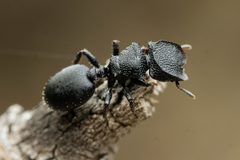
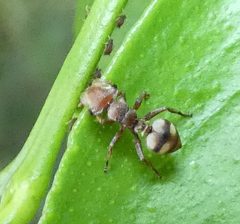
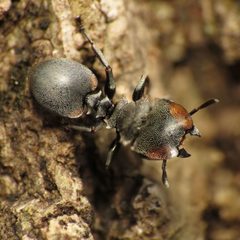
Cephalotes is a Neotropical of arboreal ants commonly known as turtle ants. All appear to be capable of gliding, using their flattened bodies to steer their fall and land back on tree trunks rather than falling to the ground. The genus is notable for its specialized soldier , where soldiers use their distinctive plate-like to block nest entrances. Cephalotes ants possess conserved gut bacterial that participate in nitrogen recycling and fiber digestion, supporting their herbivorous diet.
Pronunciation
How to pronounce Cephalotes: //ˈsɛfələˌtiːz//
These audio files are automatically generated. While they are not always 100% accurate, they are a good starting point.
Identification
Turtle ants are recognized by their flattened, disc-shaped bodies and large, shield-like in soldier . The soldier head varies from less-specialized forms capable of active defense to highly specialized forms that function exclusively as living doors, blocking nest cavity entrances. are generally smaller with more typical proportions. The flattened body shape is an for their gliding .
Images
Habitat
Strictly arboreal; nests in pre-existing cavities in trees throughout Neotropical forests. select specific nesting sites that maximize soldier performance in nest defense.
Distribution
Neotropical region, including Central and South America, from Mexico to Argentina.
Diet
Fiber-rich plant-based diet; and larvae rely on gut bacterial for digestion of cellulose, hemicelluloses, lignins, starches, and pectins.
Life Cycle
Larvae acquire bacterial environmentally, while harbor specialized, conserved symbiont lineages. Larval gut bacteria include Enterobacteriales capable of catabolizing dietary fibers.
Behavior
All appear capable of gliding (parachuting), steering their descent to land on tree trunks rather than falling to the ground, which is often flooded in their . Soldiers defend nests by blocking entrances with their ; species with more specialized soldiers rely exclusively on this passive defense, while those with less specialized soldiers use both active and passive defense.
Ecological Role
Arboreal herbivores that process plant material with assistance from gut microbiome. Nitrogen recycling by symbiotic bacteria allows exploitation of nitrogen-poor plant diets.
Similar Taxa
- ProcryptocerusSister sharing arboreal habits and similar body plan; both genera possess conserved gut bacterial and gliding capabilities
- AttaBoth are in tribe Attini and engage in complex social organization with specialization, but Atta are leaf-cutting fungus farmers with different nesting and lack the turtle ants' gliding and phragmotic soldiers
Sources and further reading
- BugGuide
- Wikipedia
- iNaturalist taxon
- NCBI Taxonomy
- Catalogue of Life
- ESA Entomology Games Are Both Educational and Entertaining | Bug Squad
- Meloidae Holdings | Entomology Research Museum
- Prime Time for Learning | Bug Squad
- Atta cephalotes ant - Entomology Today
- leafcutter ant, Atta cephalotes - Entomology Today
- Cephalotes-ants - Entomology Today
- Breeding biology of Pale-edged Flycatcher (Myiarchus cephalotes) in northeastern Ecuador
- Atta cephalotes . [Distribution map].
- Exploring the Metabolic and Digestive Functions of Bacterial Gut Symbionts In Cephalotes Turtle Ants
- How urbanite is the leaf-cutter ant Atta cephalotes (Hymenoptera: Myrmicinae) in Colombia?