
Cephalotes rohweri
(Wheeler, 1916)
Sonoran Turtle Ant, gliding ant
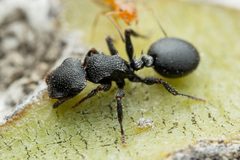
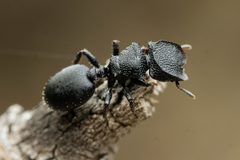
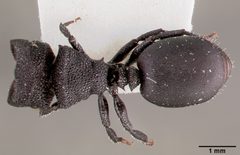
Cephalotes rohweri is a desert-dwelling arboreal known for its distinctive shape and ability to glide through the air when falling from trees. Colonies nest in abandoned cavities within Palo Verde trees and feed primarily on pollen, rarely descending to the ground. The exhibits temperature-sensitive gut microbiome dynamics, with bacterial mutualists in the Cephalotococcus declining under warm conditions.
Pronunciation
How to pronounce Cephalotes rohweri: //sɛfəˈloʊtiːz roʊˈwɛri//
These audio files are automatically generated. While they are not always 100% accurate, they are a good starting point.
Identification
Distinguished from other Cephalotes by its association with the Sonoran Desert and Palo Verde trees. The gliding and are shared with other members of the ; precise species-level identification likely requires examination of morphological characters not specified in available sources.
Images
Habitat
Arboreal in desert environments, specifically nesting in abandoned cavities within Palo Verde trees (Parkinsonia florida or Cercidium floridum) in the Sonoran Desert.
Distribution
Sonoran Desert region of North America.
Seasonality
Gut microbiome composition varies seasonally in response to temperature changes, with bacterial abundance and composition shifting between warmer and cooler periods.
Diet
Feeds primarily on pollen of Palo Verde trees. Capable of consuming other foods and has been suggested to occasionally forage on the ground, though this is not its primary feeding strategy.
Host Associations
- Palo Verde - pollen sourceParkinsonia florida or Cercidium floridum; primary food source
- Cephalotococcus - mutualistBacterial mutualist in gut, decreases in abundance under warm conditions
- Gracilibacteria - Member of Candidate Radiation, suspected epibiont found in low abundance in gut
Life Cycle
Colony size ranges from approximately 50 to 200–300 individuals. Colonies frequently contain multiple reproductive queens. requires several months to mature into .
Behavior
Exhibits directed aerial descent (gliding or "parachuting") when falling from trees, steering their fall to return to the trunk. This minimizes time spent on the ground in the desert environment.
Ecological Role
Pollen consumer on Palo Verde trees; may contribute to pollination. a distinctive gut microbiome including temperature-sensitive bacterial mutualists, making it a model for studying climate change effects on -microbe relationships.
Similar Taxa
- Other Cephalotes speciesShare arboreal habits, gliding , and irregular ; distinguished by geographic distribution and specific tree associations
- Atta cephalotesSimilar but belongs to different tribe (Attini vs. Atta in Attini); A. cephalotes is a leafcutter with fungal gardens, not a pollen-feeding gliding ant
More Details
Microbiome Research Significance
Cephalotes rohweri has emerged as a model organism for studying how climate change may reshape microbiomes. Research demonstrates that both field temperature variation and experimental warming alter gut bacterial , with implications for predicting microbe-mediated responses to environmental change.
Soldier Deployment Strategy
Because development spans several months, queens cannot rapidly adjust soldier-to- ratios in response to threats. The has evolved an effective strategy for deploying major workers (soldiers) to maximize colony survival under this constraint.
Sources and further reading
- BugGuide
- Wikipedia
- GBIF taxonomy match
- iNaturalist taxon
- NCBI Taxonomy
- Catalogue of Life
- ESA Entomology Games Are Both Educational and Entertaining | Bug Squad
- Meloidae Holdings | Entomology Research Museum
- Prime Time for Learning | Bug Squad
- Atta cephalotes ant - Entomology Today
- leafcutter ant, Atta cephalotes - Entomology Today
- Cephalotes-ants - Entomology Today
- Thermal sensitivity and seasonal change in the gut microbiome of a desert ant, Cephalotes rohweri
- Thermal sensitivity and seasonal change in the gut microbiome of a desert ant, Cephalotes rohweri