
Myrmecocystus testaceus
Emery, 1893
Brick Honeypot Ant
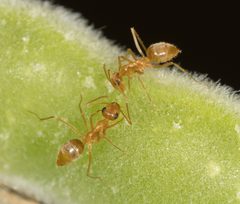
Myrmecocystus testaceus is a native to the southern United States, commonly known as the Brick Honeypot Ant. As a member of the Myrmecocystus, it possesses the distinctive —specialized that store liquid food in their greatly distended , serving as living food reserves for the colony. The species nests in sandy soils and has been documented as a for the myrmecophilous Cremastocheilus.
Pronunciation
How to pronounce Myrmecocystus testaceus: /mɪr.mɛ.kɔˈsɪs.tʊs tɛsˈtɑː.kjuˌs/
These audio files are automatically generated. While they are not always 100% accurate, they are a good starting point.
Identification
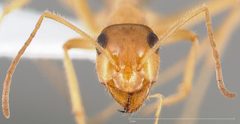
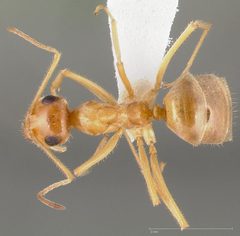
Identification to level within Myrmecocystus requires examination of morphological characters not fully detailed in available sources. The is distinguished from other formicine ants by the presence of — with enormously expanded, translucent capable of storing liquid food. The specific epithet 'testaceus' (Latin for 'brick-colored') suggests reddish-brown coloration, though this trait alone is insufficient for definitive species identification without additional diagnostic features.
Images
Habitat
Nests in sandy substrates throughout the southern United States. The has been observed in arid and semi-arid environments where sandy soils permit excavation of nest chambers.
Distribution
Found throughout the southern United States. Documented observations span this geographic range, with specific localities including sandy in the southwestern and south-central regions.
Seasonality
activity pattern has been documented. Seasonal patterns of above-ground activity are not explicitly described in available sources.
Host Associations
- Cremastocheilus - Documented as for anteater scarab beetles (Cremastocheilus), which are myrmecophilous beetles that enter nests and feed on ant larvae and pupae. The beetles employ death-feigning to gain entry to nests.
Life Cycle
Possesses the characteristic honeypot ant involving three : queens, , and . Repletes are specialized workers that serve as living storage vessels, gorging on nectar and other liquid foods until their become greatly distended, then hanging immobile from the nest ceiling to regurgitate food when colony resources are scarce. Complete with , larva, pupa, and stages.
Behavior
foraging activity has been documented. The exhibits the honeypot ant behavioral : collect liquid food resources that are stored by for later colony consumption during periods of scarcity.
Ecological Role
Functions as a food storage within its . serve as a buffer against resource fluctuations, allowing colonies to persist through periods of food scarcity. The contributes to soil turnover through nest excavation in sandy .
Human Relevance
Minimal direct economic impact. The may serve as an indicator of healthy sandy soil . Its association with myrmecophilous beetles makes it of interest for studies of - ecological interactions.
Similar Taxa
- Myrmecocystus mexicanusOverlapping geographic range and shared honeypot ant ; requires careful morphological examination to distinguish
- Myrmecocystus navajoAnother southwestern honeypot ant with similar and appearance
- Other FormicinaeLack the characteristic of Myrmecocystus; repletes with massively distended are diagnostic for the
More Details
Etymology
The specific epithet 'testaceus' derives from Latin, meaning 'brick-colored' or 'earthenware-colored,' likely referring to the reddish-brown coloration of the .
Taxonomic authority
First described by Carlo Emery in 1893, a prominent Italian entomologist who made extensive contributions to .