
Dorymyrmex bureni
(Trager, 1988)
Buren's Pyramid Ant, Pyramid Ant
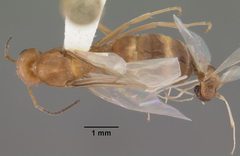
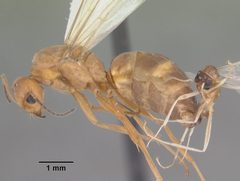
Dorymyrmex bureni is a medium-sized in the Dorymyrmex, commonly known as pyramid ants. Described by Trager in 1988, this species is native to the Atlantic Coastal Plain of the southeastern United States. are light orange, fast-moving, and range 2–4 mm in length. The species is distinguished by its crater-shaped nest mounds in sandy soil and a characteristic coconut-like odor emitted when crushed. Unlike the aggressive red imported fire ant (Solenopsis invicta), D. bureni is relatively harmless to humans and lacks a functional sting.
Pronunciation
How to pronounce Dorymyrmex bureni: //ˌdɔːrɪˈmɪrmɛks bjuːˈriːnaɪ//
These audio files are automatically generated. While they are not always 100% accurate, they are a good starting point.
Identification
Dorymyrmex bureni can be distinguished from similar by its light orange coloration, medium size, and crater-shaped nest mounds in sandy . It is most similar to Dorymyrmex flavus, with which it may co-occur or abut in range; accurate identification often requires examination of subtle morphological characters. The curved cephalic hairs used for sand transport are a notable feature. The coconut-like odor when crushed is distinctive but requires destructive sampling.
Images
Habitat
Sandy soils, particularly in coastal and near-coastal environments. Nests are constructed in open, bare ground with a characteristic crater-shaped mound of excavated sand surrounding a single central entrance.
Distribution
to the Atlantic Coastal Plain of the United States, with continuous from the Florida Keys north to coastal New Jersey. Disputed western records extend to Alabama, Georgia, and possibly Mississippi or eastern Texas, though verifiable modern records appear to stop near the Mississippi River. Introduced to Ocean Cay, Bahamas.
Diet
Predatory on living insects, including other winged ants. Collects honeydew from sap-sucking insects.
Life Cycle
Colonies are small in size. Nests typically have a single entrance.
Behavior
are fast-moving and active foragers. When crushed, workers emit a foul-smelling coconut odor. The is not aggressive toward humans and is unable to sting.
Ecological Role
Native in sandy coastal . Documented as occurring in sea turtle nests on Georgia barrier islands, where ant presence correlates with reduced hatchling success, particularly in nests near dune vegetation.
Human Relevance
Not considered an indoor pest; control is unnecessary. Occasionally encountered in conservation contexts due to interactions with sea turtle nesting sites.
Similar Taxa
- Dorymyrmex flavusOverlapping or adjacent distribution to the west; morphologically similar and historically confused with D. bureni, contributing to uncertainty about western range limits
- Solenopsis invictaSympatric in southeastern United States but distinguished by aggressive , painful sting, and larger, more populous colonies
Sources and further reading
- BugGuide
- Wikipedia
- GBIF taxonomy match
- iNaturalist taxon
- NCBI Taxonomy
- Catalogue of Life
- Myrmecologist Jill Oberski: A Dream Come True | Bug Squad
- Let's All Appreciate Ants! Don't Miss These Biodiversity Museum Programs | Bug Squad
- Don't Miss This Virtual Seminar About an Ant Genus from the Amazon | Bug Squad
- Ants and Moths: Think Noon and Night! | Bug Squad
- Ants in the Nest: A Possible Emerging Pressure on Sea Turtles
- Predator or Prey? | Beetles In The Bush