
Dorymyrmex flavus
McCook, 1879
Yellow Pyramid Ant
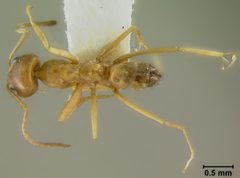
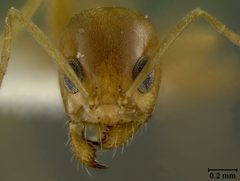
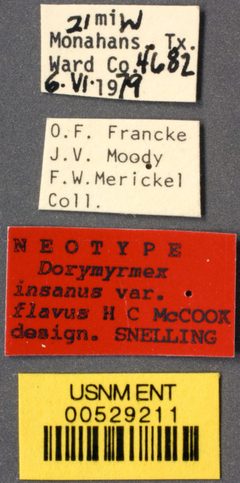
Dorymyrmex flavus is a small in the Dorymyrmex, commonly known as pyramid ants. First described by McCook in 1879, it is to the United States and Mexico. The species name refers to its golden-yellow coloration. It is one of multiple Dorymyrmex species found in North America, with research by Oberski (2023) indicating that the Nearctic fauna of this genus is more diverse than previously recognized.
Pronunciation
How to pronounce Dorymyrmex flavus: //dɔːrɪˈmɜːrmɛks ˈfleɪvəs//
These audio files are automatically generated. While they are not always 100% accurate, they are a good starting point.
Identification
Small, golden-yellow pyramid . Distinguished from other Dorymyrmex by coloration and geographic distribution. Dorymyrmex bicolor has bicolored orange and black , while D. flavus is uniformly yellow. From D. insanus (black workers) by color. Accurate species-level identification within Dorymyrmex often requires examination of morphological details beyond coloration, as several North American species are superficially similar.
Images
Habitat
Constructs conspicuous crater-shaped nests in bare soil. Associated with dry temperate regions including deserts, shrublands, and beaches.
Distribution
to the United States and Mexico. Found west of the Mississippi River in the United States, based on expert commentary distinguishing it from D. bureni (east of the Mississippi).
Behavior
Constructs conspicuous crater-shaped nests in bare soil. Foraging and feeding preferences not documented in available sources.
Similar Taxa
- Dorymyrmex bicolorBoth small pyramid ants with conspicuous crater-shaped nests; D. bicolor has dull orange and black bicolored versus uniformly golden-yellow in D. flavus
- Dorymyrmex insanusSimilar small size and nest structure; D. insanus has black versus golden-yellow in D. flavus
- Dorymyrmex bureniSuperficially similar in appearance; D. bureni occurs east of the Mississippi River while D. flavus occurs west of the Mississippi
More Details
Taxonomic research context
Research by Jill Oberski (Ward lab, UC Davis, 2023) on Dorymyrmex and has nearly doubled the number of recognized Dorymyrmex in North America, indicating that diversity in this was previously underestimated. This research used UCE phylogenomics, morphometrics, and traditional species description methods.
Sources and further reading
- BugGuide
- Wikipedia
- GBIF taxonomy match
- iNaturalist taxon
- Catalogue of Life
- Myrmecologist Jill Oberski: A Dream Come True | Bug Squad
- Let's All Appreciate Ants! Don't Miss These Biodiversity Museum Programs | Bug Squad
- Don't Miss This Virtual Seminar About an Ant Genus from the Amazon | Bug Squad
- Ants and Moths: Think Noon and Night! | Bug Squad
- Predator or Prey? | Beetles In The Bush
- Bug Eric: Wasp Wednesday: Polistes flavus