
Dorymyrmex insanus
(Buckley, 1866)
Crazy Pyramid Ant, Pyramid Ant
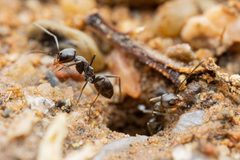
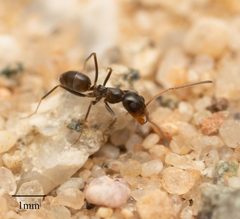
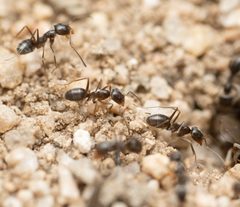
Dorymyrmex insanus, commonly called the crazy pyramid ant, is a of pyramid ant known for its rapid, frenetic movement and swarming . The specific epithet "insanus" (Latin for "insane") refers to this characteristic frantic activity. are small (~3 mm), black, and construct conspicuous cone-shaped nest mounds in bare soil. The species exhibits high heat and remains active in extreme temperatures. It is listed as Vulnerable by the IUCN.
Pronunciation
How to pronounce Dorymyrmex insanus: /dɔːrɪˈmɪrmɛks ɪnˈsɑːnəs/
These audio files are automatically generated. While they are not always 100% accurate, they are a good starting point.
Identification
Dorymyrmex insanus can be distinguished from the sympatric Dorymyrmex bicolor by its uniform black coloration; D. bicolor are bicolored with dull orange and black. Both share the characteristic crater-shaped nests and small worker size (~3 mm). The frenetic, rapid movement of foraging workers is a behavioral cue. Nest clusters of small cone-shaped mounds in bare, dry soil are diagnostic for the .
Images
Appearance
are small, approximately 3 mm in length, and black in color. The constructs conspicuous crater-shaped or cone-shaped nest mounds in bare soil, typically around 10 cm in diameter. Nest entrances are small and often found in clusters.
Habitat
Hot, very dry, and open environments including deserts, shrublands, and beaches. Frequently found in disturbed areas such as agricultural land and human-settled regions. Nests are constructed in bare soil with sparse vegetation.
Distribution
Southern United States, much of Central America, and tropical South America. Specific records from Brazil (Mato Grosso, Rio de Janeiro, Rio Grande do Norte, São Paulo) and Colombia (Atlántico, Bolívar, Magdalena). Present in Davis, California and other dry temperate regions of North America.
Seasonality
remain active even in extreme heat, exhibiting high heat compared to co-occurring . Activity patterns extend through hot periods when other ants may be less active.
Diet
consume honeydew and other nutritious liquids, as well as insect carcasses obtained through foraging. They occasionally hunt live insects.
Behavior
Exhibits frenetic, rapid movement and swarming when food is discovered. Forms large, quickly moving foraging trails that can adapt to terrain. are highly active even in extreme heat due to high thermal .
Ecological Role
forager and scavenger in hot, dry . Occurs in large, open areas including disturbed . Potential ecological significance in seed and soil modification through nest construction, though specific roles are not well documented.
Human Relevance
Occurs in agricultural and urban disturbed areas, suggesting of human-modified landscapes. Nest mounds may be conspicuous in bare soil areas. Listed as Vulnerable by the IUCN, indicating conservation concern.
Similar Taxa
- Dorymyrmex bicolorOverlapping distribution and similar nest structure; distinguished by bicolored (orange and black) versus uniform black
- Dorymyrmex bureniAnother native pyramid ant in similar ; morphological and behavioral similarities require careful examination for separation
More Details
Conservation Status
Listed as Vulnerable by the International Union for Conservation of Nature (IUCN)
Etymology
The specific epithet 'insanus' (Latin for 'insane') refers to the ' frenzied movements and rapid swarming
Research Context
Dorymyrmex is a focus of modern phylogenomic and biogeographic study; D. insanus is part of a Nearctic fauna that has undergone rapid evolutionary radiation with superficially similar
Sources and further reading
- BugGuide
- Wikipedia
- GBIF taxonomy match
- iNaturalist taxon
- NCBI Taxonomy
- Catalogue of Life
- Ants and Moths: Think Noon and Night! | Bug Squad
- Myrmecologist Jill Oberski: A Dream Come True | Bug Squad
- Let's All Appreciate Ants! Don't Miss These Biodiversity Museum Programs | Bug Squad
- Don't Miss This Virtual Seminar About an Ant Genus from the Amazon | Bug Squad
- Dorymyrmex bureni Archives - Entomology Today
- Ants in the Nest: A Possible Emerging Pressure on Sea Turtles