
Dorymyrmex
Mayr, 1866
pyramid ants, cone ants
Species Guides
7- Dorymyrmex bicolor(Bicolored Pyramid Ant)
- Dorymyrmex bureni(Buren's Pyramid Ant)
- Dorymyrmex flavopectus(Yellow-chested Pyramid Ant)
- Dorymyrmex flavus(Yellow Pyramid Ant)
- Dorymyrmex grandulus(Great Cone Ant)
- Dorymyrmex insanus(Crazy Pyramid Ant)
- Dorymyrmex smithi(Smith's Pyramid Ant)
Dorymyrmex is a of ants in the Dolichoderinae, commonly known as pyramid ants or cone ants. The genus exhibits an amphitropical distribution pattern, with highest diversity concentrated in arid temperate regions of North and South America rather than tropical zones. Phylogenomic studies have identified four major groups: D. flavescens, tener, wolffhuegeli, and pyramicus groups. The genus has undergone rapid evolutionary radiation, particularly in the pyramicus group, presenting ongoing taxonomic challenges.
Pronunciation
How to pronounce Dorymyrmex: //ˌdɔːrɪˈmɜːrmɛks//
These audio files are automatically generated. While they are not always 100% accurate, they are a good starting point.
Identification
Dorymyrmex can be distinguished from other Dolichoderinae by the combination of a single petiolar node, a single propodeal tooth or spine, and an elevated . Within the genus, identification is challenging due to minimal morphological differentiation in rapidly radiating groups such as the pyramicus group; molecular and phylogenomic approaches are often necessary for reliable identification. Conspicuous crater-shaped nests in bare soil are a helpful field indicator for some species.
Images
Appearance
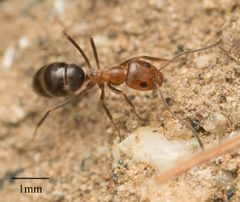
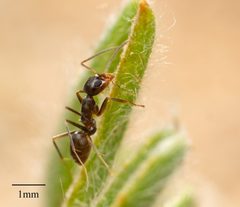
are generally small, typically 3–6 mm in length. The is characterized by a single petiolar node, a propodeum bearing a single posteriorly projecting tooth or spine (the 'pyramid' or 'cone' that gives these ants their ), and a distinctly elevated above the level of the pronotum. Coloration ranges from black to bicolored patterns of dull orange and black. The pyramicus group shows minimal morphological differentiation despite comprising multiple .
Habitat
Specialized for arid and semi-arid environments including deserts, shrublands, beaches, and dry temperate grasslands. nest preferentially in dry or disturbed , generally in soil without vegetation cover. Sandy beach habitats and areas with sparse vegetation are commonly occupied. The shows a high degree of endemicity and specialized habitat preferences despite being frequently encountered in disturbed areas such as roadsides.
Distribution
Strictly American distribution, occurring in the Nearctic and Neotropical regions from the Great Plains of North America to Patagonia in South America. The exhibits an amphitropical pattern with concentration in dry temperate zones north and south of the tropics. Colombia at least nine . between continents occurred via Central America before the complete closure of the Isthmus of Panama, likely through savanna 'stepping stones' during cooler, drier periods.
Host Associations
Behavior
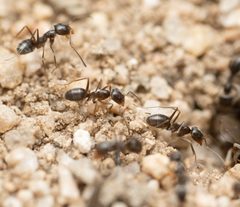
Foraging involves information transfer between individuals through antennal contacts, generating collective improvement in food exploitation. In Dorymyrmex goetschi, spatial heterogeneity increases travel time and reduces locomotion velocity; nestmate encounters produce more tortuous paths and reduced speed, with negative effects on foraging success in heterogeneous environments. construct conspicuous crater-shaped nest entrances in bare soil.
Ecological Role
Potential agents of of crop pests. Heavy metal bioaccumulation in D. brunneus indicates utility as environmental indicators in tropical agricultural regions. The contributes to soil disturbance and nutrient cycling in arid through nest construction.
Human Relevance
Some may serve as agents for agricultural pests. Presence in crop areas has been used to monitor environmental pollution through heavy metal bioaccumulation. Frequently encountered by collectors due to abundance in disturbed , though several species show high endemicity and specialized habitat requirements.
Similar Taxa
- ConomyrmaFormerly recognized as a separate , now synonymized within Dorymyrmex; corresponds to the pyramicus group
- AraucomyrmexFormerly recognized as a separate , now treated as a clade within Dorymyrmex
- ForeliusAnother Dolichoderinae in similar arid ; distinguished by different propodeal structure and nest architecture
Misconceptions
Despite being dismissed by collectors as 'roadside weeds,' many Dorymyrmex exhibit high endemicity, specialized preferences, and varied structure rather than being ecological .
More Details
Phylogenomic insights
Ultraconserved element (UCE) sequencing of 167 specimens representing 69 has clarified evolutionary relationships, revealing four major species groups and supporting a single event from South America to North America via Central America before the complete formation of the Panamanian isthmus.
Taxonomic challenges
The has never received a comprehensive global revision. Rapid radiation in the pyramicus group has produced superficially similar with minimal morphological differentiation, creating persistent difficulties in species delimitation that require integrative taxonomic approaches combining , phylogenomics, and .
Sources and further reading
- BugGuide
- Wikipedia
- GBIF taxonomy match
- iNaturalist taxon
- NCBI Taxonomy
- Catalogue of Life
- Myrmecologist Jill Oberski: A Dream Come True | Bug Squad
- Let's All Appreciate Ants! Don't Miss These Biodiversity Museum Programs | Bug Squad
- Don't Miss This Virtual Seminar About an Ant Genus from the Amazon | Bug Squad
- Ants and Moths: Think Noon and Night! | Bug Squad
- Colony of Red Ants Roams the Bohart Museum of Entomology | Bug Squad
- Dorymyrmex bureni Archives - Entomology Today
- The Ant GenusDorymyrmexMayr (Hymenoptera: Formicidae: Dolichoderinae) in Colombia
- Spatial Heterogeneity and Nestmate Encounters Affect Locomotion and Foraging Success in the Ant Dorymyrmex goetschi
- First Phylogenomic Assessment of the Amphitropical New World Ant Genus Dorymyrmex (Hymenoptera: Formicidae), a Longstanding Taxonomic Puzzle
- Seasonal niche differentiation of Camponotus morosus and Dorymyrmex goetschi (Hymenoptera: Formicidae) in sandy beach habitats: Insights from stable isotope analysis
- Ultraconserved element (UCE) phylogenomics illuminates the evolutionary history and biogeography of Dorymyrmex pyramid ants
- The Great Wanderer: The Phylogeographic History of the Bicolor Pyramid Ant (Dorymyrmex bicolor Wheeler, 1906) in Central Veracruz, Mexico
- Bioaccumulation of Heavy Metals in the Bodies of Workers of Camponotus Atriceps And Dorymyrmex Brunneus (Hymenoptera, Formicidae): An Exploratory Study