
Ibalia leucospoides
(Hochenwarth, 1785)
knife-shaped ibalia, Sirex Ibaliid Wasp
Ibalia leucospoides is a solitary endoparasitoid in the Ibaliidae, native to the Northern Hemisphere and widely introduced to the Southern Hemisphere as a agent for the woodwasp Sirex noctilio. are active from April to December depending on location, with a synchronized with . The exhibits pro-ovigenic , with females emerging with a high proportion of mature relative to lifetime . Adult feeding has minimal impact on egg maturation, survival, or capacity.
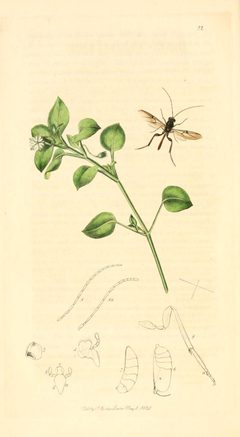
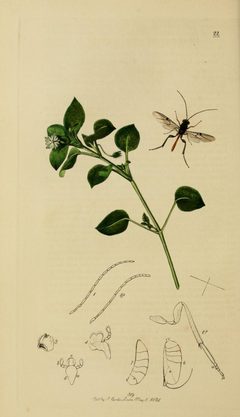
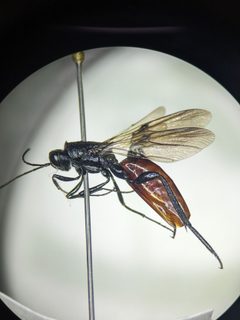
Pronunciation
How to pronounce Ibalia leucospoides: /iːˈbeɪliə luːˈkɒspɔɪdiːz/
These audio files are automatically generated. While they are not always 100% accurate, they are a good starting point.
Identification
Laterally compressed, knife-shaped that appears flattened as if pressed between pages. Body length approximately 15 mm. Black , , and legs; abdomen dark red, rectangular, and unmarked. Wings transparent with semitransparent ends. with 13 segments in females, 15 in males. Distinguished from Ibalia anceps by color pattern differences.
Images
Habitat
Forests dominated by conifers including Abies, Cupressus, Libocedrus, Picea, Pinus, and Tsuga . Frequently found in conifer plantations where introduced for .
Distribution
Native to Africa, Australia, Europe and Northern Asia (excluding China), North America, and Southern Asia. Introduced to additional countries for of Sirex noctilio.
Seasonality
active April to December depending on geographic location. , with one per year typically coinciding with .
Host Associations
- Sirex noctilio - primary woodwasp; main target of introductions
- Sirex nigricornis - native North American woodwasp
- Urocerus - woodwasp
- Xeris - woodwasp
- Tremex columba - Pigeon Tremex horntail, probable in some regions
Life Cycle
with one per year. Females lay on eggs or first-instar larvae of siricid woodwasps concealed within conifer wood. Larva initially feeds internally as endoparasitoid, later exiting to feed externally. occurs within host gallery. emerge to feed on remains of woodwasp larvae before pupating. Pro-ovigenic strategy with high initial egg load relative to potential lifetime .
Behavior
Courtship involves rhythmic lateral movements, mounting, -nodding cycles in males, and wing-fanning in females. Males attracted to blend of four straight-chain alkanes (C23, C25, C26, C27) in sex-specific ratios. Females locate using olfactory cues from the fungal Amylostereum areolatum, particularly attracted to volatiles from two-week-old fungal cultures. Can discriminate host patch quality from distance without sampling, with patch residence time influenced by surrounding quality. Con-specific interference occurs when differently-sized females compete on same patch, with smaller female typically abandoning site. capacity shows high individual variability, positively correlated with body size and negatively with wing loading.
Ecological Role
Specialized regulating of woodwasps in conifer forests. Acts as agent against Sirex noctilio, though characterized as better population regulator than suppressor due to spatial and temporal . Introductions have established successfully in Southern Hemisphere, though spread capacity may lag behind that of host at regional .
Human Relevance
Widely introduced for of Sirex noctilio, a destructive pest of pine plantations. Two used in introductions: I. l. leucospoides (Palearctic) and I. l. ensiger (Nearctic). Genetic studies indicate introductions drew from wide geographic range with possible bottlenecks. No evidence of hybridization between subspecies in introduced range.
Similar Taxa
- Ibalia ancepsSimilar laterally compressed body form and size; distinguished by different color pattern, particularly in wing markings. I. anceps associated primarily with deciduous hardwood such as hickory and Tremex columba, whereas I. leucospoides specializes on conifer-inhabiting siricids.
Sources and further reading
- BugGuide
- Wikipedia
- GBIF taxonomy match
- iNaturalist taxon
- Catalogue of Life
- Bug Eric: Ibaliid Wasps
- Bug Eric: Wasp Wednesday: Pigeon Tremex Horntail
- Linking reproductive and feeding strategies in the parasitoid Ibalia leucospoides: does feeding always imply profit?
- The Influence of Food and Con-specifics on the Flight Potential of the Parasitoid Ibalia leucospoides
- Table 1: Components of each blend used in behavioral assays for male Ibalia leucospoides .
- Host selection by Ibalia leucospoides based on temporal variations of volatiles from the hosts’ fungal symbiont
- The effects of patch richness on con‐specific interference in the parasitoidIbalia leucospoides(Hymenoptera: Ibaliidae)
- A double-edged sword: Amylostereum areolatum odors attract both Sirex noctilio (Hymenoptera: Siricidae) and its parasitoid, Ibalia leucospoides
- The functional response ofIbalia leucospoides(Hymenoptera: Ibaliidae), a parasitoid ofSirex noctilio(Hymenoptera: Siricidae)
- Influence of life history traits and information use on resource acquisition and dispersal in the parasitoid Ibalia leucospoides Hochenwarth (Hymenoptera Ibaliidae)
- Response of wasp parasitoidIbalia leucospoidesto volatiles from fungal symbiont (Amylostereumareolatum) of Sirex noctilio
- Olfactory Stimulants for Sirex nigricornis (Hymenoptera: Siricidae) and its Parasitoid, Ibalia leucospoides (Hymenoptera: Ibaliidae), in Odors of Stressed and Bark Beetle–Colonized Pines
- Classical biological control of an invasive forest pest: a world perspective of the management ofSirex noctiliousing the parasitoidIbalia leucospoides(Hymenoptera: Ibaliidae)
- Patch choice from a distance and use of habitat information during foraging by the parasitoid Ibalia leucospoides
- Courtship behavior and identification of a sex pheromone in Ibalia leucospoides (Hymenoptera: Ibaliidae), a larval parasitoid of Sirex noctilio (Hymenoptera: Siricidae)
- Food and Host Searching Decisions Made by Ibalia leucospoides (Hymenoptera: Ibaliidae), a Parasitoid of Sirex noctilio (Hymenoptera:Siricidae)
- Sequence data reflect the introduction pathways of the Sirex woodwasp parasitoid, Ibalia leucospoides (Ibaliidae, Hymenoptera)