
Sirex nigricornis
Fabricius, 1781
black-horned woodwasp, native woodwasp
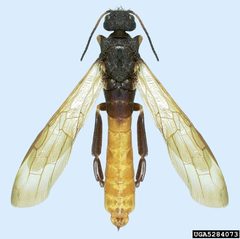
Sirex nigricornis is a native North American woodwasp ( Siricidae) that inhabits pine forests in the eastern United States. Unlike the Sirex noctilio, this primarily attacks stressed, dying, or recently dead pines rather than healthy trees. Females possess a prominent ovipositor for drilling into wood and deposit along with a symbiotic wood-decaying fungus. The species serves as for multiple including the Deladenus proximus, which sterilizes female eggs, and the ichneumonid Rhyssa howdenorum.
Pronunciation
How to pronounce Sirex nigricornis: /ˈsaɪrɛks nɪɡɪˈkɔrnɪs/
These audio files are automatically generated. While they are not always 100% accurate, they are a good starting point.
Images
Habitat
Pine forests; specifically associated with shortleaf pine (Pinus echinata) and other pine . Requires wood of appropriate moisture content and decay stage for larval development—freshly cut bolts are preferred for oviposition drilling, but 15-day-old bolts are required for successful .
Distribution
Native to eastern North America; documented from Arkansas, Louisiana, central Louisiana pine forests, and Ontario, Canada.
Host Associations
- shortleaf pine (Pinus echinata) - plant for oviposition and larval developmentFemales drill into wood to deposit ; larval development requires specific wood aging conditions
- Deladenus proximus - parasitic Parasitizes larvae and sterilizes in females; rates 16-43% among sites and years
- Rhyssa howdenorum - Ichneumonid ; and period timed to availability in central Louisiana
- Ibalia leucospoides - Shares olfactory attraction to stressed pine volatiles with ; uses same chemical cues for host location
Life Cycle
Complete with wood-boring larval stage. Females drill into pine bolts using ovipositor to deposit . Successful development and requires wood bolts seasoned approximately 15 days; freshly cut wood (0-day) is preferred for oviposition drilling but does not support successful emergence. Moisture content decreases over seasoning time with majority of loss at bolt ends.
Behavior
Females exhibit strong oviposition preference for freshly cut pine bolts, drilling into wood with prominent ovipositor. This preference is mismatched with developmental requirements—successful only occurs from 15-day-old bolts. attracted to olfactory stimulants from stressed and bark beetle-colonized pines, including oxygenated monoterpenes (verbenone, fenchone, terpinen-4-ol) and bark beetle (frontalin, endo-brevicomin, ipsenol, ipsdienol). Males are more frequently parasitized by than females when emerging from the same trees.
Ecological Role
Wood-borer that accelerates decomposition of stressed and dying pines; of wood-decaying symbiotic fungus. Serves as for multiple and parasitic , contributing to forest complexity. influenced by -dependent .
Human Relevance
Not considered a pest of healthy trees; targets already compromised pines. Distinguished from Sirex noctilio which attacks healthy trees. Research subject for development of monitoring lures based on olfactory attraction to stressed pine volatiles.
Similar Taxa
- Sirex noctilio ; S. nigricornis is native and primarily attacks stressed/dying pines while S. noctilio attacks healthy trees
- Tremex columbaAnother siricid woodwasp with similar cigar-shaped body and prominent ovipositor, but different tree associations (hardwoods vs. pines)
Sources and further reading
- BugGuide
- GBIF taxonomy match
- iNaturalist taxon
- NCBI Taxonomy
- Encyrtid Holdings | Entomology Research Museum
- Bug Eric: Tiny Wasp Hero Slays Redback Spiders in Australia
- Bug Eric: Tree Cricket Courtship
- Bug Eric: Wasp Wednesday: Chlorion aerarium
- Bug Eric: Wasp Wednesday: Pigeon Tremex Horntail
- Olfactory Stimulants for Sirex nigricornis (Hymenoptera: Siricidae) and its Parasitoid, Ibalia leucospoides (Hymenoptera: Ibaliidae), in Odors of Stressed and Bark Beetle–Colonized Pines
- Sirex nigricornis (Hymenoptera: Siricidae) Oviposition Preference and Development in Relation to Host Age, and a Novel Live-Trapping System for Wood-Borers
- Timing of Adult Emergence and Flight Period of Rhyssa howdenorum (Hymenoptera: Ichneumonidae), a Parasitoid of Sirex nigricornis (Hymenoptera: Siricidae), in Central Louisiana
- Pathology, distribution, morphological and genetic identity of Deladenus proximus (Tylenchida: Neotylenchidae) a parasitic nematode of the woodwasp, Sirex nigricornis in the eastern United States
- Natural Enemies Associated With <I>Sirex noctilio</I> (Hymenoptera: Siricidae) and <I>S. nigricornis</I> in Ontario, Canada
- Association of the native parasitic nematode Deladenus proximus with individuals and populations of the native woodwasp Sirex nigricornis