
Urocerus
Geoffroy, 1762
horntail, woodwasp
Species Guides
5- Urocerus albicornis(white-horned horntail)
- Urocerus californicus(California Horntail)
- Urocerus cressoni(Black-and-red Horntail)
- Urocerus flavicornis(Yellow-horned Horntail)
- Urocerus taxodii(Taxodium horntail)
Urocerus is a of horntails (woodwasps) in the Siricidae containing approximately seven to eight described . These large, non-venomous are characterized by their elongated, cylindrical bodies and prominent cornus (horn-like spine) at the tip of the . Females possess a long, drill-like ovipositor used to insert into dead, dying, or weakened trees. Species in this genus are obligate mutualists with wood-decaying fungi, which they and cultivate for larval nutrition. Several species have broad distributions across the Northern Hemisphere, with some introduced outside their native ranges.
Pronunciation
How to pronounce Urocerus: /ˌjʊəroʊˈsiːrəs/
These audio files are automatically generated. While they are not always 100% accurate, they are a good starting point.
Identification
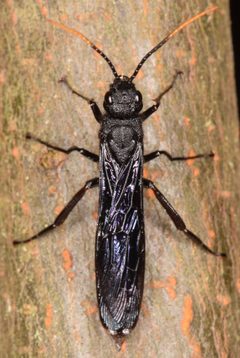
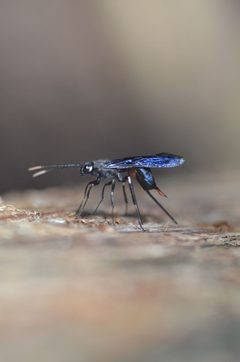
Members of Urocerus can be distinguished from other siricid by their large size and specific morphological features. Urocerus gigas, the giant woodwasp, is among the largest siricids, with females reaching 37–50 mm and males 18–37 mm. The body is cylindrical and cigar-shaped, with the broadly joined to the . Both sexes possess a short, spine-like cornus at the tip of the abdomen; females additionally have a long, needle-like ovipositor projecting ventrally. Antennal coloration varies among : U. flavicornis has yellow , U. albicornis has white antennae, and U. californicus occurs in western North America. Western specimens of related species often exhibit paler coloration than eastern .
Images
Habitat
Forested areas with dead, dying, or weakened trees. utilize both coniferous and deciduous depending on the species. Urocerus gigas occurs in coniferous forest stands with weakened and declining trees, particularly Norway spruce (Picea abies). Other species are associated with hardwood trees including maple, beech, elm, apple, pear, poplar, oak, hickory, sycamore, and hackberry. Horntails are attracted to fire-damaged trees and newly felled timber.
Distribution
Widespread across the Northern Hemisphere. Urocerus gigas is native to Europe, Asia, and Northern Africa. Urocerus albicornis is native to North America but has been introduced and established in northern Spain and other parts of Europe. Urocerus japonicus occurs in Japan. Urocerus californicus is found in western North America including California, Oregon, and Utah. Records exist from Vermont in the eastern United States. The has been documented in Scandinavia (Denmark, Norway, Sweden) and the Baltic region.
Seasonality
are active from late June through September, with peak activity during summer months. typically occurs in late summer or fall. In the Basque Country (Spain), flight period was documented from late June to September. Development from to adult typically requires more than one year.
Diet
Larvae are fully dependent on mutualistic fungi for nutrition. feeding habits are poorly documented; adults may not feed, or may feed on tree sap from wounds.
Life Cycle
Females drill into wood using their ovipositor and inject along with fungal spores or oidia stored in specialized abdominal glands (mycangia). The fungus decomposes wood through white rot, creating accessible nutrients for developing larvae. Larvae are -like, possess a terminal cornus, and feed on the decayed wood and fungal mycelium. Development typically spans more than one year. occurs within the wood, and emerge through exit holes. The cycle continues when females fungal to new trees.
Behavior
Females use their ovipositor to drill into bark and wood, creating tunnels for deposition. This drilling , combined with fungal inoculation, weakens trees and creates optimal conditions for fungal . are non-aggressive and do not sting; the apparent "stinger" is the harmless cornus in both sexes and the ovipositor in females. Males are often observed resting quietly on foliage. Adults are attracted to weakened or fire-damaged trees. Some specific fungal mutualists with high genetic diversity in fungal .
Ecological Role
Secondary forest insects that exploit trees already stressed by environmental factors, , or other damage. They are not primary pests of healthy trees. As obligate fungal mutualists, they contribute to wood decomposition and nutrient cycling in forest . They serve as for including giant ichneumons (Megarhyssa) and ibaliid wasps (Ibalia), which drill into wood to attack horntail larvae. Some economically important tree-pathogenic fungi, particularly Amylostereum species, which can cause wood rot and drying in coniferous trees.
Human Relevance
Large size and intimidating appearance cause alarm, but they are non-venomous and harmless to humans. Occasionally mistaken for stinging . Urocerus albicornis has been introduced to Europe and is subject to pest risk assessment. Urocerus gigas Amylostereum chailletii, a fungus of economic concern to conifer forestry. sometimes emerge from firewood stored indoors. Generally considered beneficial or neutral in forest , with no control measures needed for homeowners.
Similar Taxa
- TremexTremex columba (Pigeon Tremex) is another large siricid with similar cylindrical body shape, cornus, and long ovipositor in females. Distinguished by distribution (Tremex primarily eastern North America, Urocerus more widespread) and antennal characteristics; Urocerus often have distinctive pale .
- SirexSirex are also large woodwasps with fungal mutualisms, but differ in fungal associate (Amylostereum areolatum vs. A. chailletii in Urocerus gigas) and show different patterns of fungal genetic diversity. Sirex noctilio is a notable pest, whereas most Urocerus species are not considered primary pests.
- XiphydriaXiphydria are smaller siricids (around 0.5 inches) with similar body plan but reduced size; may be confused with small horntails but lack the large size and prominent ovipositor of Urocerus.
Sources and further reading
- BugGuide
- Wikipedia
- GBIF taxonomy match
- iNaturalist taxon
- NCBI Taxonomy
- Catalogue of Life
- Bug Eric: Wasp Wednesday: Pigeon Tremex Horntail
- Amylostereum laevigatum associated with the Japanese horntail, Urocerus japonicus
- Amylostereum laevigatum associated with a horntail, Urocerus antennatus
- Fungal Communities Associated with Siricid Wood Wasps: Focus on Sirex juvencus, Urocerus gigas, and Tremex fuscicornis
- Composición de especies y periodo de vuelo de las avispas de la madera (Hymenoptera: Siricidae) en los bosques de coníferas del País Vasco, con la confirmación del asentamiento de la especie exótica Urocerus albicornis (Fabricius, 1781) en el norte de España
- Pest categorisation of Urocerus albicornis.
- Pest categorisation of Urocerus japonicus.