
Ibalia
Latreille, 1802
Species Guides
2- Ibalia anceps
- Ibalia leucospoides(knife-shaped ibalia)
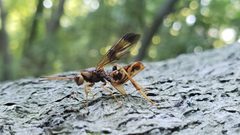
Ibalia is a of in the Ibaliidae, comprising approximately 13-14 described . All species are specialized parasitoids of siricid woodwasps (family Siricidae), attacking the larval stages of their within dead or decaying wood. Females locate host larvae by detecting volatile compounds emitted by symbiotic fungi that siricids cultivate for nutrition. The genus is notable for its laterally compressed , giving a distinctive flattened appearance, and for its role as a agent against woodwasps such as Sirex noctilio.
Pronunciation
How to pronounce Ibalia: //aɪˈbeɪliə//
These audio files are automatically generated. While they are not always 100% accurate, they are a good starting point.
Identification
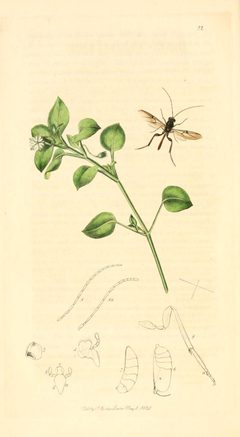
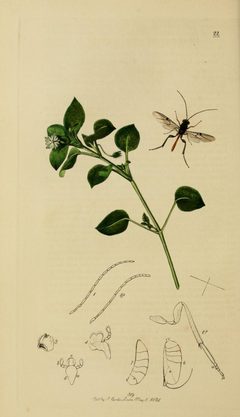
Ibalia are recognized by their strongly laterally compressed , appearing as if flattened between two surfaces. The body is relatively large compared to other Cynipoidea, averaging 12-14 mm in length. Males possess 15 antennal segments while females have 13 segments. Females have a visible ovipositor for drilling into wood to reach larvae. Coloration and wing patterns vary geographically among species.
Images
Habitat
Forested areas with dead, dying, or weakened hardwood and coniferous trees that support siricid woodwasp . characterized by highly aggregated distribution of and specific resource availability.
Distribution
Widespread in the Northern Hemisphere; Ibalia anceps ranges from Nova Scotia, Ontario, and Wisconsin south to Florida and Texas and west to Colorado. Other occur in Europe and Asia. Ibalia leucospoides has been widely introduced to the Southern Hemisphere for programs.
Seasonality
of Ibalia anceps fly primarily in late May and early June. Activity patterns of other vary by region and availability.
Host Associations
- Siricidae (family) - PARASITOID_OFAll Ibalia are of siricid woodwasps; specific associations include Tremex columba, Sirex noctilio, Sirex cyaneus, Sirex nigricornis, Tremex apicalis, Xeris spectrum, and Urocerus gigas
Life Cycle
Proovigenic strategy: females emerge with a high proportion of mature relative to their potential . feeding has negligible effect on egg maturation, survival, or capacity. Females drill into wood with their ovipositor to deposit eggs on or near siricid larvae. The ibaliid larva initially feeds internally as an endoparasitoid, then exits to complete development as an ectoparasitoid.
Behavior
Females locate patches by detecting volatile compounds emitted by symbiotic fungi (Amylostereum and Cerrena ) that siricid larvae feed on, rather than detecting hosts directly. Females can discern differences in host patch quality at a distance without sampling, and patch exploitation time depends on information obtained from neighboring patches. Courtship includes rhythmic lateral movements, mounting, -nodding cycles in males, and wing-fanning in females. Males are attracted to a blend of four straight-chain alkanes (C23, C25, C26, C27) in sex-specific ratios that function as a contact . capacity depends on morphological characteristics including size and wing loading.
Ecological Role
agent of siricid woodwasps. Acts as a regulator rather than suppressor of populations due to spatial and temporal that allow host persistence. Contributes to forest dynamics by influencing populations of wood-boring insects.
Human Relevance
Used in programs, particularly Ibalia leucospoides for management of the woodwasp Sirex noctilio in pine plantations of the Southern Hemisphere. Not a pest or threat to humans; does not sting.
Similar Taxa
- IchneumonidaeIchneumonid wasps also possess long ovipositors for drilling into wood to reach , but differ in having cylindrical rather than laterally compressed and different wing venation
- MegarhyssaGiant ichneumon also parasitize wood-boring insects and have extremely long ovipositors, but are larger, have different body proportions, and lack the compressed of Ibalia
- RhyssaAlso parasitizes siricid larvae but belongs to Ichneumonidae; differs in body shape and is generally larger with different ovipositor structure
Sources and further reading
- BugGuide
- Wikipedia
- GBIF taxonomy match
- iNaturalist taxon
- NCBI Taxonomy
- Catalogue of Life
- Bug Eric: Ibaliid Wasps
- Bug Eric: Wasp Wednesday: Pigeon Tremex Horntail
- On the taxonomy of some forms of Ibalia Latreille (Hymenoptera: Cynipoidea) associated with conifers
- Table 1: Components of each blend used in behavioral assays for male Ibalia leucospoides .
- Influence of life history traits and information use on resource acquisition and dispersal in the parasitoid Ibalia leucospoides Hochenwarth (Hymenoptera Ibaliidae)
- Response of wasp parasitoidIbalia leucospoidesto volatiles from fungal symbiont (Amylostereumareolatum) of Sirex noctilio
- Linking reproductive and feeding strategies in the parasitoid Ibalia leucospoides: does feeding always imply profit?
- Further Biological Notes on Rhyssa and Ibalia, parasitising Sirex cyaneus, Fabr.
- Olfactory Stimulants for Sirex nigricornis (Hymenoptera: Siricidae) and its Parasitoid, Ibalia leucospoides (Hymenoptera: Ibaliidae), in Odors of Stressed and Bark Beetle–Colonized Pines
- The effects of patch richness on con‐specific interference in the parasitoidIbalia leucospoides(Hymenoptera: Ibaliidae)
- The Influence of Food and Con-specifics on the Flight Potential of the Parasitoid Ibalia leucospoides
- Patch choice from a distance and use of habitat information during foraging by the parasitoid Ibalia leucospoides
- The attraction of Tremex apicalis (Hymenoptera, Siricidae, Tremecinae) and its parasitoid Ibalia japonica (Hymenoptera, Ibaliidae) to the fungus Cerrena unicolor
- The functional response ofIbalia leucospoides(Hymenoptera: Ibaliidae), a parasitoid ofSirex noctilio(Hymenoptera: Siricidae)
- Courtship behavior and identification of a sex pheromone in Ibalia leucospoides (Hymenoptera: Ibaliidae), a larval parasitoid of Sirex noctilio (Hymenoptera: Siricidae)
- Classical biological control of an invasive forest pest: a world perspective of the management ofSirex noctiliousing the parasitoidIbalia leucospoides(Hymenoptera: Ibaliidae)
- The biology of Ibalia drewseni Borries (Hymenoptera: Ibaliidae), a parasite of siricid woodwasps