
Diplolepis nervosa
(Curtis, 1838)
Spiked Pea Gall Wasp
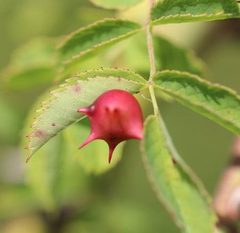
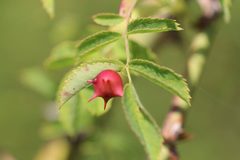
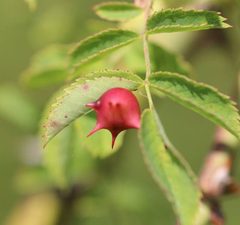
Diplolepis nervosa is a gall wasp in the Diplolepididae that induces distinctive spiked pea galls on wild roses (Rosa ). Like other members of its , it exhibits an with both sexual and parthenogenetic phases. The species is native to Europe and has been introduced to North America, where it has become established. The galls it produces are among the most recognizable of rose galls due to their characteristic spiny, pea-like appearance.
Pronunciation
How to pronounce Diplolepis nervosa: //ˌdɪploʊˈlɛpɪs nərˈvoʊsə//
These audio files are automatically generated. While they are not always 100% accurate, they are a good starting point.
Identification
The galls of Diplolepis nervosa are diagnostic: small, spherical, pea-like structures approximately 5–10 mm in diameter, covered with numerous sharp, slender spines or filaments that give them a bristly appearance. These galls are borne on the leaves and stems of wild roses, typically clustered. The are tiny, approximately 2–3 mm in length, with reduced wing venation typical of cynipoids. Females have a visible ovipositor for inserting into plant tissue. The can be distinguished from the related Diplolepis rosae (which produces the smooth, mossy rose gall) by the spiny rather than mossy or smooth gall surface.
Images
Habitat
Found in supporting wild rose , including hedgerows, woodland edges, scrubland, and disturbed ground. The requires access to Rosa species as obligate for gall development.
Distribution
Native to Europe; recorded from Belgium, the United Kingdom, and other parts of western and central Europe. Introduced to North America, with established in Canada and the United States.
Seasonality
Sexual emerge in spring from overwintered galls; parthenogenetic (agamic) generation females emerge in late summer to autumn. Gall formation is most evident on plants during late spring through summer.
Diet
Larvae feed on nutritive tissue within the gall induced on Rosa . do not feed; they rely on larval reserves and brief nectar feeding if at all.
Host Associations
- Rosa - gall Obligate; induces galls on leaves and stems
Life Cycle
Exhibits heterogony (). The sexual produces bisexual that mate and give rise to the parthenogenetic generation. The agamic generation consists solely of females that reproduce parthenogenetically and produce the galls. Larvae develop within the gall tissue, which provides both nutrition and protection.
Behavior
Females insert into plant tissue using their ovipositor, simultaneously introducing chemical stimuli that induce gall formation. The developing larva feeds on the nutritive layer of lining the gall interior, manipulating plant growth to maintain this food source. are short-lived and primarily focused on .
Ecological Role
As a gall inducer, modifies plant growth and creates microhabitats that support a of , , and other gall-associated insects. The galls serve as a food source and shelter for these secondary occupants, contributing to local biodiversity.
Human Relevance
Of minor economic significance; galls cause cosmetic damage to ornamental roses but rarely threaten plant health. Occasionally studied in contexts and as a model for understanding plant-insect interactions and gall induction mechanisms.
Similar Taxa
- Diplolepis rosaeProduces the mossy rose gall on Rosa, but galls are larger, irregularly lobed, and covered with moss-like filaments rather than distinct spines; galls are often reddish and less spherical.
- Diplolepis mayriAnother European Diplolepis on Rosa; produces different gall (bullet galls or spiny bedeguar variants), with galls typically more elongated and with different spine arrangement.
- Diplolepis spinosaAlso produces spiny galls, but spine and gall size differ; precise identification often requires gall examination and context.