
Diplolepis rosae
(Linnaeus, 1758)
Mossy Rose Gall Wasp, Rose Bedeguar Gall Wasp, Robin's Pincushion Gall Wasp
A gall-inducing in the Diplolepididae that forms distinctive mossy, pincushion-like galls on wild roses, primarily Rosa canina and Rosa arvensis. The is notable for its predominantly parthenogenetic , with fewer than 5% males in most . Females lay up to 60 in developing rose buds, inducing chemically-driven plant tissue distortion that creates the characteristic bedeguar gall. The wasp has been introduced to North America alongside cultivated roses.
Pronunciation
How to pronounce Diplolepis rosae: /ˌdɪpləˈlɛpɪs ˈroʊzae/
These audio files are automatically generated. While they are not always 100% accurate, they are a good starting point.
Identification
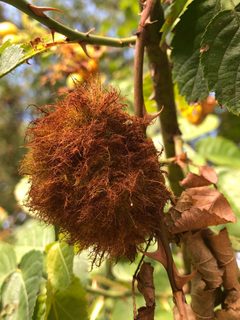
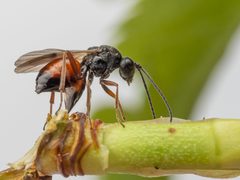
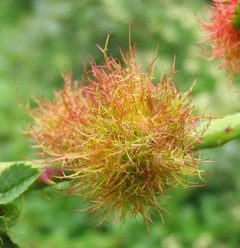
The can be distinguished from other Diplolepis by the female's yellow-red abdominal and leg markings on a black body, and the presence of a hypopygium. The gall is diagnostic: D. rosae produces the densely filamentous, moss-covered 'bedeguar' or 'Robin's pincushion' gall, whereas the related D. mayri induces galls with sparse, short, unbranched filaments typically on twigs rather than buds. Gall location also differs: D. rosae galls form predominantly on leaf axils (85.1%) and shoot sides (63.5%), with fewer on flowers/fruits and shoot tips.
Images
Habitat
Heathland, scrubland, and hedgerows supporting wild rose shrubs; in North America also found in parks and gardens with cultivated roses. Galls occur more frequently on plants under stress from drought, waterlogging, or damage, and on younger or damaged plants rather than vigorous, intact specimens. Laboratory rearing successful on multiple Rosa under controlled conditions.
Distribution
Native to Europe; introduced to North America. Recorded from Belgium, Canada, Czech Republic (Brno region), France, Hungary, Romania, and other European countries. GBIF records confirm presence in Belgium and Canada.
Seasonality
emerge from galls primarily in May, with emergences continuing through August in some . laid May-July; first instar larvae June-August; second instar July-October or March depending on climate; pupae present mid-March to mid-July. Gall growth most rapid June-July, completing by October.
Host Associations
- Rosa canina - primary dog rose
- Rosa arvensis - primary field rose
- Rosa rubiginosa - secondary sweet briar rose
- Rosa dumalis - secondary
- Rosa rubrifolia - secondary
- Rosa gallica - laboratory
- Rosa spinosissima - laboratory
- Periclistus brandtii - found in 10% of galls, 3.6% of ; harmless co-occupant
- Eurytoma rosae - attacks both D. rosae and P. brandtii larvae
- Glyphomerus stigma - attacks both D. rosae and P. brandtii larvae
- Orthopelma mediator - ichneumon that lays directly into D. rosae larvae
- Caenacis inflexa - hyperparasitoid
- Pteromalus bedeguaris - hyperparasitoid
Life Cycle
Females lay singly on epidermal within developing rose buds using a specialized ovipositor inserted between leaflets. Larval feeding stimulates plant to produce enlarged 'nutritive' cells that are continually replaced and consumed. Five larval instars; development rate and hibernation stage climate-dependent. In warm/dry conditions, 70% overwinter as and 30% as second instar larvae; in milder conditions, 47% prepupae and 53% larvae. Prepupa undergoes final moult to pupa in February-March. emerge May-July. No ; primarily parthenogenetic year-round in laboratory conditions.
Behavior
Females use modified ovipositor to deposit between developing leaflets of expanding buds. Gall formation involves rapid tissue proliferation June-July, with concentric layers developing around a nutritive core. Galls positioned closer to ground produce higher success. Larger galls show reduced rates relative to gall volume. Vertebrate occasionally break open mature galls to access larvae/pupae.
Ecological Role
Gall formation creates complex microhabitat supporting diverse of , , and hyperparasitoids. Acts as natural control on wild roses by redirecting plant resources into gall tissue. Nutrient cycling through approximately 50% preimaginal mortality. Associated parasitic fungus Phragmidium subcorticum frequently attacks gall tissues.
Human Relevance
Subject of extensive folklore; names 'bedeguar' and 'Robin's pincushion' reflect cultural significance. No economic damage to roses despite gall formation; galls cause only cosmetic effects. Used in laboratory studies of gall induction, - interactions, and evolution of . Potential biocontrol interest for related pest .
Similar Taxa
- Diplolepis mayriAlso induces galls on roses, but produces sparsely filamented, twig-based galls with short unbranched filaments rather than dense mossy structures; historically less common and more suited to laboratory rearing
- Other Cynipidae/DiplolepididaeNumerous gall wasps induce rose galls, but D. rosae is distinguished by the unique bedeguar and specific associations
More Details
Reproductive biology
Two distinct genetic lineages identified in French , differing 13.2-fold in rate and 1.6-fold in heterozygosity. The higher-recombination lineage shows purifying selection on male trait genes, suggesting maintenance of capacity despite predominant thelytoky. endosymbiont implicated in female-biased sex ratios through manipulation.
Gall architecture
Galls consist of 1-20 intergrown parts (mean 7) containing 1-225 (mean 54). Cell size varies by inhabitant: largest cells (3.9×3.1 mm) contain successfully developing gall wasps. Optimal clutch size appears to be 25-30 chambers based on success, with secondary peak around 60 chambers.
Historical notes
First described by Linnaeus in 1758 as Cynips rosae. Subject of early biological study by Alfred C. Kinsey, who began his scientific career with two decades of cynipid research before his famous human sexuality work.
Sources and further reading
- BugGuide
- Wikipedia
- GBIF taxonomy match
- iNaturalist taxon
- NCBI Taxonomy
- Bug Eric: Wasp Wednesday: Gall Wasps
- An Introduction to the Wonderful World of Wasps: Meet the Heath Sand Wasp - Buglife Blog - Buglife
- ID Challenge #16 | Beetles In The Bush
- new species | Blog - Part 4
- Dynamic Rearrangement Events in the Mitogenomes of Gall Inducing Wasps, Diplolepis fructuum and Diplolepis rosae (Hymenoptera: Diplolepididae)
- Diplolepis Rosae (L.) (Hymenoptera: Cynipidae): Development, Ecology and Galls in the Brno Region
- A robust multigenerational laboratory rearing methodology for Diplolepis mayri and Diplolepis rosae on wild roses ( Rosa spp.)
- Distribution of Wolbachia among the guild associated with the parthenogenetic gall wasp Diplolepis rosae
- Distribution of Wolbachia among the guild associated with the parthenogenetic gall wasp Diplolepis rosae
- ANATOMY OF THE OVIPOSITOR AND OVIPOSITION BEHAVIOR OF THE GALL WASPDIPLOLEPIS ROSAE(HYMENOPTERA: CYNIPIDAE)
- No host-associated differentiation in the gall wasp Diplolepis rosae (Hymenoptera: Cynipidae) on three dog rose species
- Optimal clutch size of the gall wasp <i>Diplolepis rosae</i> (Hymenoptera: Cynipidae)
- Host Plant Specificity and Allozyme Variation in the Parthenogenetic Gall Wasp Diplolepis mayri and its Relatedness to D. rosae (Hymenoptera: Cynipidae)
- Population genomics of the mostly thelytokous Diplolepis rosae (Linnaeus, 1758) (Hymenoptera: Cynipidae) reveals population-specific selection for sex
- Transcriptome analysis of Diplolepis rosae : revealing overexpression of genes potentially associated with insect immune response and gall formation at early larval stages
- Population Genomics of the Mostly Thelytokous Diplolepis rosae (Linnaeus, 1758) (Hymenoptera: Cynipidae) Reveals Population-specific Selection for Sex
- The effect of hosptlant and parasitoids on the reproductive success of the parthenogenetic gall wasp Diplolepis rosae (Hymenoptera, Cynipidae)
- No Concordant Phylogeographies of the Rose Gall Wasp Diplolepis rosae (Hymenoptera, Cynipidae) and Two Associated Parasitoids across Europe
- Correction to: Interrupted hibernation of the gall-inducer affects its parasitoids – a case study on some gall communities of Diplolepis rosae (Hymenoptera: Cynipidae) in Bulgaria