
Disholcaspis canescens
Round Honeydew Gall Wasp
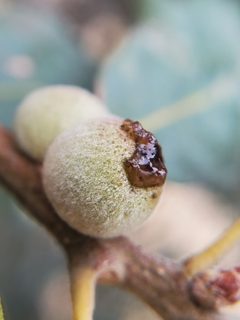
Disholcaspis canescens is a of gall wasp in the Cynipidae, known for inducing distinctive galls on oak trees. Like other members of the Disholcaspis, this species produces round, detachable galls on oak twigs. The genus is notable for having eliminated males from the in all known species, with females reproducing parthenogenetically and producing only female offspring. The specific epithet 'canescens' refers to a grayish or hoary appearance, though the precise application to this species' galls or is not detailed in available sources.
Pronunciation
How to pronounce Disholcaspis canescens: //dɪsˌhɒlkəˈspɪs kəˈnɛsɛnz//
These audio files are automatically generated. While they are not always 100% accurate, they are a good starting point.
Identification
Galls of Disholcaspis canescens are round and detachable, formed on oak twigs. The galls are distinguished from other Disholcaspis by their specific morphological characteristics and associations, though precise diagnostic features require examination. The Disholcaspis produces 'bullet galls' or similar rounded twig galls that are generally harder and more woody than leaf galls. Species-level identification typically requires knowledge of the host oak species and gall , as the themselves are small and morphologically similar.
Images
Habitat
Associated with oak-dominated forests and woodlands where oak occur. The specific requirements beyond host presence are not documented.
Seasonality
females emerge in fall and immediately oviposit into oak twigs to initiate the next , consistent with the seasonal pattern reported for other Disholcaspis .
Host Associations
- Quercus - gall induction on twigs oak not specified in available sources; -level association only
Life Cycle
Reproduces via (thelytoky) with no males known. Females emerge from galls in fall and lay directly into oak twigs without mating. The resulting galls develop over the following growing season, with new females emerging to continue the cycle. This represents an 'agamic' lacking .
Behavior
Females inject into oak twig tissue using their ovipositor, simultaneously introducing secretions that induce gall formation. The enlarged venom glands characteristic of gall-inducing Cynipidae are likely employed in this process.
Ecological Role
As a gall inducer, creates specialized microhabitats on oak trees that may be utilized by other organisms. The galls provide shelter and food for the larvae, and potentially for and , though specific associations for this are not documented.
Similar Taxa
- Disholcaspis quercusglobulusAlso produces round bullet galls on oak twigs; distinguished by specific gall and oak preferences
- Disholcaspis quercusmammaProduces rough bullet galls on oaks; has notably large venom glands ( occupying one-third of volume)
- Other Disholcaspis speciesApproximately a dozen in all produce similar twig galls; require examination of gall and for identification