
Callirhytis quercuspunctata
(Bassett, 1863)
Gouty Oak Gall Wasp
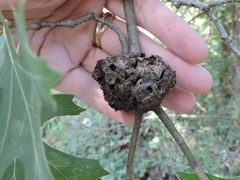
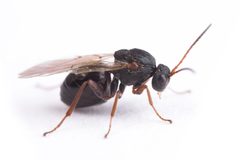
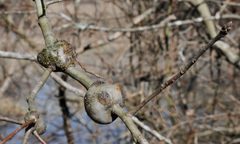
Callirhytis quercuspunctata, commonly known as the Gouty Oak Gall Wasp, is a cynipid gall wasp that induces gouty oak galls on oak trees. Like other members of the Callirhytis, this has a complex involving alternating that produce distinct gall types on different oak tissues. The manipulates oak growth through chemical secretions to create protective structures housing developing larvae. The species is associated with oaks (Quercus spp.) and has been documented across eastern North America.
Pronunciation
How to pronounce Callirhytis quercuspunctata: /ˌkælɪˈraɪtɪs ˌkwɜrkəsˌpʌŋkˈteɪtə/
These audio files are automatically generated. While they are not always 100% accurate, they are a good starting point.
Identification
Distinguished from other oak gall wasps by the distinctive gouty gall : hard, woody, irregular swellings on branches rather than leaves or acorns. Differs from the related horned oak gall wasp (Callirhytis cornigera) by lacking the characteristic horn-like projections on mature galls. Separated from bullet gall formers (Disholcaspis spp.) by the irregular, tumor-like gall shape versus the smooth, bullet-shaped galls. Leaf-galling cynipids such as Neuroterus and Cynips produce entirely different gall structures on oak foliage. Accurate species-level identification typically requires gall examination and oak species confirmation.
Images
Habitat
Associated with oak-dominated including deciduous forests, woodlands, urban and suburban areas with oak plantings, and riparian corridors where oaks occur. The requires living oak tissue for gall induction and development.
Distribution
Eastern North America, with observations concentrated in the United States. Documented from the Midwest through the eastern seaboard, including Missouri and Maryland. Distribution corresponds with range of oak .
Seasonality
Activity patterns follow the typical cynipid bimodal with spring and summer . Exact timing varies by geographic location and oak . Gall formation on branches becomes visible as woody swellings during growing seasons.
Host Associations
- Quercus spp. - Induces galls on oak branches and twigs; specific oak associations require verification
Life Cycle
Exhibits heterogonic with alternating parthenogenetic (agamic) and sexual , a characteristic of many cynipid . The agamic generation produces females asexually that develop within woody branch galls. Sexual generation involves male and female wasps emerging from typically smaller, often leaf-based galls, though specific gall locations for C. quercuspunctata generations are not fully documented. Larval development occurs entirely within gall chambers, with emerging through exit holes chewed through gall tissue.
Behavior
Females inject into oak tissue along with gall-inducing chemical secretions that manipulate plant development. Larvae remain sedentary within galls, feeding on nutritive tissue. emerge by chewing through gall walls using .
Ecological Role
Acts as a gall inducer that creates structure for a of associated organisms. Galls may harbor , , and forming complex . The functions as a primary consumer of oak tissue, though individual galls have minimal impact on healthy trees. Heavy can contribute to branch dieback.
Human Relevance
Primarily of academic and ecological interest. Galls may cause aesthetic concern in ornamental oaks. Heavy potentially contribute to oak decline in stressed trees, though C. quercuspunctata is not considered a major forest pest compared to some related . Provides educational opportunities for studying plant-insect interactions and gall .
Similar Taxa
- Callirhytis cornigeraAlso induces woody branch galls on oaks, but produces distinctive horned galls with spiny projections versus the irregular tumor-like gouty galls of C. quercuspunctata
- Disholcaspis spp.Form bullet galls—smooth, spherical, detachable galls on branches—distinctly different from the irregular, attached, tumor-like gouty galls
- Andricus spp.Many induce oak galls but typically on leaves or acorns rather than woody branch tissue; gall differs substantially
More Details
Gall terminology
The 'gouty oak gall' refers to the swollen, irregular gall appearance resembling gout-induced tissue swelling. This distinguishes them from other morphological gall types on oaks.
Taxonomic history
Originally described by Bassett in 1863; like many cynipids, has undergone taxonomic revisions with some authorities historically placing in related .