
Callirhytis quercuscornigera
(Osten Sacken, 1862)
Horned Oak Gall Wasp
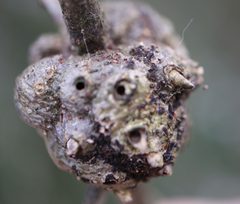
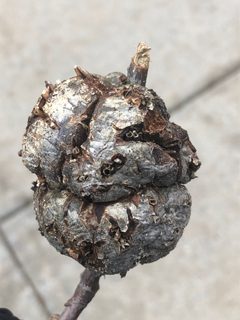
Callirhytis quercuscornigera, the horned oak gall wasp, is a cynipid that forms distinctive woody galls on oak twigs. The exhibits complex heterogony—a cyclical with alternating sexual and that produce different gall types on different oak tissues. The horned twig galls are large, woody structures with conspicuous horn-like projections through which wasps emerge. Heavy have been documented to contribute to decline and mortality of pin oaks, particularly in urban and suburban settings.
Pronunciation
How to pronounce Callirhytis quercuscornigera: /ˌkælɪˈraɪtɪs ˌkwɜːrkəsˌkɔːrnɪˈdʒɪrə/
These audio files are automatically generated. While they are not always 100% accurate, they are a good starting point.
Identification
The horned oak gall is distinguished from other oak galls by its large size, woody texture, twig location, and the presence of multiple horn-like projections. Similar bullet galls (Disholcaspis spp.) lack horns and have smooth surfaces. Oak apple galls are larger, spongy, and leaf-based. Gouty oak galls are irregular woody swellings without organized horn structures. The horns are diagnostic—no other North American oak gall wasp produces this structure.
Images
Habitat
Associated with oak trees, particularly pin oak (Quercus palustris), but also other red oak group . Found in deciduous forests, urban plantings, suburban landscapes, and riparian corridors where oaks occur.
Distribution
Eastern United States, with records from the Mid-Atlantic region (Maryland, Virginia), Midwest (Missouri), and extending through the oak-dominated forests of the eastern deciduous biome. Specific range boundaries not fully documented.
Seasonality
females emerge from twig galls in spring shortly after oak bud-break. Sexual develops in leaf galls during summer, with mating and -laying into twigs occurring late summer. Twig galls require approximately 30 months to mature before the next .
Diet
Larvae feed exclusively on nutritive plant tissue induced within the gall—abnormally proliferating rich in proteins and that the stimulates the oak to produce. do not feed; they rely on larval reserves.
Host Associations
- Quercus palustris - primary Pin oak; documented site of heavy causing tree decline
- Quercus rubra group - Red oak section
Life Cycle
Complex heterogonic cycle: (1) females emerge from woody twig galls in spring, fly short distances, and oviposit into developing leaf buds, inducing small, inconspicuous leaf galls; (2) Both sexes emerge from leaf galls in summer, mate, and females oviposit into tender green twigs; (3) hatch and induce woody twig galls that enlarge over 2–3 growing seasons; (4) Fully developed asexual females emerge after approximately 30 months to complete the cycle.
Behavior
females are poor fliers and move only short distances from sites to oviposition locations on the same or nearby trees. The larva remains sedentary within the gall, feeding on induced nutritive tissue. Gall development is continuous while attached to the living twig.
Ecological Role
Gall formation creates a specialized microhabitat that supports a of , , and hyperparasitoids. The gall's sweet secretions attract predatory including yellow jackets and paper wasps, which may incidentally protect the gall from other herbivores. Heavy can cause branch dieback and tree stress, potentially influencing oak in localized areas.
Human Relevance
Documented as a significant pest of ornamental pin oaks, with heavy contributing to tree decline and mortality—notably observed at Dulles Airport. The 30-month gall development period makes management difficult. Galls are sometimes collected for educational purposes to demonstrate insect-plant interactions.
Similar Taxa
- Disholcaspis spp.Form smooth, hornless bullet galls on oak twigs; lack the diagnostic horn projections of C. quercuscornigera.
- Callirhytis quercuspunctataForms gouty oak galls—irregular, knobby woody swellings without organized horn structures; galls are more amorphous and often clustered.
- Andricus spp.Oak apple gall formers produce larger, spongy, often detachable galls on leaves or twigs with entirely different architecture.
More Details
Gall development duration
The extended 30-month development period for twig galls is unusually long among cynipids and contributes to management challenges, as galls present on trees may represent oviposition events from two or more years prior.
Parthenogenesis mechanism
The reproduces through automixis (a form of ), producing female offspring genetically identical or nearly so to the mother, allowing rapid increase when conditions favor a single .