
Callirhytis perdens
Ruptured Twig Gall Wasp
Callirhytis perdens is a gall wasp in the Cynipidae that induces distinctive stem galls on several oak in California. Unlike many gall wasps where larvae develop entirely within attached galls, this species exhibits a unique where mature larval capsules are expelled from fissures in the gall and complete development on the ground. The species was formerly classified under the Andricus. It is considered locally abundant within its restricted range.
Pronunciation
How to pronounce Callirhytis perdens: /kæˈlaɪraɪtɪs ˈpɜːrdɛnz/
These audio files are automatically generated. While they are not always 100% accurate, they are a good starting point.
Identification
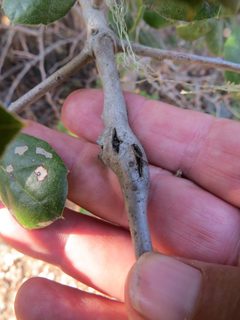
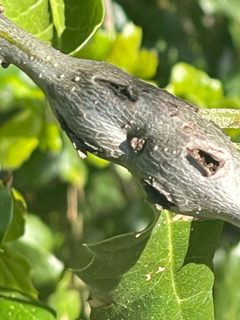
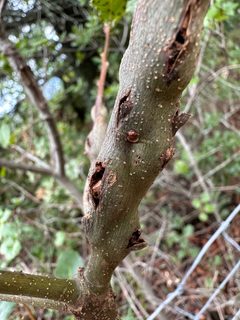
The galls induced by Callirhytis perdens are integral stem galls, meaning they are woody swellings incorporated directly into the twig rather than detachable structures. Mature galls develop lateral fissures through which larval capsules are expelled. The specific gall and the distinctive expulsion of capsules onto the ground after rainfall distinguishes this from other California oak gall wasps. are small hymenopterans typical of the Cynipidae, with reduced wing venation characteristic of the group.
Images
Habitat
Associated with oak woodlands and savannas in California, specifically where oaks (coast live oak, interior live oak, canyon live oak) occur. Galls form on stems of mature oaks. The ground beneath host trees, particularly leaf litter, serves as critical for the final developmental stage after capsule expulsion.
Distribution
to California, North America. Documented on coast live oaks, interior live oaks, and canyon live oaks throughout the state.
Seasonality
Gall development occurs over an extended period, with larval capsules typically expelled after the first showers of the rainy season. This timing suggests and oviposition likely occur in spring, with ground-level development and emergence following winter rains.
Host Associations
- coast live oak - induces stem gallsQuercus agrifolia
- interior live oak - induces stem gallsQuercus wislizeni
- canyon live oak - induces stem gallsQuercus chrysolepis
Life Cycle
Females oviposit directly into oak stems, inducing integral woody galls. Larvae develop within nutritive tissue inside the gall. Over time, particularly following the first rains of the wet season, mature larval capsules are expelled through lateral fissures that develop in the gall wall. These capsules fall to the ground and complete development in leaf litter below the host tree. This ground-dwelling phase is unusual among gall wasps and represents a distinctive deviation from the typical pattern of complete gall-enclosed development.
Behavior
Larval capsules expelled onto the ground may either successfully emerge as or become prey for birds and soil-dwelling organisms. The expulsion mechanism appears timed to rainfall, which may facilitate or reduce risk.
Ecological Role
As a gall inducer, the manipulates oak stem development to create protected nursery chambers. The expulsion of larval capsules transfers nutrients and from to forest floor, potentially influencing soil . Expelled capsules serve as food resources for birds and soil biota. The wasp contributes to the high diversity of gall-forming insects associated with California oaks.
Human Relevance
No documented economic or medical significance. The ruptured twig galls may be noticed by observers of oak vegetation but do not appear to cause significant tree damage. The has been documented through citizen science platforms, with over 1,000 iNaturalist observations contributing to knowledge of its distribution.
Similar Taxa
- Callirhytis quercuspunctataAnother Callirhytis inducing oak stem galls, but produces persistent woody galls without capsule expulsion; galls remain attached and emerge directly from the gall structure
- Antistrophus spp.Cynipid gall wasps on rosinweeds (Silphium) in central North America; induce solid stem galls but on entirely different plant (Asteraceae) and lack the capsule expulsion
More Details
Taxonomic history
The was transferred from Andricus to Callirhytis, reflecting revised understanding of relationships within Cynipidae. This reclassification aligns it with other oak-galling species formerly placed in Andricus.
Abundance
Described as locally abundant within its California range, suggesting successful exploitation of oaks across suitable .