
Amphibolips cookii
Gillette, 1888
Oak Apple Gall Wasp
Amphibolips cookii is a cynipid gall wasp that induces the formation of oak apple galls on oak trees. The is widely distributed in North America and has been documented extensively through science observations. Its involves an between sexual and forms, a trait common among Cynipidae but with specific associations for this species. The itself is small and inconspicuous; its primary visibility comes from the distinctive galls it produces on oak foliage.
Pronunciation
How to pronounce Amphibolips cookii: /ˌæm.fɪˈboʊ.lɪps ˈkʊk.aɪ/
These audio files are automatically generated. While they are not always 100% accurate, they are a good starting point.
Identification
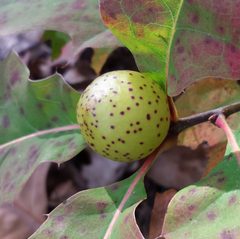
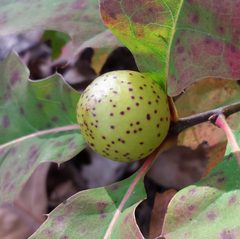
The is most reliably identified by its gall and association rather than characteristics. The oak apple galls induced by A. cookii are distinguished from those of related Amphibolips species by their size, surface texture, and the specific oak species they inhabit. Galls are typically larger and more spherical than those of A. quercusinanis, with a smoother outer surface lacking prominent spines or warts. Adult identification requires microscopic examination of morphological characters including antennal segment proportions, wing venation patterns, and genitalia structure. Molecular sequencing may be necessary for definitive identification where gall characters are ambiguous.
Images
Appearance
The is minute, measuring approximately 2–4 mm in length. Body coloration is predominantly dark brown to black. Wings are clear and membranous with reduced venation characteristic of small cynipids. are short and segmented. Sexual and differ slightly in , with sexual females generally possessing longer ovipositors relative to body size. The gall—often the most visible sign of the —is spherical to subspherical, 10–25 mm in diameter, with a fleshy, often reddish or yellowish outer layer and a central larval chamber.
Habitat
Associated with oak-dominated forests, woodlands, and urban plantings where oaks occur. Found in ranging from eastern deciduous forests to oak savannas and riparian corridors. The 's presence is dictated by host oak availability rather than specific habitat structure.
Distribution
Documented across eastern and central North America, from the Atlantic seaboard westward to the Great Plains, and from southern Canada through the southeastern United States. Records cluster in regions with substantial oak cover, including the Appalachian Mountains, Ozark Plateau, and upper Midwest.
Seasonality
Sexual emerge in spring, typically April to May, coinciding with oak leaf flush. generation adults emerge in late summer to early autumn, approximately August to October. Gall formation becomes visible on developing leaves in late spring and persists through summer.
Host Associations
- Quercus - gall inducerSpecific oak not definitively established; likely restricted to section Quercus (white oaks) based on related species
Life Cycle
Exhibits heterogony with alternating sexual and . The sexual generation develops in galls formed on oak catkins or leaves in spring; emerge, mate, and oviposit into oak tissues to initiate asexual generation galls. Asexual females develop within these galls over summer, emerging to lay that produce the subsequent sexual generation. The precise timing and gall location differ between generations.
Behavior
Females oviposit into oak tissue, triggering gall formation through chemical manipulation of plant development. Larvae develop within the gall, feeding on nutritive tissue lining the larval chamber. exit through holes. No parental care is exhibited.
Ecological Role
Acts as a primary gall inducer, creating structure for a of , , and hyperparasitoids that inhabit oak apple galls. Galls may influence oak leaf physiology and, in high densities, marginally affect tree growth. Serves as prey for birds and other .
Human Relevance
Of minor economic significance; galls are occasionally collected for educational purposes or natural history curiosity. No known direct impact on timber production or oak health. Frequently photographed and documented by naturalists, contributing to public engagement with insect biodiversity.
Similar Taxa
- Amphibolips quercusinanisProduces similar spherical oak apple galls; distinguished by smaller gall size, more textured surface, and different oak associations
- Biorhiza pallidaInduces oak apple galls in Europe; not overlapping in range but similar gall ; A. cookii is North American
- Andricus confertusProduces clustered oak apple galls; distinguished by gall pattern and western North American distribution
More Details
Taxonomic history
Described by Gillette in 1888, with subsequent taxonomic revisions placing it within the tribe Cynipini. The has been subject to ongoing study regarding specificity and alternation.
Observation data
Over 3,600 science observations document this , providing substantial distributional and phenological data, though many records are gall-based rather than observations.